🕷️ Gypsy moth group: invasive risk overview
🧾 Quick Facts
The Gypsy moth group, scientifically recognized within the genus Lymantria, is notorious for its role as invasive species affecting forestry and urban environments. Understanding its biological and ecological characteristics is crucial for managing its spread and impact.
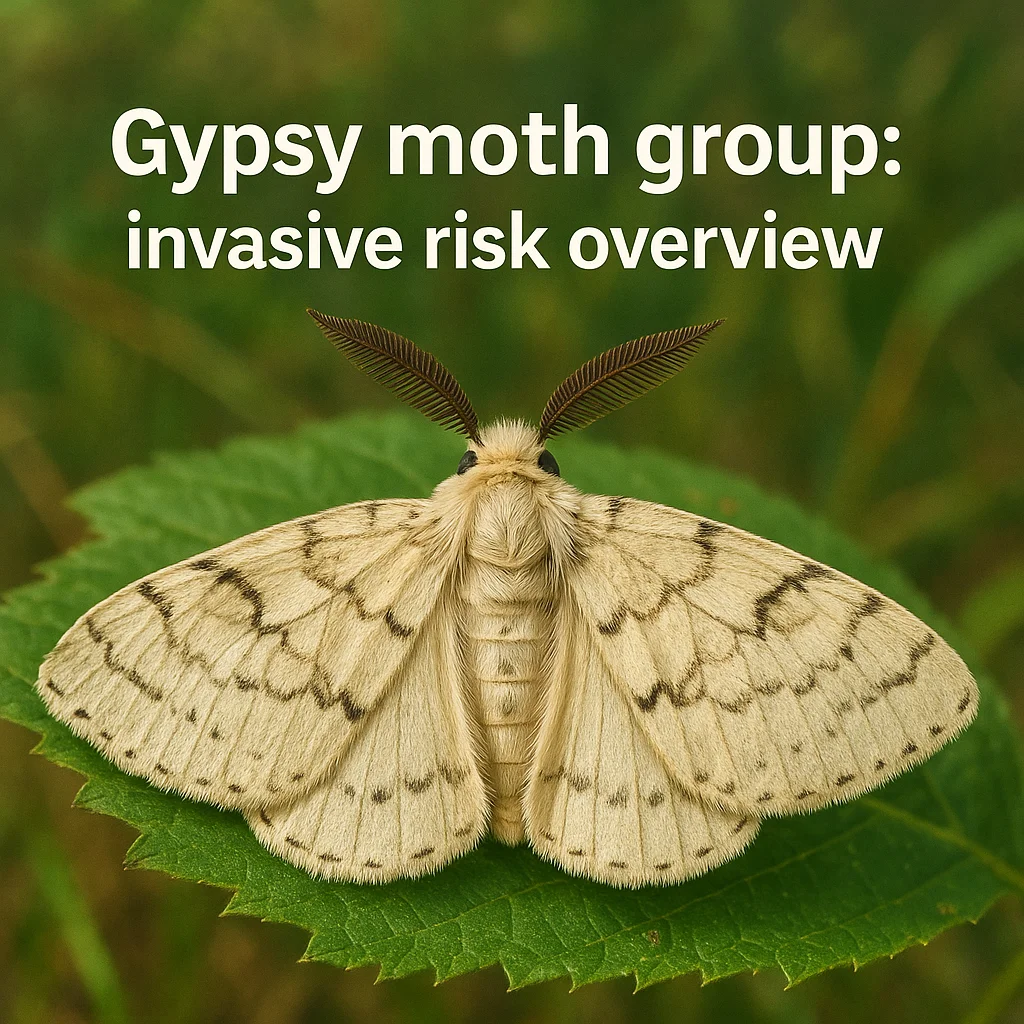
- Common names: Gypsy moth, Spongy moth
- Scientific name: Varies, predominantly Lymantria dispar
- Insect or not: Yes, it is an insect, a type of moth
- Order / family: Lepidoptera / Erebidae
- Typical size range (adult): Wingspan 3.5 to 6 inches
- Key colors/patterns: Brownish with hairy bodies; males are darker than females
- Activity: Primarily nocturnal
- Typical habitats: Forests, gardens, urban areas
- Where in the world it occurs: Europe, Asia, North America
- Seasonality: Adults visible primarily in summer
🔍 Identification
The Gypsy moth group can be identified by their characteristic body shape and features. Males tend to be dark brown with robust antennae, while females are larger and lighter, typically incapable of sustained flight.
Their wings feature a mottled pattern, aiding in camouflage. Their legs are short but robust, supporting a slow, deliberate movement.
Often confused with other moth species, they can be distinguished by their visible hairy bodies and the unique waveform of their forewing veins.
- Top ID Tips:
- Note the hairy body
- Wavy patterns on forewings
- Robust antennae in males
- Females larger and lighter
- Nocturnal activity
- Common forest and urban presence
- Ovoid abdomen, broader in females
- Observe wing patterns for variance
🧠 Basic Body Structure
The Gypsy moth is an insect, characterized by a tripartite body structure: head, thorax, and abdomen. It has six legs, consistent with all insects, and an exoskeleton providing structural support and protection. The wings, present in adults, enable flight activities mainly in males.
As invertebrates, Gypsy moths lack an internal skeleton. Instead, their strength and mobility come from the exoskeleton, which requires periodic molting to allow for growth.
🌍 Habitat & Distribution
Gypsy moths are versatile and adaptive, inhabiting diverse environments including deciduous and coniferous forests, suburban gardens, and urban parklands. They prefer temperate climates and are known to hide under tree bark, within leaf litter, or amid dense foliage during their larval and pupal stages.
Originally from Europe and Asia, they have been introduced, sometimes inadvertently, to parts of North America, where they thrive in similar climates. Their populations can vary significantly, influenced by climatic changes and human interventions.
📅 Seasonal Appearance & Activity
The adult Gypsy moths are most active and visible in the warm summer months, though this can vary regionally between late spring and early fall. They are primarily nocturnal, drawn to artificial lights.
Weather conditions greatly influence their activity; mild temperatures may extend their active periods, while excessive rain or cold conditions can limit visibility.
- Best Time to Spot It:
- Late spring through early fall
- Warm, humid evenings
- After periods of rain cessation
- Areas near artificial lighting
🥚 Reproduction & Egg-Laying
Gypsy moths exhibit a distinctive mating ritual where males use pheromones to locate females. Females lay eggs in masses, often on tree trunks, stones, or outdoor structures. These egg masses, covered with a dense layer of hair from the female's abdomen, can contain hundreds of eggs.
The number of eggs varies based on region and environmental conditions, impacting local population density and spread potential.
🌀 Metamorphosis & Life Cycle
The Gypsy moth undergoes complete metamorphosis, transitioning through egg, larva, pupa, and adult stages.
Eggs hatch into caterpillars that feed voraciously on foliage, primarily at night. The larval stage is crucial for growth and can last several weeks depending on food availability and temperature.
After reaching maturity, larvae transform into pupae within secluded areas. The pupation lasts around two weeks before emerging as adults, ready to mate and continue the cycle.
🍽️ Diet & Feeding Behavior
As larvae, Gypsy moths are primarily herbivorous, consuming a wide range of tree and shrub foliage. As adults, they do not feed and exist solely to reproduce.
Their mandibles are adapted for chewing, making them effective leaf-eaters. This feeding behavior can significantly impact forest ecosystems, leading to defoliation events.
🦉 Predators & Defense
Gypsy moths face predation from birds, small mammals, spiders, and parasitoid wasps. Their primary defense includes effective camouflage and hiding during vulnerable life stages. Larvae can also secrete unpalatable chemicals to deter some predators.
- Defense Highlights:
- Camouflage on tree bark
- Chemical secretions in larvae
- Nocturnal feeding to avoid predators
- Group egg-laying as a deterrent
- Hairy covering may irritate predators
👥 Social Behavior & Swarms
Gypsy moths are primarily solitary, although larvae may be found in large groups due to concentrated egg masses. Mating and egg-laying behaviors are similarly independent, with no formation of colonies or social structures like hive systems.
Occasionally, population explosions may occur, resembling swarming behavior as a result of favorable conditions and leading to noticeable defoliation events.
🧭 Senses & Communication
Gypsy moths rely on a keen sense of smell for mating communication, primarily through pheromones. Males are equipped with feather-like antennae to detect pheromone trails.
Vision plays a lesser role, but their ability to detect movement and shadows aids in predator avoidance.
🌱 Role in the Ecosystem
In their native habitats, Gypsy moths play a role in shaping forest dynamics as part of the food web, providing sustenance for predators. However, as invasive species, their ravenous appetite for foliage can disrupt local ecosystems, leading to defoliation and affecting biodiversity.
They unintentionally contribute to forest thinning, which can be beneficial for certain plant species, while being detrimental to others and affecting overall ecosystem health.
📉 Population & Conservation Notes
Gypsy moth populations vary significantly by region and can be subject to drastic increases. Effective management often involves controlling egg masses and using biological control agents like pathogens and predators. Conservation efforts focus on maintaining ecological balance and minimizing human-induced spread.
- How to Help (Low-Impact):
- Plant native species
- Avoid using outdoor lights at night
- Reduce pesticide usage
- Support habitat restoration projects
⚠️ Human Interaction & Safety
Gypsy moths do not bite or sting humans. However, handling larvae can cause skin irritation due to their hair. In case of contact, wash the affected area and avoid scratching. Seek professional assistance if a severe reaction occurs.
Observation of these moths should be respectful, maintaining distance without attempting to collect or harm them.
📌 Summary
- Distinctive hairy moths, active at night
- Found in forests, gardens, across Europe and North America
- Visible mainly in summer; both larvae and adults have broad impacts
- Complete metamorphosis lifecycle; significant defoliators as larvae
- Targets of birds, mammals, and parasitic insects
- Serve ecological roles but can disrupt habitats
- Widely found, but control measures vary by region
- Non-aggressive to humans; interaction should be careful and observant