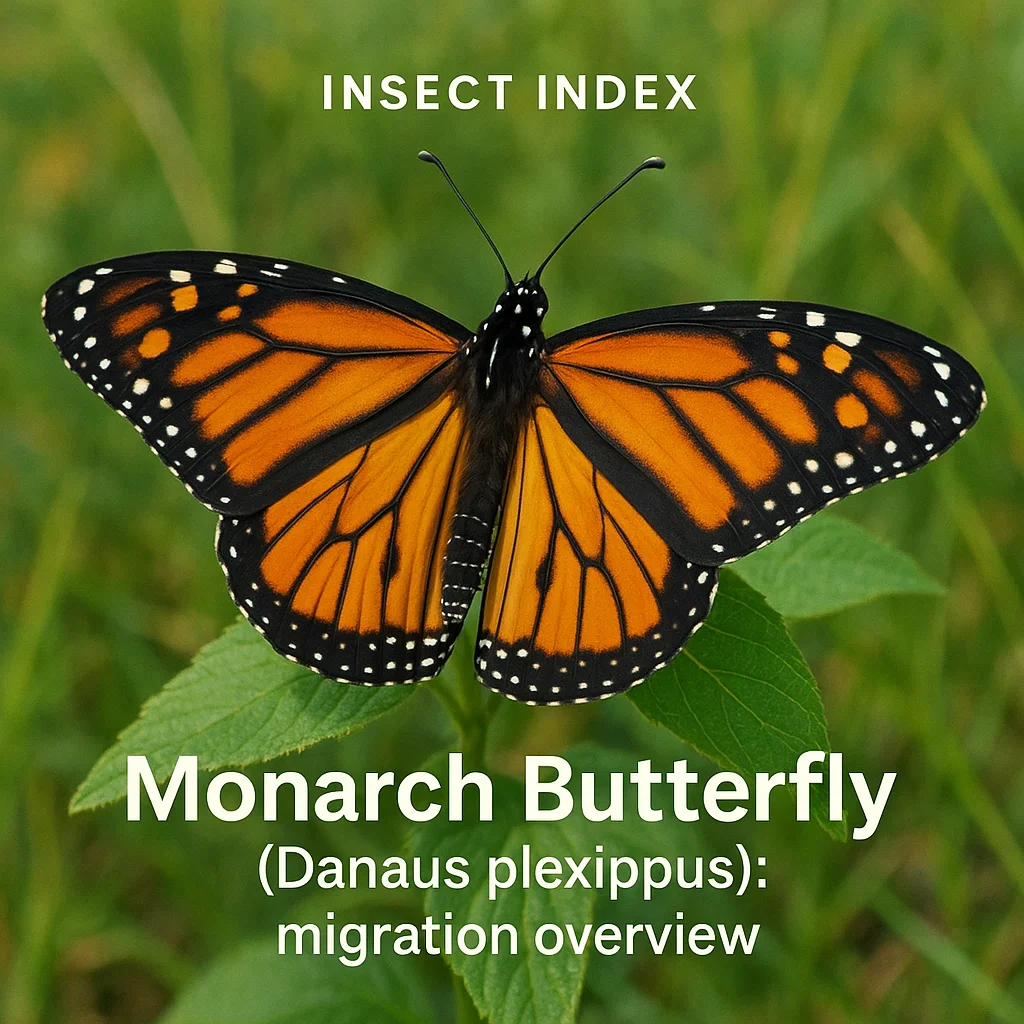
🕷️ Monarch Butterfly (Danaus plexippus): migration overview
🧾 Quick Facts
The Monarch Butterfly, scientifically known as Danaus plexippus, is one of the most recognizable and extensively studied butterflies worldwide. These migratory creatures display remarkable long-distance flights and are chiefly noted for their impressive seasonal migrations, particularly across North America. Here are some key facts about the Monarch Butterfly:
- Common names: Monarch Butterfly, Milkweed Butterfly
- Scientific name: Danaus plexippus
- Insect or not: Yes, it is an insect (an invertebrate species)
- Order/Family: Lepidoptera / Nymphalidae
- Typical size range (adult): Wingspan of 3.5 to 4 inches (9 to 10 cm)
- Key colors/patterns: Bright orange wings with black and white markings
- Activity: Diurnal (active during the day)
- Typical habitats: Meadows, fields, urban gardens
- Where in the world it occurs: Primarily North America, also found in Australia, New Zealand, and parts of Europe
- Seasonality: Most visible during the warmer months of spring and summer
🔍 Identification
The Monarch Butterfly is distinct and relatively easy to identify. With bright orange wings veined with black and a unique flight pattern, it is often seen fluttering around milkweed plants. Here's how you can recognize this iconic species in the field:
- Body shape and silhouette: Slender thorax and broad, rounded wings
- Antennae type: Clubbed antennae typical of butterflies
- Wing features: Bright orange with black veins and white spots on the wing edges
- Leg traits and movement style: Long, slender legs; graceful flight with slow, gliding moments
- Distinguishing look-alikes: Can be confused with the Viceroy Butterfly, but Monarchs lack the horizontal black line on the hind wing found in Viceroys
Top ID Tips:
- Look for bright orange and black coloration
- Watch for slow, distinct flight near milkweed
- Check for white spots along the wing edges
- Note the absence of a black line across the hind wing
- Observe the Clubbed antennae typical of butterflies
- Often seen in open fields and gardens
🧠 Basic Body Structure
The Monarch Butterfly, as an insect, has a body divided into three parts: head, thorax, and abdomen. It is an invertebrate, meaning it lacks a backbone. Monarchs possess six legs, characteristic of insects, a hard exoskeleton that provides protection, and the capability to undergo molting as they grow.
Wings are a crucial part of the Monarch's anatomy, enabling their incredible migrations. These butterflies undergo a complete metamorphosis, transitioning from larvae to a winged adult.
🌍 Habitat & Distribution
Monarch Butterflies prefer open habitats such as meadows, fields, and gardens. They require access to milkweed plants, which serve as crucial breeding sites and are essential for the larval stage.
These butterflies are widely distributed across North America and can also be found in parts of South America, Australia, and Western Europe. Climate changes and habitat loss have impacted their distribution and encouraged conservation efforts to create Monarch-friendly environments.
📅 Seasonal Appearance & Activity
The Monarchs are mostly seen during spring and summer, as they migrate towards North America in search of breeding sites. They are diurnal, actively feeding and mating during daylight.
Weather doesn't dramatically affect their seasonal visibility, but temperature and wind patterns can influence their migration routes. Monarchs are more frequently spotted during warm, sunny weather.
Best Time to Spot It:
- Spring and Summer in North America
- Midday when temperatures are mild
- In regions where milkweed is abundant
- During migration periods in spring and fall
🥚 Reproduction & Egg-Laying
Monarch Butterflies exhibit unique reproductive strategies. Mating occurs after an elaborate courtship where males can be seen chasing potential mates and engaging in a flight dance.
Female Monarchs lay eggs singly on the underside of milkweed leaves. The typical egg count varies, but females can lay hundreds during their lifetime, ensuring the continuity of their migratory cycles.
🌀 Metamorphosis & Life Cycle
The Monarch Butterfly undergoes complete metamorphosis, progressing from egg to larva (caterpillar), to pupa (chrysalis), and finally to an adult butterfly.
During the larval stage, striped caterpillars feed exclusively on milkweed leaves, which makes them toxic to many predators. The pupal stage lasts about two weeks, after which the adult butterfly emerges. The longevity of each stage can vary based on environmental conditions, particularly temperature.
🍽️ Diet & Feeding Behavior
Monarch Butterflies have different diets at each life stage. As larvae, they strictly consume milkweed, which provides chemical defenses against predators. Adults, however, feed on nectar from a variety of flowering plants, using a proboscis to suck up nutrients.
Monarchs play a vital role as pollinators in their ecosystems, visiting and aiding in the reproduction of numerous flowering plants.
🦉 Predators & Defense
Natural predators of Monarchs include birds, reptiles, and spiders. However, their brightly colored wings serve as a warning to potential predators about their toxicity, acquired from milkweed consumption as larvae.
Defense Highlights:
- Bright coloration signals toxicity
- Undergoes aposematic or warning coloration
- Mimicked by Viceroy Butterflies for shared protection
- Deploys startle display if threatened
👥 Social Behavior & Swarms
The Monarch Butterfly is primarily solitary but showcases remarkable communal behavior during migration. These migrations are triggered by seasonal temperature changes and the need for suitable breeding grounds.
Largest gatherings occur at overwintering sites in Mexico and California, where millions of Monarchs cluster together for warmth and protection.
🧭 Senses & Communication
Monarch Butterflies use a combination of sight, smell, and touch to navigate and communicate. Their keen vision helps locate flowers and mates while sensitive antennae detect pheromones and environmental cues.
Communication among Monarchs can include visual displays during mating or territorial scrambles and the use of pheromones.
🌱 Role in the Ecosystem
Monarch Butterflies serve essential roles as pollinators, aiding the reproduction of various plants. By feeding on nectar, they transfer pollen between flowers, supporting biodiversity.
The reliance on and connection to milkweed exemplify a mutualistic relationship; Monarchs acquire food and protection, while milkweed benefits from pollination.
📉 Population & Conservation Notes
Though widely recognized and appreciated, Monarch populations are impacted by habitat destruction and pesticide use. Conservation efforts are underway to address these threats, focusing on habitat preservation and widespread planting of native milkweed.
How to Help (Low-Impact):
- Plant native milkweed in gardens
- Use natural pest control methods and avoid pesticides
- Support habitat restoration and conservation programs
- Educate others about Monarch habitats
⚠️ Human Interaction & Safety
Monarch Butterflies do not bite or sting. They are safe to observe and enjoy without concern for personal harm. It is important for observers to respect their role in the ecosystem and avoid collecting wild specimens.
📌 Summary
- Monarch Butterflies are iconic for their migratory behavior and bright orange coloration.
- They inhabit fields, meadows, and gardens, requiring milkweed for reproduction.
- Most visible during warmer months; migrate between breeding and wintering grounds.
- Undergo complete metamorphosis from egg to adult.
- Larvae feed on milkweed; adults on nectar, serving as key pollinators.
- Predators learn to avoid them due to their toxicity and warning coloration.
- Conservation efforts focus on overcoming habitat loss and promoting sustainable environments.
- Respectful observation—with emphasis on habitat preservation—is crucial for their survival.