🕷️ Light Attraction: Why Moths Gather at Lamps
🧾 Quick Facts
Moths drawn to artificial light at night is a common phenomenon observed worldwide. These fascinating insects have an intriguing life cycle and play a crucial role in various ecosystems.
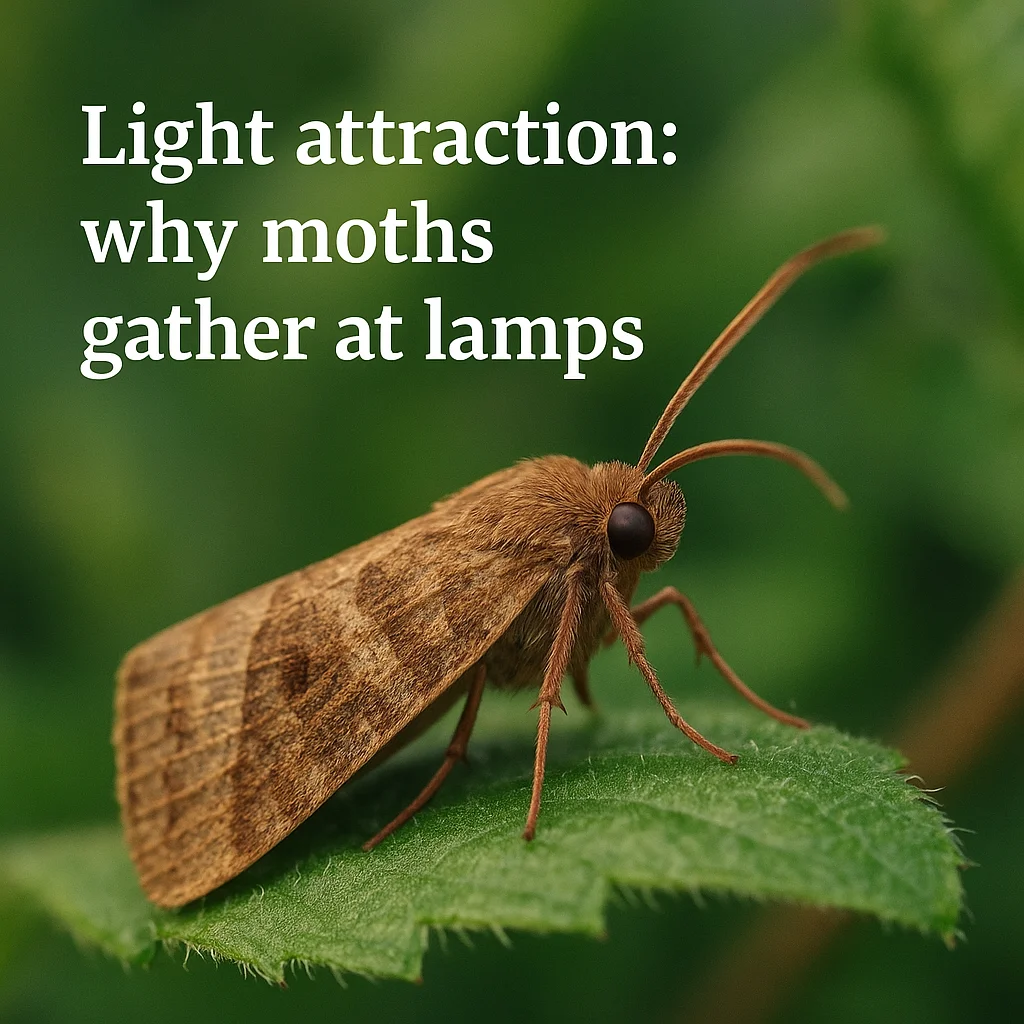
- Common Names: Moths
- Scientific Name: Varies (depending on species)
- Insect or Not: Yes, moths are invertebrates
- Order / Family: Lepidoptera
- Typical Size Range (Adult): From 0.1 inch to over 7 inches
- Key Colors/Patterns: Diverse, including browns, grays, brightly colored patterns, and camouflage designs
- Activity: Primarily nocturnal
- Typical Habitats: Forests, grasslands, urban areas, gardens
- Where in the World It Occurs: Nearly worldwide except for extreme climatic regions
- Seasonality: Typically visible in spring and summer, varies by region
🔍 Identification
Identifying moths that gather at lights requires observing several key characteristics influenced by their large diversity.
- Body Shape and Silhouette: Generally a stout body with large wings relative to size
- Antennae Type: Feather-like or thread-like, often differing from butterfly's slim, club-shaped antennae
- Wing Features: Moths have scaled and often fringed wings that can be quite colorful or mimicking backgrounds
- Leg Traits and Movement Style: Six legs, some species are efficient fliers; others are more static
- Distinguishing Look-Alikes: Can be mistaken for butterflies, but moths generally have feathery or saw-edged antennae and more robust bodies
- Look for nocturnal activity near artificial lights
- Check for feather-like or thread-like antennae
- Observe wings at rest—which cover the body like a tent
- Notice any buzzing flutter as they are attracted to the light
- Different patterns may help blend with resting surfaces during the day
- Study varying body sizes, from small to large individuals
- Observe prominent scales on wings seen in close view
🧠 Basic Body Structure
Moths, like all insects, have three main body parts: head, thorax, and abdomen.
These invertebrates possess six legs and are covered in an exoskeleton. They undergo molting as they grow and develop. Many species have wings, which are typically covered with scales. Moths are invertebrates, indicating they lack a backbone.
🌍 Habitat & Distribution
Moths can thrive in a vast range of environments, from dense forests and serene grasslands to bustling urban settings and tranquil gardens.
They inhabit microhabitats such as beneath tree bark, amidst leaf litter, or on the underside of leaves. Globally, moths are found across continents, barring extremely cold regions. Climate shifts impacting habitats can affect the presence and variety of visible moths in area-specific ecosystems.
📅 Seasonal Appearance & Activity
People can predominantly see moths during warmer seasons, where they are actively darting around artificial light sources.
Most moths are nocturnal, appearing after sunset and thriving in warm, humid conditions.
- Best policy to view them on warm spring and summer nights
- Spot them around well-lit environments
- Rainy weather often limits sightings
- Cool, dry conditions may reduce activity
🥚 Reproduction & Egg-Laying
Moth mating behaviors feature in various colorful displays and chemical communication via pheromones. Females lay eggs on a range of surfaces, such as plant leaves, bark, or soil.
The number of eggs and specifics regarding egg-laying strategies can widely vary due to differing species habits and environmental factors.
🌀 Metamorphosis & Life Cycle
Moths experience complete metamorphosis, transitioning from egg to larva (caterpillar), pupa (chrysalis), and finally, to the adult moth.
In the larval stage, they primarily feast on plant matter, including leaves, stems, and various vegetation. This stage can last several weeks depending on conditions. As pupae, they transition into their final form before emerging as mature adults. Adult moths focus on reproduction and feeding, mainly on nectar from flowers, which can last from a few weeks to several months.
🍽️ Diet & Feeding Behavior
While in larval form, moths predominantly consume plant leaves and sometimes the fruits and stems of their host plants.
Adults utilize proboscis to feed on nectar, playing a vital role as pollinators. Their feeding behavior shifts from herbivory in the larval stage to nectarivory in adulthood.
🦉 Predators & Defense
Moths face predation from birds, bats, amphibians, reptiles, and arthropods like spiders. They employ several defense mechanisms to evade these threats.
- Camouflage to blend with their environments
- Some mimicry of dangerous insects or elements in nature
- Possess the ability to quickly dodge predators
- Chemical secretions as deterrents against predators
👥 Social Behavior & Swarms
Typically, moths do not demonstrate organized social behavior or swarming tendencies.
They are solitary, focusing on mating when encountering others. In some genera, moth congregations around lights can be likened to accidental gatherings rather than organized swarms.
🧭 Senses & Communication
Moths rely on a strong sense of smell, using their antennae to detect pheromones and locate potential mates. Their vision is adapted to nocturnal life, with some species capable of detecting ultraviolet light.
Communication is mainly pheromone-based for unwritten chemical messages related to mating and territory.
🌱 Role in the Ecosystem
Moths are integral to ecosystems, providing pollination services and acting as food sources for a variety of animals.
Their larvae assist in controlling vegetation growth, and their diets help recycle organic material, contributing to nutrient cycling. Effects on human agriculture vary, with moth caterpillars sometimes considered pests while adults are critical pollinators.
📉 Population & Conservation Notes
Many moth populations are stable, yet others face pressures from habitat loss, pollution, pesticide use, and climate change. Light pollution is a significant factor influencing moth behavior and survival rates.
- Plant native flora to support moth populations
- Limit pesticide use in gardens
- Maintain natural habitat features such as leaf litter
- Install light fixtures with moth-friendly settings
⚠️ Human Interaction & Safety
While moths do not bite or sting humans, they should be observed respectfully without attempts to capture or collect them.
In cases where allergies to moth scales arise, individuals should wash the affected area and seek advice if irritation occurs.
📌 Summary
- Moths are nocturnal insects drawn to artificial light
- They feature a diverse range of sizes and colors
- Active in warm months, primarily at night
- Undergo complete metamorphosis
- Herbivorous as larvae; nectar-feeding as adults
- Predators include birds and spiders; employ camouflage for protection
- Crucial pollinators and part of complex ecosystems
- Population impacted by environmental changes and light pollution
- Encourage conservation through habitat-friendly practices
- Respectful observation is key for human interactions