🕷️ Stag vs rhinoceros beetle: quick ID
🧾 Quick Facts
The stag and rhinoceros beetles are fascinating members of the insect world, known for their impressive size and unique morphology. They are popular subjects for nature enthusiasts due to their striking appearance and intriguing life cycles.
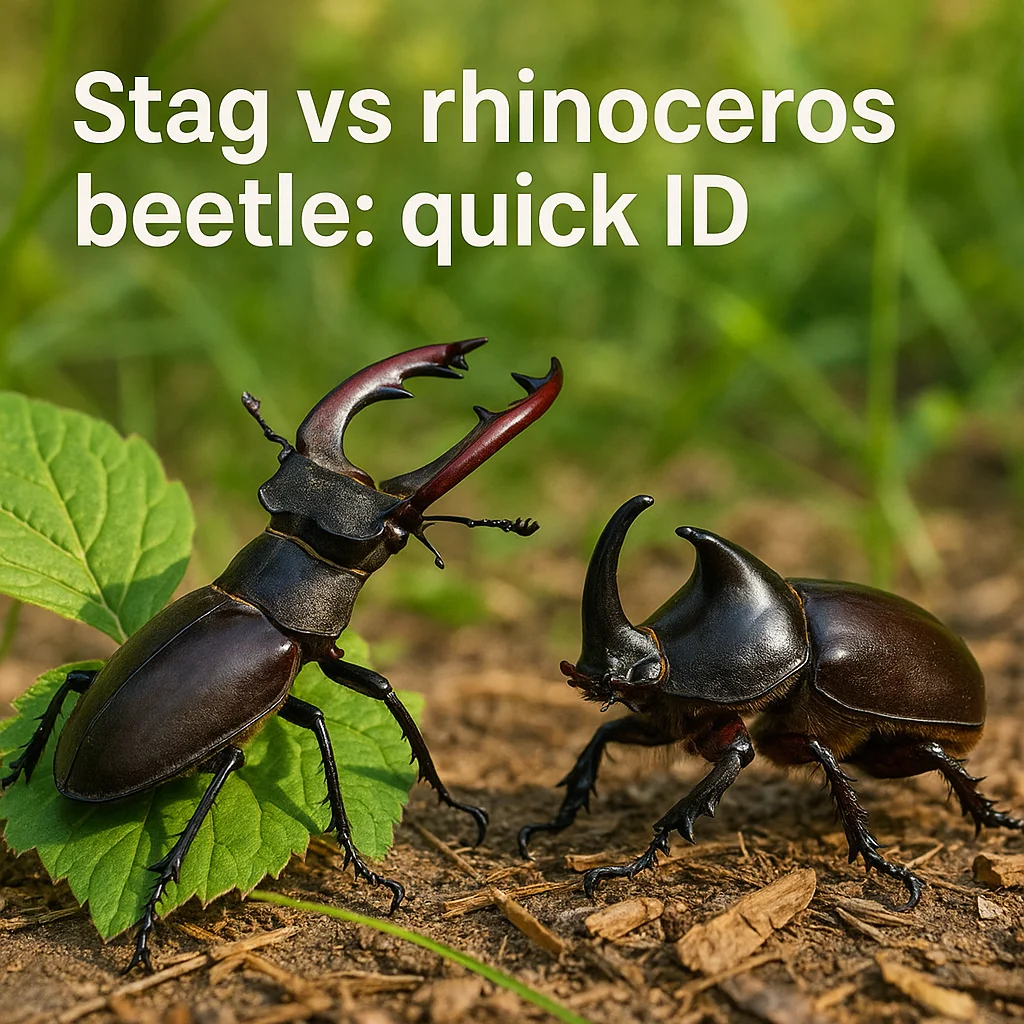
- Common names: Stag beetle, Rhinoceros beetle
- Scientific name: Varies by species
- Insect or not: Yes, they are invertebrates.
- Order / family: Coleoptera, Lucanidae (stag beetles); Scarabaeidae (rhinoceros beetles)
- Typical size range: 2–12 cm (adult)
- Key colors/patterns: Brown, black, iridescent green
- Activity: Primarily nocturnal
- Typical habitats: Forests, woodlands, gardens
- Where in the world it occurs: Europe, Asia, Americas, Africa (varies by species)
- Seasonality: Adults are most visible in late spring to summer
🔍 Identification
Stag and rhinoceros beetles can be identified by their captivating body shapes and prominent features. Recognizing these beetles can be easier through a few key characteristics.
- Body shape and silhouette: Stag beetles have elongated mandibles resembling deer antlers, while rhinoceros beetles have a horn-like projection on their heads.
- Antennae type: Stag beetles have recognizable, clubbed antennae; rhinoceros beetles have similar but smaller antennae.
- Wing features: Both types have hard wing covers called elytra, covering membranous wings beneath.
- Leg traits and movement style: Strong legs for digging in the rhinoceros beetles; stag beetles are less adept at digging.
- Common confusion: Often confused with other large beetles due to size but can be differentiated by horns/mandibles.
- Top ID Tips:
- Look for pronounced mandibles in stag beetles.
- Check for head horns in rhinoceros beetles.
- Consider size and body robustness.
- Observe the sheen of the elytra.
- Check for clubbed antennae shape.
- Look at movement and leg position.
🧠 Basic Body Structure
As insects, both stag and rhinoceros beetles have a fundamental body structure divided into three main segments: head, thorax, and abdomen. Each possesses six legs attached to the thorax. Their bodies are protected by a rigid exoskeleton, which they periodically shed through a process called molting. Both beetles are invertebrates, meaning they do not have a vertebral column (backbone).
🌍 Habitat & Distribution
Stag and rhinoceros beetles are commonly found in diverse environments. Preferred habitats for stag beetles include temperate forests, woodlands, and gardens where they can find decaying wood for their larvae. Rhinoceros beetles thrive in tropical and subtropical forests and regions rich in decomposing plant material. These beetles can be found across Europe, Asia, Africa, and the Americas, adapting well to environments where their larval food sources abound. Changes to their habitats, like deforestation and urbanization, can influence their visibility and local population dynamics.
📅 Seasonal Appearance & Activity
Both beetles are predominantly seen in the warmer months, with many species' adults visible in late spring to early summer. They are mostly nocturnal, being active during the night to avoid predators and extreme daytime temperatures. Warm, humid conditions after rainy periods typically increase their activity levels.
- Best Time to Spot It:
- Late spring evenings
- Summer nights after rain
- Warm, humid climates
- Nighttime for observing activity
🥚 Reproduction & Egg-Laying
Reproduction for these beetles involves mostly solitary behaviors. Male stag beetles often engage in combat rituals with their mandibles to secure mating rights. Rhinoceros beetles might use their horns in a similar manner. Eggs are typically laid in decaying wood (stag beetles) or organic-rich soil (rhinoceros beetles). Egg counts can vary widely depending on species and environmental factors.
🌀 Metamorphosis & Life Cycle
Both stag and rhinoceros beetles undergo complete metamorphosis, which includes the stages of egg, larva, pupa, and adult.
During the larval stage, known as grubs, they consume decaying wood or organic matter, playing crucial roles in nutrient recycling within their habitats. The pupa stage is when the larva transforms within a protective casing. The duration for each stage varies by species and environmental factors but typically larval development may take from several months up to a few years.
🍽️ Diet & Feeding Behavior
Larvae of both beetles are detritivores, consuming decaying plant matter and thus aiding in breaking down organic material. Adult stag beetles may feed on tree sap and soft fruits, whereas adult rhinoceros beetles are less interested in feeding as they focus more on reproduction during their short lifespan. Their mouthparts are typically adapted for chewing, aligning with their roles as scavengers and decomposers.
🦉 Predators & Defense
Predators of stag and rhinoceros beetles include birds, mammals, and reptiles. Their defense mechanisms are multi-fold and fascinating.
- Defense Highlights:
- Well-armored exoskeleton
- Camouflage among leaves and bark
- Imposing horns and mandibles as deterrents
- Strong grip for holding onto surfaces
👥 Social Behavior & Swarms
These beetles are generally solitary, interacting with one another primarily for mating. Males are known to be territorial, displaying competitive behavior through physical confrontations. Swarming is not a common behavior among these beetles; they do not engage in mass movements or migrations.
🧭 Senses & Communication
The senses of stag and rhinoceros beetles are adapted to their nocturnal lifestyle. Their vision, while functional, is not as advanced as their senses of smell and touch, which are heightened for detecting mates and food sources through pheromones. Rhinoceros beetles are known for their drumming communication with substrate through vibrations, while stag beetles use their mandibles for intermittent sound production.
🌱 Role in the Ecosystem
Stag and rhinoceros beetles play vital ecological roles, particularly in decomposition. By feeding on decaying plant matter, they contribute to nutrient cycling and soil health. This process aids in breaking down dead material, making nutrients available to other organisms such as plants. They also serve as prey for various animals, thus forming an integral part of the food web.
📉 Population & Conservation Notes
The population status of stag and rhinoceros beetles varies widely depending on species and region. Many common species are frequently observed in suitable habitats, though some species face threats from habitat loss due to deforestation and urban expansion. Climate changes and light pollution also impact their life cycles and occurrence.
- How to Help (Low-Impact):
- Plant native trees and shrubs
- Leave deadwood in gardens
- Avoid using pesticides
- Create dark zones to minimize light pollution impact
⚠️ Human Interaction & Safety
Both stag and rhinoceros beetles are generally harmless to humans, but their imposing appearance can be startling. They do not bite or sting, and interaction is often limited to observation. When viewing these beetles, it is important to respect their habitat and not disturb or collect them. In rare cases of an allergic reaction to any contact, seeking medical advice is recommended.
📌 Summary
- Stag and rhinoceros beetles are identifiable by their mandibles and horns.
- They thrive in forests and areas rich in decomposing wood.
- These beetles are most active during warm nights in summer.
- They undergo complete metamorphosis with larval stages lasting several months to years.
- Larvae feed on decaying plant matter, adults on sap and fruits.
- Main threats include habitat loss and climate change.
- They play key roles in ecosystems as decomposers and prey.
- Observing these beetles offers a chance to appreciate incredible biodiversity.