🕷️ Stag beetle larvae: wood-decay lifestyle
🧾 Quick Facts
The stag beetle larvae, renowned for their wood-decaying lifestyle, belong to a group of fascinating insects that play a crucial role in their ecosystems. Known for their distinctive appearance and fascinating life cycle, these larvae can be found in various regions around the world.
- Common names: Stag beetle larvae, Lucanid larvae
- Scientific name: Varies by species (e.g., Lucanus cervus)
- Insect or not: Yes, they are insects, meaning they are invertebrates.
- Order / family: Coleoptera / Lucanidae
- Typical size range (adult): 2.5 to 7.5 cm in length
- Key colors/patterns: Primarily cream-colored, with a dark head capsule
- Activity: Nocturnal (primarily for adults)
- Typical habitats: Deciduous forests, woodlands, gardens
- Where in the world it occurs: Europe, Asia, North America
- Seasonality: Larvae visible throughout the year; adults most visible from late spring to summer
🔍 Identification
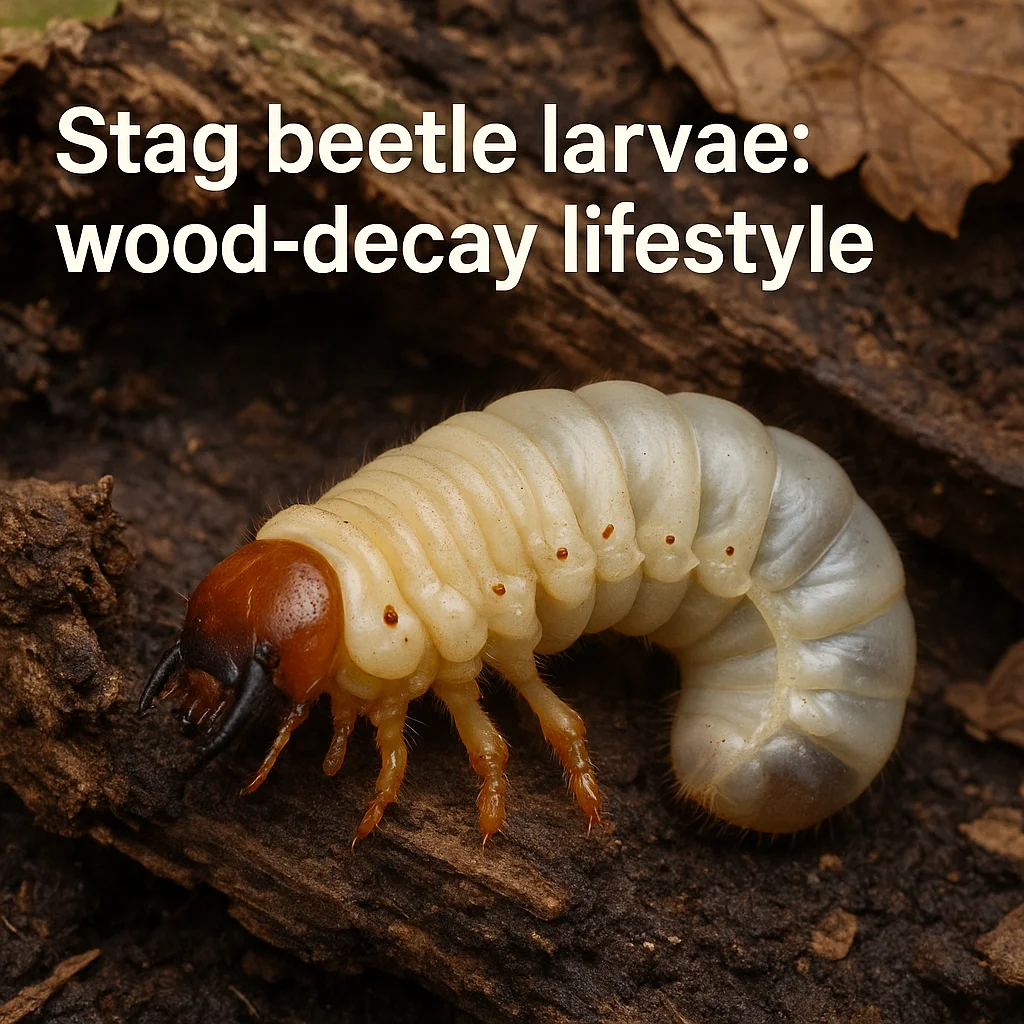
Stag beetle larvae are recognizable by their robust, C-shaped body and creamy white color. Often found in decaying wood, they have an obvious dark brown to black head capsule. Adult beetles are more easily seen, with their large mandibles and robust bodies.
- Robust, C-shaped body with a creamy white appearance
- Dark brown to black head capsule
- Antennae on adults are branched (resembling a comb)
- Adults have large, distinctive mandibles
- Six legs located near the head
- Adults may have wings under hard elytra
- Often confused with the larvae of rhinoceros beetles but differ in head shape and habitat
🧠 Basic Body Structure
As insects, stag beetle larvae have a fundamental body structure divided into three parts: head, thorax, and abdomen. They possess six legs, which are primarily utilized for movement in soil or decaying wood. The larvae do not have wings, but adults have concealed wings beneath their hard wing covers (elytra).
Stag beetle larvae are invertebrates, meaning they lack a backbone, and their bodies are instead protected by an exoskeleton. This outer protective layer is shed multiple times during their development through a process known as molting.
🌍 Habitat & Distribution
Stag beetle larvae thrive in environments rich in decaying wood, such as deciduous forests, woodlands, and urban gardens with abundant fallen branches and logs. They favor temperate climates across Europe, parts of Asia, and North America. Often found beneath logs and within rotting stumps, their sightings depend largely on local habitat preservation and forest management practices.
📅 Seasonal Appearance & Activity
While stag beetle larvae can be found year-round, adult stag beetles are most visible during the warmer months, often from late spring through summer. Both larvae and adults are influenced by weather conditions, with activity typically decreasing during colder temperatures.
- Adults most visible from late spring to summer
- Larvae can be found year-round
- Best seen during warm, humid evenings
- Increased sightings after rainfall
🥚 Reproduction & Egg-Laying
Male stag beetles engage in combat using their enlarged mandibles to win over females. Mating involves intricate courtship displays. Females lay their eggs in decaying wood, ensuring a nutrient-rich environment for the hatching larvae. Depending on the species, females lay between 10 to 30 eggs, and the viability of the eggs is greatly influenced by the condition of the wood substrate.
🌀 Metamorphosis & Life Cycle
Stag beetles undergo complete metamorphosis, consisting of four stages: egg, larva, pupa, and adult. The larval stage is the longest, lasting from one to three years. During this time, they feed primarily on decaying wood, aiding in the decomposition process.
Once the larvae are fully grown, they enter the pupal stage, forming a pupal chamber in the soil or wood. After several weeks to months, the pupae transform into adult beetles, emerging when conditions are favorable, typically in late spring or summer. Adult stag beetles live for a brief period, ranging from a few weeks to a few months, during which they focus on reproduction.
🍽️ Diet & Feeding Behavior
Stag beetle larvae are adapted to consuming decaying wood, which they break down with their strong mandibles. As herbivores, they play an essential role in nutrient recycling and forest health. Adult stag beetles, on the other hand, feed on tree sap, overripe fruits, and occasionally nectar, using their chewing mouthparts to access these resources.
🦉 Predators & Defense
Stag beetles and their larvae are preyed upon by a variety of animals, including birds, small mammals, reptiles, and amphibians. Larvae employ camouflage by blending with the wood substrate, while adults rely on their hard exoskeleton and swift flight to evade predators. However, their prominent mandibles make handling by predators challenging.
- Camouflage: Blends into decaying wood
- Exoskeleton: Provides physical protection
- Mandibles: Deter predators by their intimidating size
- Flight: Quick escape from threats
👥 Social Behavior & Swarms
Stag beetles are generally solitary creatures. During the mating season, males are more likely to be seen in groups, competing for females. However, these gatherings are temporary and primarily for reproductive purposes.
🧭 Senses & Communication
Stag beetles have well-developed senses that aid in navigation and communication. They utilize their antennae to detect chemical signals and pheromones, which play a crucial role in mate attraction. Additionally, vibrations and physical contact are used for interaction among individuals within close proximity. Adult beetles have large, easier-to-spot eyes for navigating their nocturnal world.
🌱 Role in the Ecosystem
Stag beetle larvae are vital decomposers, breaking down dead wood and recycling nutrients back into the ecosystem. This process not only enriches soil quality but also supports a diverse range of plant life. By aiding in wood decay, they contribute to maintaining forest health and serve as a food source for various animals.
While their presence in gardens can aid in the decomposition of wood, they have little direct impact on human activities and agriculture.
📉 Population & Conservation Notes
The population status of stag beetles varies by region. In some areas, they are considered common, while in others, they face threats from habitat loss, deforestation, and light pollution. Conservation efforts focus on preserving natural woodlands and promoting sustainable forestry practices.
- How to Help (Low-Impact):
- Preserve natural habitats by leaving fallen logs and branches
- Plant native tree species to support local ecosystems
- Avoid using pesticides in environments where stag beetles thrive
- Encourage local conservation initiatives for habitat protection
⚠️ Human Interaction & Safety
Stag beetle larvae and adults are generally harmless to humans. While adults have large mandibles, they rarely pose a threat unless provoked, and even then, they do not possess strong biting capabilities. Observing these insects respectfully and avoiding interaction is encouraged to ensure their conservation.
If any discomfort occurs from handling stag beetles, washing the area with soap and water is advised, and professional medical guidance should be sought if any severe reactions occur.
📌 Summary
- Stag beetles are recognized by their robust, C-shaped larvae and large adults with distinctive mandibles.
- They inhabit deciduous forests and woodland areas, thriving in regions with abundant decaying wood.
- Most active from late spring to summer, with adults emerging during warmer months.
- Undergo complete metamorphosis; larvae consume decaying wood, and adults feed on tree sap.
- Predators include birds, mammals, and reptiles; defenses involve camouflage and exoskeleton protection.
- Provide essential ecological services by recycling nutrients and supporting forest health.
- Population varies; conservation focuses on habitat preservation.
- Generally safe around humans; avoid handling to ensure mutual safety.