🕷️ European Stag Beetle (Lucanus cervus): ID and habitat
🧾 Quick Facts
The European Stag Beetle (Lucanus cervus) is a fascinating and charismatic beetle, famous for its impressive mandibles. This insect, recognized as the largest terrestrial beetle in Europe, captivates both entomologists and nature enthusiasts. Here are some essential quick facts about the stag beetle:
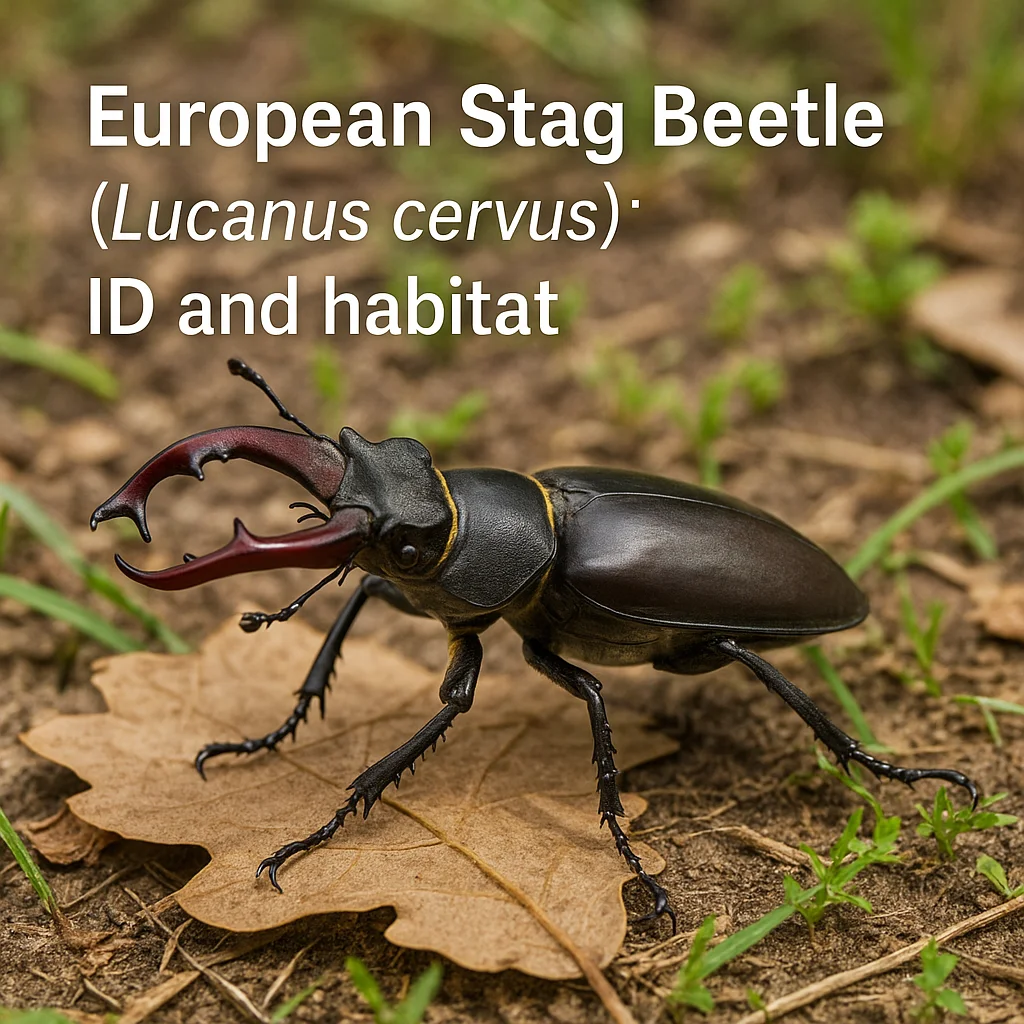
- Common names: Stag beetle
- Scientific name: Lucanus cervus
- Insect or not: Yes, it's an insect and an invertebrate
- Order / Family: Coleoptera / Lucanidae
- Typical size range: 25–75 mm (1–3 in) in length, including mandibles
- Key colors/patterns: Dark brown to black, with chestnut-brown wing cases
- Activity: Mainly nocturnal
- Typical habitats: Woodlands and urban gardens
- Where in the world it occurs: Europe and parts of western Asia
- Seasonality: Most visible from late spring to early summer
🔍 Identification
The European Stag Beetle is easily recognizable due to its distinctive features, particularly the enlarged mandibles of males that resemble a stag's antlers. Here's how to identify it:
- Body shape and silhouette: Robust and elongated with a distinctly large head and mandibles in males
- Antennae type: Elbowed with comb-like segments
- Wing features: Hard wing covers (elytra) protect the flying wings underneath
- Leg traits and movement style: Strong legs adapted for digging and gripping; walks slowly
- Distinguishing look-alikes and common confusion: May be confused with rhinoceros beetles, but lack the horn on the thorax
- Look for large, antler-like mandibles on males
- Dark, glossy body with reddish-brown elytra
- Typically seen near decaying wood
- Males are significantly larger than females
- Slow, lumbering flight pattern at dusk
- Distinctive sound when flying, resembling a drone
🧠 Basic Body Structure
As an insect, the European Stag Beetle is an invertebrate with a segmented body consisting of a head, thorax, and abdomen. It possesses six legs, which are useful for gripping and moving through its environment. The stag beetle has a protective outer shell known as an exoskeleton, which it periodically molts as it grows. They have wings, protected by elytra, which aid in flight during the breeding season.
🌍 Habitat & Distribution
The European Stag Beetle is most commonly found in deciduous woodlands, where it relies on rotting wood for both larval development and adult nutrition. It thrives in urban gardens with ample dead wood materials. This beetle's geographic distribution spans across Europe, from the southern United Kingdom to parts of Western Asia, typically favoring mild to warm temperate climates with moderate to high humidity.
They seek habitats that offer ample rotting wood, which is critical for larval development. Human development and deforestation can significantly impact the presence of suitable habitats, influencing local population densities.
📅 Seasonal Appearance & Activity
The adult stag beetles are most commonly sighted during the warmer months. In general, they are active from May to August, with peak visibility in June and July. They are primarily nocturnal and are most active during warm, dry evenings.
- Best seen from late spring through summer
- Active at dusk and into the night
- Warm temperatures enhance activity
- Rainy, cold, or windy weather may reduce sightings
🥚 Reproduction & Egg-Laying
Male stag beetles engage in combat with other males using their large mandibles to win a mate. Once a female is fertilized, she will seek out decaying wood or loose soil to lay her eggs, ensuring larvae have immediate access to food. The exact number of eggs laid varies, but females generally deposit between 20 to 50 eggs.
🌀 Metamorphosis & Life Cycle
The European Stag Beetle undergoes complete metamorphosis, consisting of four stages: egg, larva, pupa, and adult.
Upon hatching, the larvae feed on decaying wood, which can take several years as they develop. They construct a pupal cell within the soil or decaying wood where they pupate. The pupal stage lasts for a few months before emerging as adults, usually in late spring or early summer. The adult beetle primarily consumes sap or sugary substances and typically lives for only a few months.
🍽️ Diet & Feeding Behavior
In the larval stage, stag beetles primarily consume decaying wood, using their strong mandibles to break down the material. Adults have mandibles primarily used for fighting, but they feed on tree sap, nectar, or overripe fruit. They serve as both herbivores and decomposers, playing a significant role in recycling forest nutrients.
🦉 Predators & Defense
Stag beetles face predation from birds, mammals, reptiles, and various invertebrates. To defend themselves, they employ several strategies:
- Camouflage: Their dark color blends into the forest floor
- Armor: Hard exoskeleton provides protection against some predators
- Biting: Males can give a strong pinch with their mandibles if threatened
- Flight: Can escape threats by taking off abruptly
👥 Social Behavior & Swarms
Stag beetles are predominantly solitary insects. They come together only during the breeding season when males search for mates. Males can be territorial and often fight using their mandibles to assert dominance over potential rivals or mating territories.
🧭 Senses & Communication
Stag beetles rely on a combination of sight and chemical cues for communication and navigation. They use their antennae to detect pheromones released by females, and vision to navigate their environment and locate mates or rivals. Sound is not a significant aspect of their communication.
🌱 Role in the Ecosystem
Stag beetles fulfill a critical ecological role as decomposers. By breaking down decaying wood, they contribute to nutrient cycling in woodland habitats. They also serve as prey for a variety of animals, thus playing a role in local food webs. Their presence indicates healthy ecosystems with abundant dead wood, which supports diverse forest biodiversity.
📉 Population & Conservation Notes
The European Stag Beetle is often reported as common in suitable habitats, although local abundance varies significantly with habitat quality. Threats to their populations include habitat loss due to urbanization and deforestation, as well as pesticide use that reduces prey availability. Conservation efforts focus on preserving their woodland habitats and promoting the maintenance of dead wood in gardens and parks.
- Encourage native plant growth
- Avoid using pesticides
- Maintain garden log piles or dead wood
- Create awareness about beetle conservation
⚠️ Human Interaction & Safety
Stag beetles are generally harmless to humans. While males can pinch with their large mandibles if provoked, they are not aggressive and rarely do so. Observing these beetles respectfully in their natural habitat without collecting or harassing them is important for their conservation. If bitten, wash the area with soap and water, avoid scratching, and seek professional help if a severe reaction occurs.
📌 Summary
- Identifiable by large, antler-like mandibles in males
- Found in deciduous woodlands and urban gardens
- Active from late spring to early summer, especially at night
- Complete metamorphosis: egg, larva, pupa, adult
- Larvae feed on decaying wood; adults on sap and fruit
- Natural defense includes camouflage, biting, and hard exoskeleton
- Solitary except during mating season; visual and chemical cues for communication
- Important decomposers in woodland ecosystems
- Conservation threats: habitat loss, urbanization, pesticides
- Non-aggressive; admire without handling for conservation