🕷️ Scarab grubs: lawn damage and identification
🧾 Quick Facts
Scarab grubs are the larval stage of scarab beetles, many of which are known for causing significant damage to lawns and gardens. These grubs play important roles in their ecosystems but can become pests in maintained landscapes.
- Common names: Scarab grubs, white grubs
- Scientific name: Varies by species
- Insect or not: Yes, they are insects
- Order / family: Coleoptera / Scarabaeidae
- Typical size range (larva): 1.5 - 2.5 cm
- Key colors/patterns: Creamy white body, brownish head
- Activity: Mostly nocturnal
- Typical habitats: Lawns, gardens, fields
- Where in the world it occurs: Found across many parts of the world, most commonly in temperate and tropical regions
- Seasonality: Grubs are most active in spring and fall
🔍 Identification
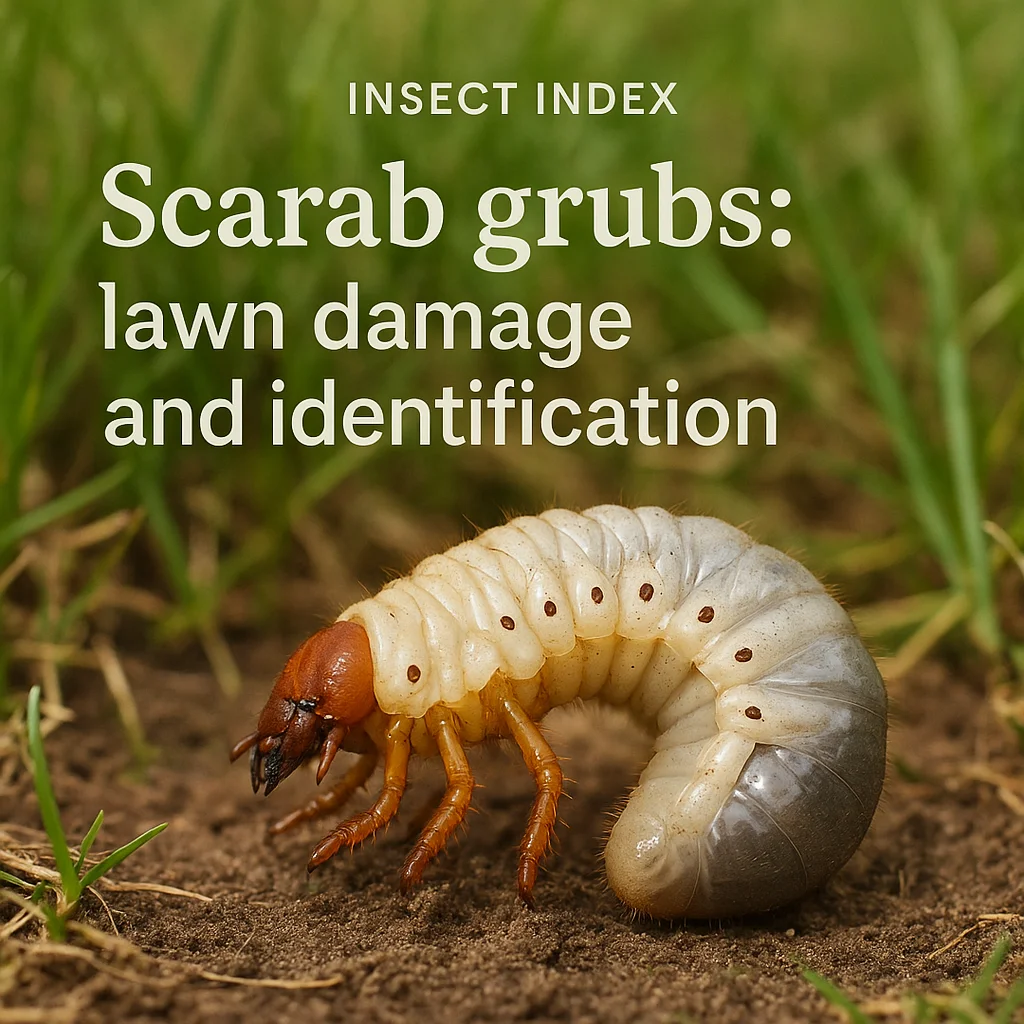
Scarab grubs are easily identified by their c-shaped body and creamy white color with a distinct brownish head. They have three pairs of legs, all positioned near the head. They are often found coiled in soil or under leaf litter, and their movement involves wriggling more than walking.
- Body shape and silhouette: Soft, c-shaped, slightly curved
- Antennae type: Short and inconspicuous
- Wing features: None; grubs are wingless
- Leg traits and movement style: Three pairs of tiny legs near the head, primarily wriggle to move
- Distinguishing look-alikes: Can be confused with other beetle larvae; check the shape and soil dwelling behaviors
- Top ID Tips:
- C-shaped body curled in soil
- Creamy white color
- Distinct dark head and tail
- Lazy, slow movement
- Presence in damaged turf
- No visible wings or long antennae
🧠 Basic Body Structure
Scarab grubs exhibit the fundamental characteristics of insects: a segmented body divided into a head, thorax, and abdomen. As typical insects, they have six legs. Their exoskeleton is soft compared to adults, and they molt several times as they grow. Interestingly, they are invertebrates, meaning they lack a backbone or internal skeleton, unlike mammals and birds.
🌍 Habitat & Distribution
Scarab grubs favor environments where they can burrow into rich soil, typically found in grasslands, agricultural fields, gardens, and lawns. Their presence is more prominent under decaying organic matter or in soil that is consistently moist. Geographically, they are widely distributed across temperate and tropical regions. Changes in habitat, such as increased urbanization or agricultural development, may impact their local abundance.
📅 Seasonal Appearance & Activity
The presence of scarab grubs corresponds to specific seasonal patterns. They are often more noticeable during spring and fall. Their activity peaks during cooler, damp conditions when they feed voraciously on plant roots.
- Best Time to Spot It:
- Early spring when lawns begin to grow
- Late summer to fall during planting season
- After rainy periods
- Dusk and dawn in moist areas
🥚 Reproduction & Egg-Laying
The adult scarab beetles engage in various courtship rituals, from visual displays to pheromone releases. Females lay eggs in soil, often choosing places with ample organic matter and plant roots. The number of eggs laid can vary significantly by species and environmental conditions but typically ranges from a few dozen to several hundred.
🌀 Metamorphosis & Life Cycle
Scarab grubs undergo complete metamorphosis, progressing from egg to larva, pupa, and then adult. After hatching, the larvae feed aggressively on plant roots, remaining in this stage for months depending on species and climate. Pupation occurs in the soil, transforming finally into adult beetles ready to emerge during warmer months.
🍽️ Diet & Feeding Behavior
The diet of scarab grubs primarily consists of organic matter found in the soil, particularly roots of grasses, which can result in significant lawn damage. They possess strong chewing mouthparts that facilitate their feeding. As larvae, these insects act as herbivores, contributing significantly to organic matter decomposition.
🦉 Predators & Defense
A wide array of birds, mammals, and other insects prey on scarab grubs. Common natural predators include birds like starlings, moles, skunks, and certain beetle species. Their primary defenses are their underground habitat and their ability to curl into a tight ball, protecting their vulnerable parts.
- Defense Highlights:
- Burrowing deep into soil
- C-shaped coiling
- Camo through muddy coloration
- No direct offensive strategies
👥 Social Behavior & Swarms
Scarab grubs are primarily solitary, confined to their subterranean life as larvae. They do not form social colonies or swarms. However, large numbers can congregate in ideal conditions, such as under rich, fertile lawns, resulting in what might appear as swarm-like behavior due to aggregated damage rather than cooperative interaction.
🧭 Senses & Communication
Scarab grubs rely heavily on their senses of touch and chemical detection. Given their underground life stage, their vision is minimal, and they perceive their environment through movements in the soil and chemical cues. These larvae may release pheromones, although this aspect is not well-documented.
🌱 Role in the Ecosystem
Scarab grubs play a crucial ecological role by recycling nutrients through their decomposition of organic matter. Their herbivorous feeding behavior aids in the aeration of soil as they tunnel, promoting healthy root growth for plants. While they can become lawn pests, they are also food sources for many wildlife species, thus contributing to the food web.
📉 Population & Conservation Notes
While generally common in favorable habitats, the abundance of scarab grubs can fluctuate based on land use changes, pesticide application, and climate shifts. Conservation efforts should focus on promoting sustainable agricultural practices and reducing chemical pesticide use to maintain their beneficial ecological roles.
- How to Help (Low-Impact):
- Grow native plants to support natural predators
- Reduce chemical pesticide use
- Leave areas of leaf litter and organic debris
- Promote diversity in garden habitats
⚠️ Human Interaction & Safety
Scarab grubs do not pose direct harm to humans as they cannot bite or sting. The primary concern is their potential to damage lawns and garden plants. It's important for homeowners to identify them accurately and consider eco-friendly management techniques. For those observing wildlife, maintaining a respectful distance and resisting the urge to collect or harm them is encouraged.
📌 Summary
- Scarab grubs are the larval stage of scarab beetles, distinguished by their c-shaped, creamy white bodies.
- Commonly found in lawns and gardens, particularly in temperate and tropical regions.
- Most active during spring and fall, favoring cooler, moist environments.
- Undergo complete metamorphosis with significant larval feeding on plant roots.
- Role as decomposers but can become pests in maintained landscapes.
- Preyed upon by birds and small mammals; rely on burrowing and coiling for protection.
- Encouraging native plant growth helps support their ecological niche.
- Important to balance pest management with conservation efforts for ecosystem health.