🕷️ Scarab beetles (Scarabaeidae): the big family overview
🧾 Quick Facts
Scarab beetles, belonging to the family Scarabaeidae, are one of the most diverse and widespread groups of insects. These beetles are known for their role in mythology and culture, as well as their ecological importance. Here's a quick look at this fascinating family:
- Common names: Dung beetles, June beetles, chafers
- Scientific name: Scarabaeidae (varies by species)
- Insect or not: Yes, they are insects (invertebrates)
- Order / family: Coleoptera / Scarabaeidae
- Typical size range: 0.2 to 2.4 inches long
- Key colors/patterns: Metallic greens, browns, blacks, some iridescent
- Activity: Primarily nocturnal, some diurnal species
- Typical habitats: Forests, grasslands, deserts, agricultural lands
- Where in the world it occurs: Worldwide, except Antarctica
- Seasonality: Spring to late summer, varies regionally
🔍 Identification
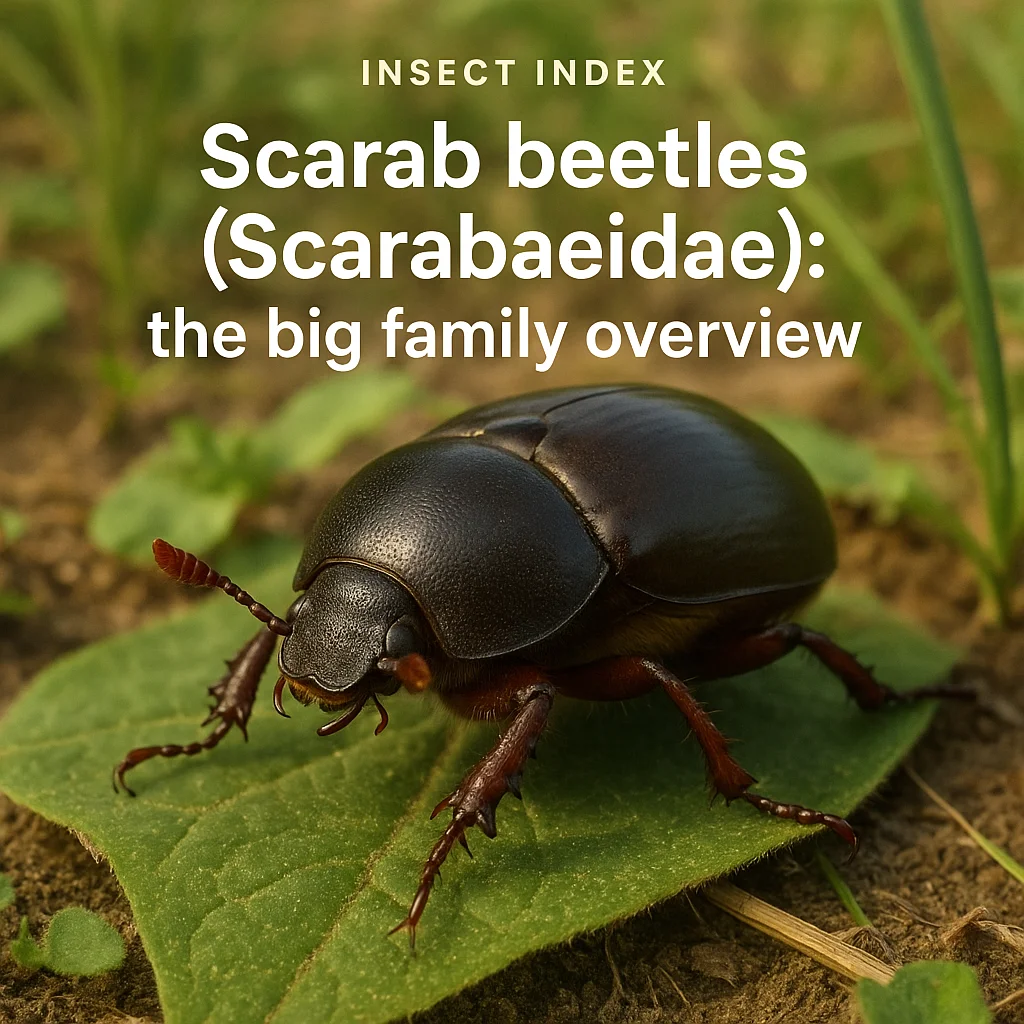
Scarab beetles can be recognized by their distinct body shapes and features.
- Body shape and silhouette: Typically oval and robust with a convex back.
- Antennae type: Lamellate antennae that can fan out or close up.
- Wing features: Hard-edged elytra (wing covers), which conceal the softer hind wings used for flying.
- Leg traits and movement style: Strong legs adapted for digging, with comb-like spurs.
- Distinguishing look-alikes and common confusion: Often confused with other beetles, such as the Buprestidae (jewel beetles), but scarabs are generally more rounded.
- Top ID Tips:
- Look for broad, oval bodies with strong hind legs.
- Check for lamellate antennae that resemble tiny fans.
- Observe coloration; many have a metallic sheen.
- Identify by habitat: often found near dung, decaying matter, or flowers.
- Note size: often larger than other beetles.
- Listen for buzzing that mimics a small helicopter in flight.
🧠 Basic Body Structure
Scarab beetles, like all insects, are characterized by a three-part body structure: head, thorax, and abdomen.
- Head: Houses the mouthparts, eyes, and antennae.
- Thorax: Bears the three pairs of legs and two pairs of wings.
- Abdomen: Encloses the digestive and reproductive organs.
All insects have an exoskeleton, which provides protection and support. To grow, they must molt; shedding this exoskeleton multiple times throughout their lifecycle. Scarabs are invertebrates, meaning they lack a backbone, relying on their hard shell for structure and movement.
🌍 Habitat & Distribution
Scarab beetles occupy a diverse range of habitats across the globe. While they prefer warm climates, they can be found almost everywhere except extreme polar regions.
- Preferred environments: Woodlands, grasslands, savannahs, and occasionally urban areas.
- Microhabitats: Often located under logs, in leaf litter, or around dung and decaying vegetation.
Geographically, they are most abundant in tropical and subtropical regions, but climate changes and habitat destruction can affect their local distribution and sighting frequency.
📅 Seasonal Appearance & Activity
Depending on the species and region, scarab beetles can be most active during certain times of the year.
- Months/seasons: Generally observed from spring to late summer, with some species active in autumn.
- Time of day: Primarily nocturnal, with some species active during the day.
- Weather influences: Warm and humid conditions favor their appearance and activity.
- Best Time to Spot It:
- Warm summer nights.
- After rainfall when the soil is soft for digging.
- Near compost heaps or gardens during dusk.
- Warmer regions often have scarabs nearly year-round.
🥚 Reproduction & Egg-Laying
The reproductive behaviors of scarab beetles vary significantly among species. Some engage in complex courtship rituals, while others rely on pheromones to attract mates. Males may fight using their horns or mandibles to secure breeding rights.
- Where eggs are laid: In soil, within dung, or decaying wood.
- Typical egg counts and strategies: Highly variable, with some species laying just a few eggs while others deposit several dozen.
🌀 Metamorphosis & Life Cycle
Scarab beetles undergo complete metamorphosis, which includes four stages: egg, larva, pupa, and adult.
- Egg: Laid in protected environments like soil or dung, taking several days to weeks to hatch.
- Larva (grub): A feeding stage, where they consume organic matter, lasting from months to years depending on habitat and species.
- Pupa: The transformation stage where the grub transitions into an adult, lasting several weeks.
- Adult: Emerges to mate and lay eggs, usually living several weeks to months.
🍽️ Diet & Feeding Behavior
The diet of scarab beetles is diverse, heavily depending on life stages and species.
- Larvae: Primarily herbivores or decomposers, feeding on plant roots, dung, or decaying vegetation.
- Adults: Herbivorous, scavenging on dung, rotting fruit, or nectar; some may even act as pollinators.
- Feeding tools: Possess strong chewing mouthparts tailored for their dietary needs.
They play crucial roles as decomposers, breaking down organic material and recycling nutrients in ecosystems.
🦉 Predators & Defense
Scarab beetles face a variety of natural enemies, but they have developed several defenses.
- Predators: Birds, reptiles, amphibians, and small mammals.
- Defense strategies: Include hardened exoskeletons, nocturnal behavior to avoid diurnal predators, and often emit unpleasant odors or fluids.
- Defense Highlights:
- Thick armor-like shells.
- Strong odors that deter predators.
- Burying behavior to escape threats.
- Quick digging and scrambling movements.
👥 Social Behavior & Swarms
Most scarabs are solitary, only coming together for mating or when food sources concentrate them, like piles of dung. Swarming behavior is uncommon, but certain environmental conditions can trigger localized population explosions.
🧭 Senses & Communication
Scarab beetles have well-developed senses to interact with their environment.
- Vision: Compound eyes provide a wide field of view, though some are more reliant on smell.
- Smell/pheromones: Pheromones are essential for communication, especially in mating.
- Communication methods: Pheromone trails and subtle vibrations are common intra-species signals.
🌱 Role in the Ecosystem
Scarab beetles are vital ecosystem players.
- Ecological importance: As decomposers, they break down detritus and cycle nutrients.
- Relationships: Some are important pollinators, while others help in soil aeration through burrowing.
- Impact on humans/agriculture: While some larvae may be agricultural pests, the overall benefits often outweigh the negatives.
📉 Population & Conservation Notes
The conservation status of scarab beetles varies widely. They are often reported as common in suitable habitats, but habitat destruction and pesticide use can lead to declines.
- How to Help (Low-Impact):
- Plant native species to provide natural food sources.
- Avoid pesticide use in gardens.
- Leave natural litter layers for habitat.
- Create beetle-friendly environments with log piles or compost.
⚠️ Human Interaction & Safety
Scarab beetles do not bite or sting humans and are generally safe to handle, though it's important to respect wildlife and avoid collecting wild specimens. If a reaction occurs, wash the area with soap and water, and seek professional advice if severe.
📌 Summary
- Identifiable by robust bodies and lamellate antennae.
- Found in a variety of terrestrial habitats worldwide.
- Most active from spring through summer, especially at night.
- Undergo complete metamorphosis with distinct life stages.
- Diet consists mainly of plant materials and decomposing matter.
- Predators include birds and small mammals; defenses include hardened shells and odors.
- Contribute significantly to ecosystems as decomposers and pollinators.
- Some populations are at risk due to habitat change and pesticide use.