🕷️ Sacred Scarab history: myths and reality
🧾 Quick Facts
Often enveloped in myth and mystery, the Sacred Scarab is a captivating group of beetles that carry both a rich cultural history and significant ecological roles. Here's a concise overview of these fascinating creatures.
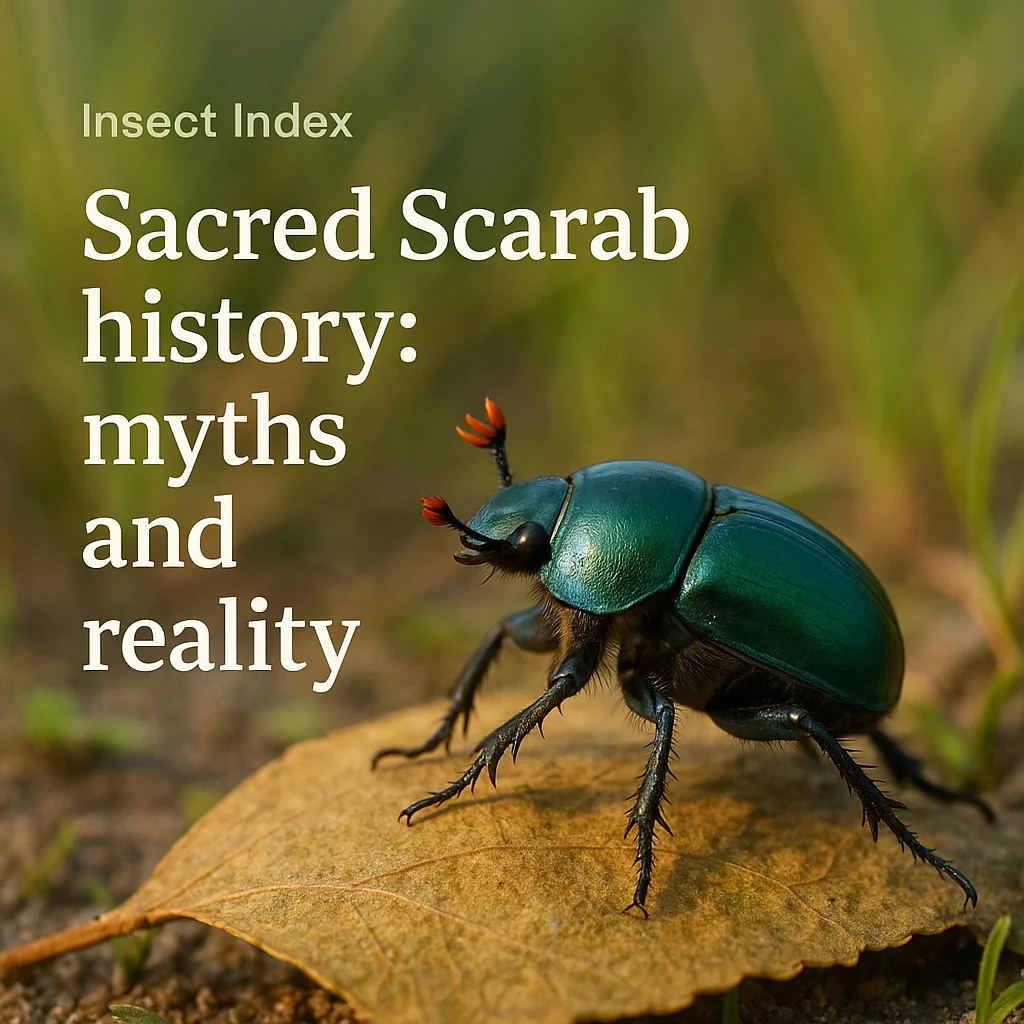
- Common Names: Sacred Scarab, Dung Beetle
- Scientific Name: Varies; Scarabaeus sacer is a well-known species
- Insect or Not: Insect (invertebrate with a segmented body)
- Order / Family: Coleoptera / Scarabaeidae
- Typical Size Range: 2 to 3 centimeters (adult)
- Key Colors/Patterns: Black or dark brown, often shiny
- Activity: Mostly nocturnal
- Typical Habitats: Grasslands, savannas, farmlands
- Where in the World: Africa, Middle East, parts of Europe
- Seasonality: Most active in warmer months
🔍 Identification
The Sacred Scarab is easily recognized by its robust, oval-shaped body, strong digging legs, and star-shaped antennas that are used for detecting chemical signals. Their unique behavior of rolling balls of dung is a key distinguishing feature. They are dark, often black or brown, with a glossy sheen.
- Body silhouette is round, stout, and compact.
- Antennae are clubbed with a tactile ability to sense the environment.
- Wings are hardened with protective elytra covering delicate flying wings underneath.
- Legs are powerful, capable of rolling dung with astounding strength.
- Often confused with other dung beetles, but their rolling behavior is distinctive.
🧠 Basic Body Structure
Like all insects, the Sacred Scarab has a body divided into three main sections: the head, thorax, and abdomen. It possesses six legs and two pairs of wings, with the outer pair called elytra that protect the inner membranous wings. They are invertebrates, meaning they lack a backbone and rely on a hard exoskeleton for structural support.
🌍 Habitat & Distribution
Sacred Scarabs thrive in open landscapes such as grasslands, savannas, and farmlands, often inhabiting areas with abundant animal dung from herbivores. They are typically found in Africa, the Middle East, and parts of Europe where temperatures are suitable. Microhabitats include areas under dung pats or burrowed into loose soil. Human agricultural expansion can both aid and hinder their presence by changing the availability and distribution of resources.
📅 Seasonal Appearance & Activity
The Sacred Scarab is most visible during the warm months when adult beetles emerge to mate and feed. Being predominantly nocturnal, they are actively engaged in their unique dung-rolling and feeding activities during the cooler evening periods.
- Best seen in spring through summer.
- Most active during late evening and night.
- More visible after rains which soften the soil.
- Look for them in areas with ample animal dung.
🥚 Reproduction & Egg-Laying
During mating season, male Sacred Scarabs perform elaborate rolling feats with dung to attract females, often working in pairs to transport and bury dung balls. Eggs are laid inside these dung balls, which nourish developing larvae. The number of eggs laid varies depending on conditions and availability of resources.
🌀 Metamorphosis & Life Cycle
The Sacred Scarab undergoes complete metamorphosis in the stages of egg, larva, pupa, and adult. Eggs hatch into larvae that feed on the dung until they pupate in the ground. This cycle ensures they use nutrient-rich environments for growth.
Egg/Larva: Laid in dung with larvae feeding on it for nutrients. This stage varies in duration depending on temperature and food availability.
Pupa: Remains in the soil, transforming over a few weeks.
Adult: Emerges for reproduction and feeding, living to fulfill ecological roles such as waste recycling.
🍽️ Diet & Feeding Behavior
Sacred Scarabs are primarily coprophages, consuming dung during all life stages. Larvae feed within dung, while adults may both feed directly on waste or use it to house their young. They have chewing mouthparts suited for breaking down organic materials, playing a vital role in nutrient cycling.
🦉 Predators & Defense
Scarabs face predation from birds, reptiles, and small mammals. Their primary defenses include their hardened exoskeleton, ability to quickly burrow into the ground, and utilization of foul-smelling substances that deter predators.
- Strong outer shell
- Quick burying capabilities
- Chemical defenses from dung
- Nighttime activity to avoid visual predators
👥 Social Behavior & Swarms
Sacred Scarabs are mostly solitary except for mating pairs that form temporary bonds for rolling dung. They do not form swarms or colonies, avoiding crowding by establishing territories around their food sources.
🧭 Senses & Communication
The Sacred Scarab utilizes a keen olfactory sense, relying heavily on chemical detection for locating dung and potential mates. Communication is typically non-verbal, achieved through pheromones and tactile interactions during mating rituals.
🌱 Role in the Ecosystem
Sacred Scarabs are crucial for nutrient cycling, decomposing manure, and thus enriching the soil. They reduce parasite loads by burying dung, promote plant growth, and indirectly support vertebrate populations by maintaining healthy environments.
📉 Population & Conservation Notes
Sacred Scarabs are generally stable, but local abundance varies. Threats include habitat disruption, pesticide use, and climate change. Conservation practices like avoiding excessive pesticide use and promoting habitat diversity are beneficial.
- Use native plants in gardens
- Limit pesticide application
- Support wildlife-friendly farming practices
- Promote biodiversity in local environments
⚠️ Human Interaction & Safety
Sacred Scarabs are non-aggressive and pose little threat to humans, as they do not bite or sting. Observing them requires respect for their natural behaviors without capturing or harming them. If handling one, wash hands afterward as a routine hygiene measure.
📌 Summary
- Sacred Scarabs are recognizable by their robust shape and dung-rolling habit.
- They inhabit grasslands and savannas, thriving near herbivore populations.
- Most active during warm, damp conditions and in the dark of night.
- Complete metamorphosis diet of dung aids in decomposition and recycling.
- Predators include birds and reptiles, with defense through scent and burrowing.
- Single pairs collaborate for reproduction and nutrient distribution.
- Utilize pheromones for communication and locating resources.
- Critical as ecological recyclers, enhancing soil health and plant growth.
- Population is stable but faces threats from environmental changes.