🕷️ June beetles: common night flyers
🧾 Quick Facts
June beetles, also known as June bugs, are fascinating insects that are most active at night. They belong to the family Scarabaeidae, which houses a variety of beetles commonly referred to as scarabs. Here are some quick facts about June beetles:
- Common names: June beetles, June bugs
- Scientific name: Varies by species
- Insect or not: Yes, they are insects and invertebrates
- Order / family: Coleoptera / Scarabaeidae
- Typical size range: 12–25 mm in length
- Key colors/patterns: Reddish-brown or black
- Activity: Nocturnal, primarily active at night
- Typical habitats: Forests, grasslands, gardens
- Where in the world it occurs: North America, and various regions worldwide
- Seasonality: Most visible during late spring to early summer
🔍 Identification
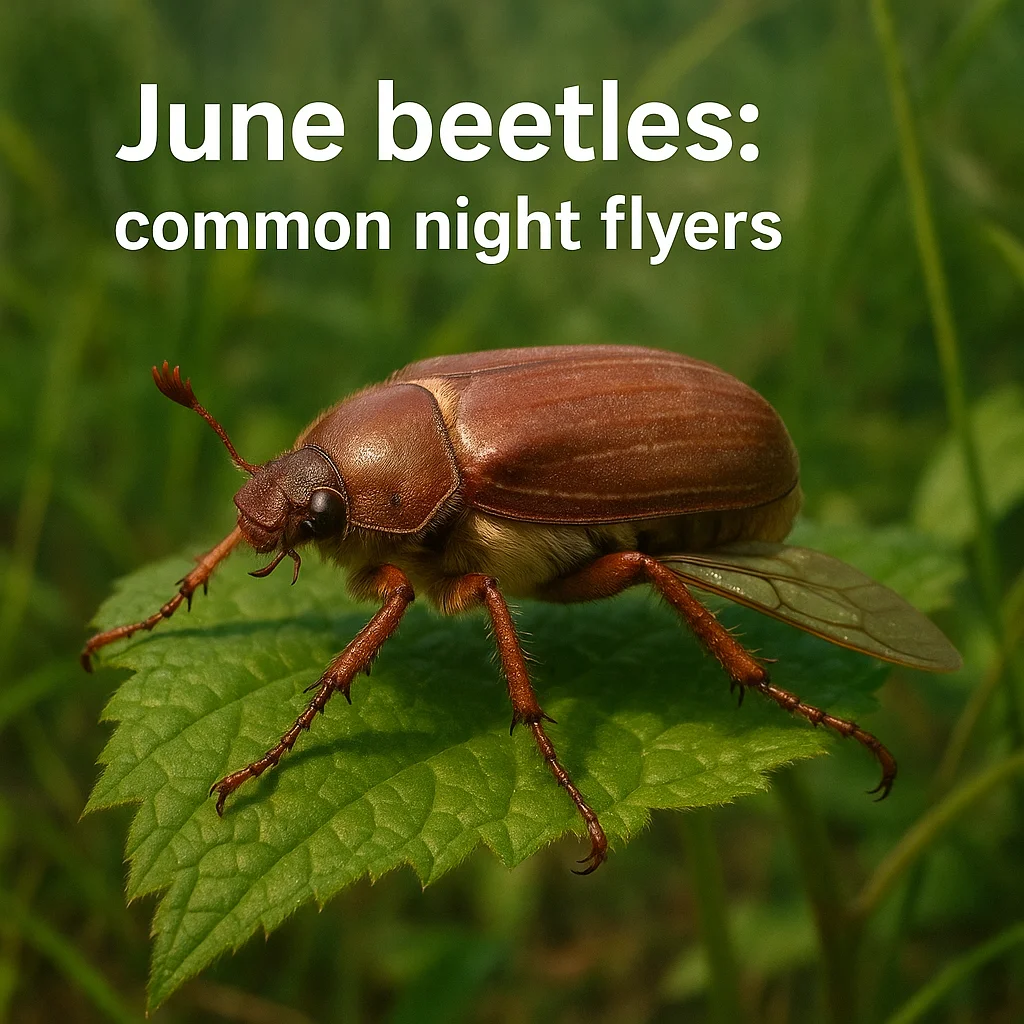
Identifying June beetles in the field involves observing their distinctive body shape and characteristic features. They have oval bodies with a hard exoskeleton that provides protection. Their antennae are distinctively fan-shaped, known as lamellate, which helps in sensing their environment. June beetles have transparent wings that are neatly tucked under their protective wing covers, or elytra, when not in use.
One can also notice their robust legs adapted for burrowing into the soil and the way these beetles can appear clumsy when in flight. They may be confused with other beetles due to their size and coloration, but their prominent lamellate antennae set them apart from similar species.
- Top ID Tips:
- Oval, robust body
- Reddish-brown or black coloration
- Fan-shaped lamellate antennae
- Hard, protective elytra
- Burrowing legs
- Primarily nocturnal
- Clumsy flight movement
- Appears during late spring to early summer
🧠 Basic Body Structure
The June beetle, like all insects, is an invertebrate and lacks a backbone. Its body consists of three main segments: the head, thorax, and abdomen. The head houses the sensory organs, including compound eyes and antennae, while the thorax serves as the attachment point for the six legs and the wings. The abdomen contains the digestive and reproductive systems.
The exoskeleton is a critical feature providing structural support and protection. June beetles molt several times during their development, allowing them to grow. They have two pairs of wings: the forewings, or elytra, which are hard and protective, and the hindwings, used for flying.
🌍 Habitat & Distribution
June beetles are adaptable insects found in a variety of environments including forests, grasslands, and urban gardens. They prefer temperate climates and are commonly found in regions with abundant vegetation. In North America, they are prevalent in suburban and rural areas.
These beetles tend to inhabit microhabitats such as under the soil surface, within leaf litter, or under decaying wood, where they can find food and protection. Changes in habitat, such as urbanization and agriculture, can impact their presence, affecting local populations and interactions with the ecosystem.
📅 Seasonal Appearance & Activity
June beetles are primarily seen during the late spring and early summer months, which is when they emerge as adults. Their nocturnal habits mean they are most active during the night, often attracted to lights.
Weather conditions such as temperature and humidity can influence their activity levels. Mild, warm nights with little wind are ideal for June beetle sightings.
- Best Time to Spot It:
- Late spring to early summer
- Warm, mild evenings
- Nighttime hours
- Following rain showers
- Near sources of artificial light
🥚 Reproduction & Egg-Laying
June beetles engage in mating activities primarily at night. Males are often seen flying around light sources searching for females. Once mates are found, the female lays eggs in the soil, where they grow and develop.
Egg quantities and specific locations for laying can vary, but many June beetles bury their eggs a few inches into the soil. This practice protects the eggs from predators and environmental stresses. After hatching, larvae remain in the soil where they continue their life cycle.
🌀 Metamorphosis & Life Cycle
June beetles undergo complete metamorphosis, consisting of four stages: egg, larva, pupa, and adult. The eggs, laid in the soil, hatch into larvae within a few weeks. Larvae, known as white grubs, feed extensively on plant roots and organic matter in the soil.
The larval stage can last several months to years, depending on environmental conditions and species. Subsequently, the larvae pupate in the soil, undergoing transformation over a few weeks before emerging as adults. Adults spend their limited lifespan feeding, mating, and contributing to reproduction.
🍽️ Diet & Feeding Behavior
June beetle larvae primarily consume plant roots, which can sometimes make them a pest in gardens and agricultural fields. Their strong chewing mouthparts are well-suited for this type of feeding. As adults, June beetles feed less but may consume various types of foliage and flowers at night.
Predominantly herbivorous, their feeding habits play a role in the ecosystem by decomposing organic material and influencing plant dynamics through their root-feeding larvae.
🦉 Predators & Defense
June beetles face natural threats from a variety of predators including birds, mammals, amphibians, and spiders. In particular, nocturnal animals that hunt at night are likely predators of June beetles.
Their primary form of defense includes their sturdy exoskeleton, which provides some protection from predators. Additionally, their nocturnal habits allow them to avoid many day-active predators. Some species can effectively camouflage themselves within their environment.
- Defense Highlights:
- Strong exoskeleton
- Nocturnal activity
- Camouflage with surroundings
- Burrowing behavior
👥 Social Behavior & Swarms
June beetles are generally solitary insects. They do not form swarms or social groups like some other insect species. Interaction mostly occurs during mating seasons, where males actively seek females for reproduction.
While not inherently social, they may be found in large numbers around light sources at night, but this is more a product of attraction to light rather than social behavior.
🧭 Senses & Communication
June beetles rely on a range of senses to navigate their environment. Their compound eyes allow them to detect movements and shapes effectively, which is crucial under low-light conditions. Antennae with sensory hairs are essential for detecting chemical signals and pheromones, which play a role in locating mates.
Their tactile sense assists in recognizing their surroundings, especially during burrowing activities. While not particularly vocal, June beetles communicate primarily through chemical cues and pheromones.
🌱 Role in the Ecosystem
June beetles contribute to their ecosystems as decomposers, feeding on plant material and breaking down organic matter, which enriches soil nutrients. Through their larval root feeding, they can influence plant population dynamics.
While sometimes considered agricultural pests, especially in their larval stage, they also serve as a food source for various animals. Their role as prey and their influence on plant systems heighten their ecological significance.
📉 Population & Conservation Notes
The population of June beetles is often reported as common in suitable habitats, although specific statistics are not widely documented. Their abundance can fluctuate with environmental changes, habitat loss, and pesticide use, impacting their numbers regionally.
- How to Help (Low-Impact):
- Plant native vegetation in gardens
- Limit pesticide use in outdoor areas
- Promote diverse plant habitats
- Maintain natural leaf litter and organic matter
- Provide safe, dark resting places during the day
⚠️ Human Interaction & Safety
June beetles are not known to bite or sting humans, posing no significant threat. However, their larvae sometimes damage crops and garden plants by feeding on roots. To prevent human-wildlife conflict, it's crucial to handle sightings with respect, avoiding harm to beetles and their habitats.
If necessary to discourage beetle presence, consider using physical barriers rather than chemical pesticides to protect plants. Observing these beetles at night can provide educational insights into insect behavior without disturbing their natural activities.
📌 Summary
- June beetles are nocturnal insects of the Scarabaeidae family.
- They are identifiable by their oval body and lamellate antennae.
- Common in North America, they prefer forested and grassy habitats.
- Adults appear mostly in late spring to early summer.
- Life cycle includes complete metamorphosis: egg, larva, pupa, adult.
- Larvae feed on plant roots; adults on foliage and flowers.
- Natural predators include birds, mammals, and reptiles.
- Play ecological roles in decomposition and as a food source.
- Visit lights at night, and may impact agriculture economically.
- Conservation efforts should focus on habitat preservation.