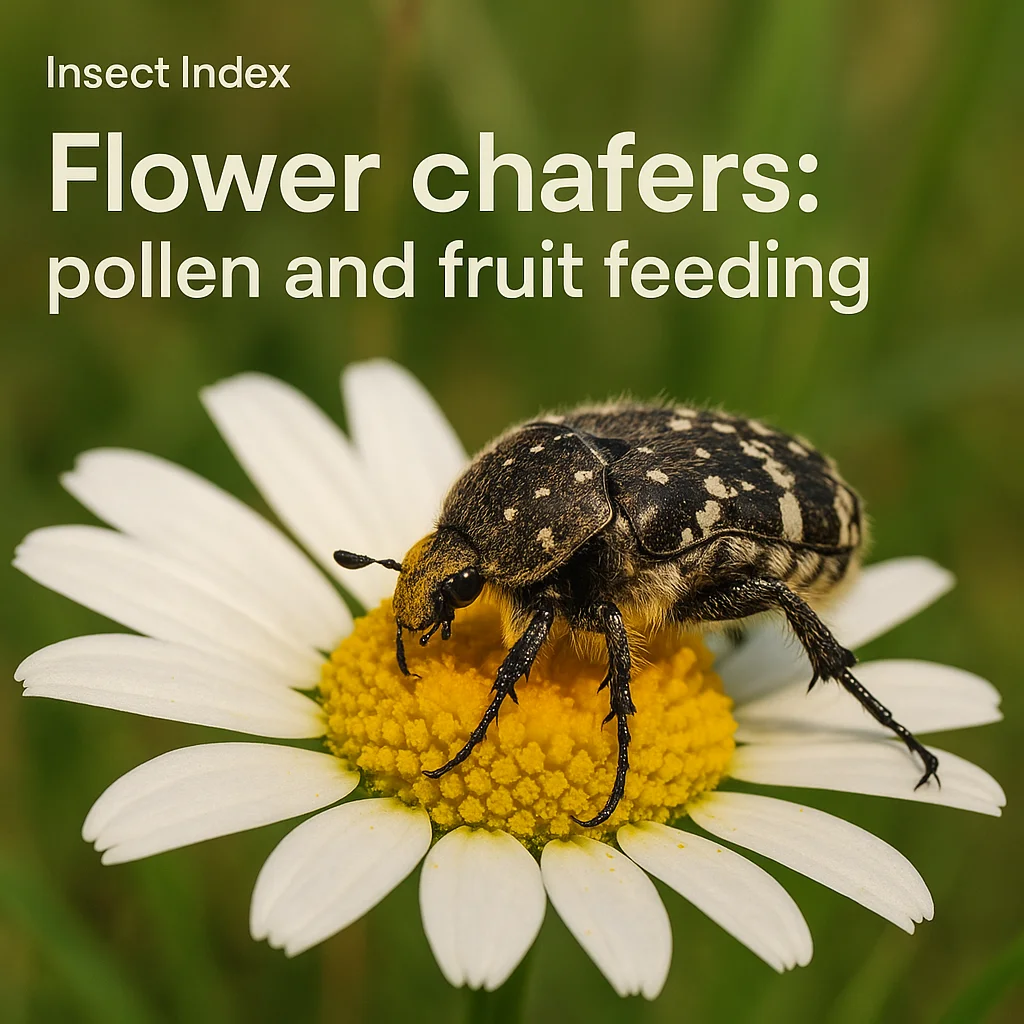
🕷️ Flower chafers: pollen and fruit feeding
🧾 Quick Facts
Flower chafers are a group of beetles known for their vibrant, metallic colors and their propensity for feeding on flowers and fruits. These insects are often found in gardens and forests worldwide.
- Common names: Flower chafers, fruit chafers
- Scientific name: Varies by species
- Insect: Yes, they are invertebrates
- Order / Family: Coleoptera / Scarabaeidae
- Typical size range: 10–30 mm in length
- Key colors/patterns: Bright metallic greens, golds, and bronzes with possible spots or stripes
- Activity: Diurnal (active during the day)
- Typical habitats: Gardens, orchards, forests
- Where in the world it occurs: Widely distributed in Europe, Africa, Asia, and parts of the Americas
- Seasonality: Most visible in the warmer months
🔍 Identification
Flower chafers can be identified by their compact, rounded bodies with distinctive metallic sheen. Their antennae typically have a club at the end, which can be fanned out during use. They possess strong and well-developed forewings that cover their membranous hindwings. Despite their bulk, these beetles are adept fliers.
With their brightly colored exoskeletons, flower chafers are often mistaken for other metallic beetles like jewel beetles. However, flower chafers generally have a more robust body and a more pronounced head.
- Top ID Tips:
- Rounded, compact body with metallic colors
- Clubbed antennae that can open like a fan
- Pronounced segmented body with visible wings
- Streamlined silhouette
- Short, strong legs
- Flight ability despite heavy body
- Commonly found on plants and flowers
- Confusable primarily with other metallic beetles
🧠 Basic Body Structure
Flower chafers, like all insects, have a basic body structure divided into three main parts: the head, thorax, and abdomen. They are invertebrates meaning they lack a backbone, instead possessing an external skeleton, or exoskeleton, that provides structural support and protection. This exoskeleton is shed multiple times throughout their life cycle in a process known as molting.
The head features sensory organs including compound eyes and antennae, which are used for tactile and chemical sensing. The thorax is the body section that houses the wings and six legs, which are crucial for their mobility and interacting with their environment. The abdomen contains vital internal organs. Flower chafers have powerful forewings known as elytra that cover their flight wings and serve protective purposes.
🌍 Habitat & Distribution
Flower chafers have a broad habitat preference, ranging from tropical forests to temperate gardens and orchards. They are most frequently found in areas where flowering plants and fruit trees are plentiful, as these provide food sources and breeding sites. Microhabitats include beneath tree bark, within leaf litter, and among clusters of flowers.
Geographically, these beetles are found across Europe, Africa, Asia, Australasia, and the Americas. Their abundance can fluctuate based on local conditions such as climate and food availability. Changes in land use and climate can influence the presence and population density of flower chafers in a given area.
📅 Seasonal Appearance & Activity
Most species of flower chafers are predominantly active during the warmer months when flowers and fruits are abundant, typically showing increased activity from spring through late summer. As diurnal insects, they are most active during daylight hours, often seen feeding on flower petals and fruits under warm and sunny conditions.
- Best Time to Spot It:
- Spring through late summer
- Sunny, warm days
- Morning and early afternoon
- When flowers and fruits are blooming or ripening
🥚 Reproduction & Egg-Laying
Mating behavior in flower chafers typically involves the male displaying colorful body or engaging in courtship rituals to attract a female. After mating, the female lays eggs in locations conducive to larval development, such as decaying wood, soil rich in organic material, or directly on host plants.
Egg laying can vary widely between species, influenced by environmental conditions and available resources. A female may lay several dozen to hundreds of eggs, ensuring that some descendants survive to adulthood, given the naturally high mortality rates for larvae.
🌀 Metamorphosis & Life Cycle
Flower chafers undergo complete metamorphosis, which consists of four stages: egg, larva, pupa, and adult. This life cycle begins when eggs hatch into larvae, commonly known as grubs, which primarily feed on decaying plant material. These larvae are often found in the soil or rotting wood.
After a variable larval stage, depending on the species and environmental factors, they pupate within the soil. During this pupal stage, metamorphosis occurs, leading to the emergence of the adult beetle. As adults, flower chafers feed on flowers and fruits, engaging in mating and laying eggs to start the cycle anew. The entire life cycle can range from several months to a couple of years, depending on species and conditions.
🍽️ Diet & Feeding Behavior
Flower chafers primarily feast on flowers and fruits, playing an essential role as pollinators in their ecosystems. They are equipped with chewing mouthparts allowing them to consume a range of plant materials. During their larval stage, they predominantly feed on decaying organic matter, which aids in decomposition. They are mainly herbivores, although some species might opportunistically scavenge on other organic matter.
🦉 Predators & Defense
Flower chafers face predation from a range of animals, including birds, small mammals, amphibians, and reptiles. Their primary defense mechanisms include their tough exoskeleton, which provides physical protection, and their ability to fly away from danger quickly. Some species have coloration that helps them blend into their floral environments, aiding in camouflage against predators.
- Defense Highlights:
- Hardened exoskeleton offers physical protection
- Camouflage coloration for blending with vegetation
- Rapid flight to evade threats
- Some employ sudden drops or evasive maneuvers
👥 Social Behavior & Swarms
Flower chafers are typically solitary in their adult stage, focusing on feeding and reproduction. They do not form complex social structures or colonies like some other insects. However, they can occasionally be found in groups when attracted to the same food source, such as a highly fragrant flowering tree or a patch of ripe fruit.
🧭 Senses & Communication
Flower chafers rely heavily on their sense of sight to locate flowers and fruits, with their compound eyes providing a broad field of vision. They also use their antennae for smelling, which is crucial for finding food. Communication primarily occurs during mating through pheromones released by potential mates to signal readiness and location.
🌱 Role in the Ecosystem
Flower chafers play a vital role in the ecosystems they inhabit, chiefly as pollinators. While feeding, they inadvertently transfer pollen between flowers, facilitating plant reproduction. Their larvae contribute to nutrient recycling by breaking down decaying organic matter. Such activities highlight their roles as decomposers and contribute to the maintenance of healthy soil ecosystems.
In some agricultural settings, however, flower chafers can become pests when their feeding damages flowers or fruits, impacting yields.
📉 Population & Conservation Notes
The population status of flower chafers varies broadly, with some species common in suitable habitats, while others face local threats due to habitat destruction, pesticide use, and climate change. Where data is limited, such variability underscores the need for careful conservation efforts tailored to regional contexts.
- How to Help (Low-Impact):
- Plant native flowering plants and shrubs
- Minimize pesticide usage to protect beetle populations
- Preserve natural habitats like woodlands and hedgerows
- Leave leaf litter and organic debris for larvae habitat
⚠️ Human Interaction & Safety
Flower chafers are generally harmless to humans and do not bite or sting. They are beneficial as pollinators and composters. If observing these beetles in the wild, it is advisable to do so respectfully and to avoid handling them as it can cause stress to the insects.
For those wishing to manage them due to potential agricultural damage, non-invasive methods like covering valuable plants or mechanical removal are recommended over chemical approaches.
📌 Summary
- Flower chafers are metallic beetles primarily found on flowers and fruits
- Recognizable by their vividly metallic and robust bodies
- Found worldwide, particularly in warm regions with abundant floral resources
- Undergo complete metamorphosis with larvae feeding on decaying matter
- Herbivorous adults serve as important pollinators
- Natural predators include birds, reptiles, and small mammals
- Play important ecological roles as pollinators and decomposers
- Population status varies; conservation efforts focus on habitat preservation
- Safe to admire without physical interaction; adhere to ethical wildlife observations