🕷️ Dung beetles: why they roll dung (ecosystem role)
🧾 Quick Facts
Dung beetles are fascinating insects renowned for their unique behavior of rolling dung. They play a significant role in ecosystems worldwide, including continents such as Africa, Asia, Europe, and the Americas. These beetles are an integral part of many environments, aiding in nutrient recycling and soil aeration.
- Common Names: Dung beetles, Scarabs
- Scientific Name: Varies by species
- Insect or Not: Insect, classified as invertebrates
- Order / Family: Coleoptera / Scarabaeidae
- Typical Size Range: 0.1 to 2.5 inches (3 to 65 mm)
- Key Colors/Patterns: Often black, brown, or metallic green
- Activity: Primarily diurnal, some nocturnal species
- Typical Habitats: Grasslands, forests, agricultural lands
- Where in the World: Africa, Asia, Europe, the Americas, Australia
- Seasonality: Most active in warmer months
🔍 Identification
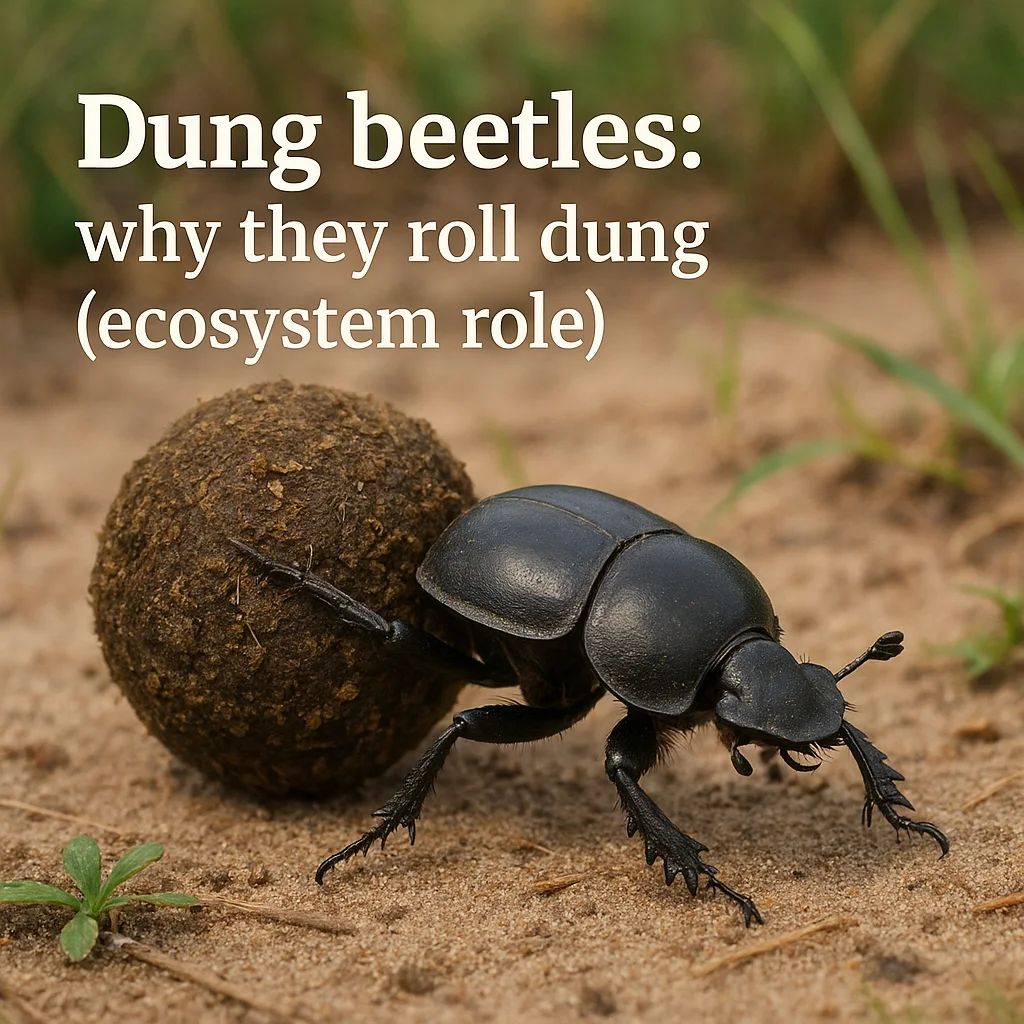
To identify dung beetles in the field, look for their distinctive body shape and behavior. They have a robust, compact body with a smooth, rounded back. Their antennae are clubbed—a common feature for scent detection in their niche. Dung beetles commonly possess strong and spiked legs, adapted for rolling dung balls and digging.
- Compact, rounded body with a hard exoskeleton
- Clubbed antennae suited for olfactory sensing
- Short, strong legs adapted for rolling and digging
- Prominent forelegs modified for burrowing
- Variably colored elytra, often metallic or dull brown/black
- Often mistaken for other beetles, but behavior is distinctive
- Size and coloration can vary greatly among species
- Whole specimen visible; ensure all parts are in frame
🧠 Basic Body Structure
As true insects, dung beetles have a typical body structure consisting of a head, thorax, and abdomen. They possess six legs, a hallmark trait of insects. Their body is protected by a hard exoskeleton, which they shed as they grow—a process known as molting. Some species have functional wings housed beneath the protective elytra that allow for flight. Dung beetles are invertebrates, meaning they lack a backbone.
🌍 Habitat & Distribution
Dung beetles inhabit a variety of environments, from tropical rainforests and savannas to temperate forests and grasslands. They thrive in areas where animals are present, as they rely on animal dung as a primary food source. Within these broad habitats, they are often found in microhabitats such as under dung piles, in soil, or in leaf litter. Dung beetle species have adapted to diverse climates across Africa, Asia, Europe, the Americas, and Australia. Changes in land use and habitat degradation can affect local populations.
📅 Seasonal Appearance & Activity
The activity of dung beetles is generally influenced by climatic conditions. They are more visible and active during warmer months and may be less active or go dormant in colder weather. While many species are diurnal, some exhibit nocturnal tendencies, especially in regions where nocturnal mammal dung is prevalent.
- Warm seasons (spring to late summer) are peak activity times
- Active during day in warmer climates, night in cooler regions
- Increased sightings after rain, when dung is more accessible
- Reduced activity in extreme temperatures and humidity levels
🥚 Reproduction & Egg-Laying
Dung beetles engage in intricate courtship and mating rituals often involving pheromones. After mating, females lay their eggs in dung balls, which they either bury or leave in shallow grooves. This behavior ensures larvae have immediate access to food upon hatching. Egg counts vary considerably among species, typically ranging from a few eggs to several dozens.
🌀 Metamorphosis & Life Cycle
Dung beetles undergo complete metamorphosis, which includes four life stages: egg, larva, pupa, and adult. Eggs hatch into larvae, which feed on the dung where they were laid. The larval stage may last several weeks to months, depending on environmental conditions. Afterward, the larvae pupate within the dung ball or soil, emerging as adults ready to continue the cycle. The adult stage's duration varies, with some species living just a few months, while others can live up to a year.
🍽️ Diet & Feeding Behavior
Dung beetles primarily consume dung during all life stages. Adults and larvae have strong mandibles adapted for chewing solid material. While some species specialize in certain types of dung, others are more generalist feeders. Their role as scavengers is crucial for nutrient recycling, influencing decomposition and soil health. They are not predatory but occasionally consume fungi or fallen fruit as supplemental food.
🦉 Predators & Defense
Dung beetles face predation from a range of animals, including birds, small mammals, reptiles, and amphibians. Their main defense strategies include camouflage, using their dark or metallic coloring to blend into the ground. Their hard exoskeleton provides physical protection, and their ability to roll dung balls allows them to quickly retreat or hide.
- Use of camouflage with surroundings
- Protective, hardened exoskeleton
- Rolling dung for strategic retreat
- Using burrows to evade threats
👥 Social Behavior & Swarms
While generally solitary, some dung beetle species display social behavior, particularly in brood care, where they cooperatively handle dung and protect young. They do not form large colonies but may congregate when food sources are abundant. Swarming is usually triggered by the availability of fresh dung or favorable environmental conditions.
🧭 Senses & Communication
Dung beetles rely heavily on their sense of smell to locate dung, with antennae adept at detecting pheromones. They also use tactile and vibratory cues during courtship and interactions with other beetles. Some species may engage in stridulation or other sound-based communication for mating or territory defense.
🌱 Role in the Ecosystem
Ecologically, dung beetles are vital for nutrient cycling. By transporting and burying dung, they promote soil aeration, enrich soil nutrients, and aid seed dispersal by inadvertently moving seeds contained in dung. This activity helps control parasites in agricultural areas and maintains ecosystem balance.
📉 Population & Conservation Notes
Generally, dung beetles are found to be common in regions where habitats are undisturbed and grazing animals are prevalent. However, their populations can be threatened by habitat loss, pesticides, and climate change. Conservation efforts focus on maintaining natural habitats and promoting agricultural practices that support dung beetle diversity.
- Plant native flora to support habitat quality
- Avoiding or minimizing pesticide usage
- Encouraging sustainable agricultural practices
- Leaving areas of manure unmanaged for beetle activity
⚠️ Human Interaction & Safety
Dung beetles do not pose any direct threat to humans as they neither bite nor sting. Observing these beetles can be a rewarding experience, emphasizing the importance of not disturbing their natural behavior or habitats. To promote conservation, avoid collecting live specimens and respect their roles in ecosystems.
📌 Summary
- Dung beetles have a durable, compact body with distinctive clubbed antennae
- Found globally in a variety of terrestrial habitats
- Most active during warmer periods and favorable weather conditions
- Undergo complete metamorphosis from egg to adult
- Scavenge and bury dung, promoting ecosystem health
- Primary predators include birds and small mammals
- Crucial for nutrient cycling and soil structure
- No safety concerns for humans; admired for ecological value