🕷️ Rhinoceros beetle larvae: compost and decay
🧾 Quick Facts
The Rhinoceros beetle larvae, key players in the composting and decay processes of their habitats, are fascinating creatures worthy of study. Here are some quick facts to help you get acquainted with them:
- Common names: Rhinoceros beetle larvae
- Scientific name: Varies by species
- Insect or not: Yes, they are invertebrates
- Order / Family: Coleoptera / Scarabaeidae
- Typical size range (adult): 2 to 6 cm
- Key colors/patterns: Creamy white as larvae, brownish-black as adults
- Activity: Mostly nocturnal
- Typical habitats: Forests, gardens, compost heaps
- Where in the world it occurs: Found in tropical and subtropical regions worldwide
- Seasonality: Most visible in late spring to early autumn
🔍 Identification
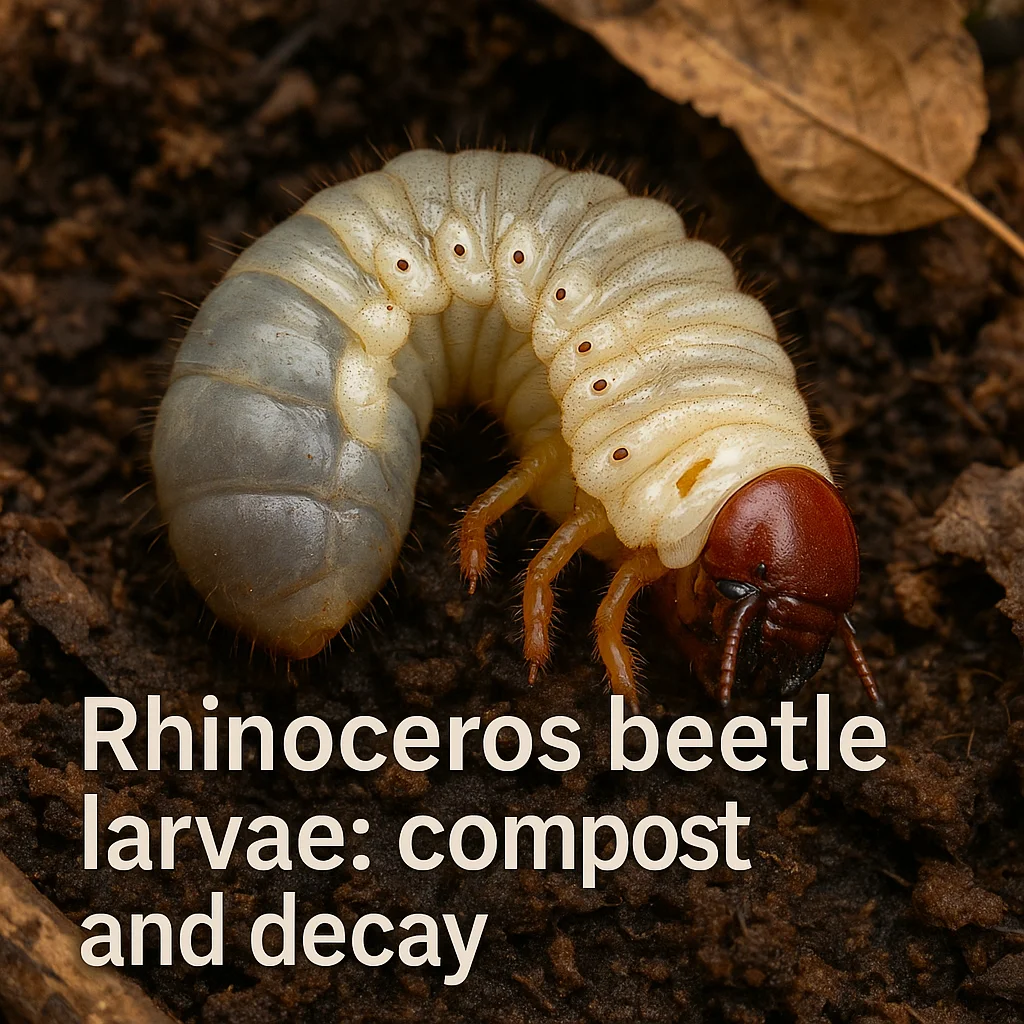
Identifying Rhinoceros beetle larvae involves observing their distinct physical characteristics. These larvae have a robust, C-shaped body that is creamy white with a dark head. Their antennae are typically short and not as prominent as in adults. Although the larvae do not have wings, adult beetles possess well-developed wings covered by a hard shell called elytra.
Unlike their adult counterparts, the larvae lack the prominent horns associated with Rhinoceros beetles. Their legs are short and stout, adapted for life underground within decaying plant matter. It is important not to confuse these larvae with other grub-like insects found in similar habitats.
- Top ID Tips:
- C-shaped body shape
- Creamy white coloration with a darker head
- Short, stout legs
- Lack of prominent body horns
- Found within decaying organic matter
- Often confused with other beetle larvae
🧠 Basic Body Structure
As insects, Rhinoceros beetle larvae share the fundamental anatomical traits common to this class of invertebrates. They possess a head, thorax, and abdomen. Although the larvae have only short, undeveloped legs, adult beetles boast six robust legs well adapted for walking and digging.
Their hard exoskeleton serves as a protective armor and supports their bodies. As these larvae grow, they undergo molting, shedding their exoskeleton to allow for further development. Though they are just one stage in the life of Rhinoceros beetles, they illustrate the fascinating complexity of nature's invertebrate community.
🌍 Habitat & Distribution
Rhinoceros beetle larvae thrive in environments rich in decaying organic matter. They are typically found in forests, where they live beneath leaf litter, rotting logs, and other detritus. These larvae can also be seen in gardens and compost heaps, where they contribute to the breakdown and recycling of plant material.
Geographically, Rhinoceros beetle larvae are widespread across the tropical and subtropical regions of the world, including continents like Asia, Africa, Australia, and the Americas. Climate changes and habitat destruction can lead to fluctuations in their population and visibility within these regions.
📅 Seasonal Appearance & Activity
Rhinoceros beetles are generally most visible from late spring to early autumn, as this is the period when adults emerge to mate and lay eggs. The larvae, however, can be active year-round, thriving beneath the surface layer of organic matter where they feast on decaying plant material.
These beetles, particularly their larvae, are mostly nocturnal, tending to remain hidden during daylight hours. Wetter environments encourage their activity, as moisture is key to the decomposition processes they aid.
- Best Time to Spot It:
- Late spring through early autumn
- During warm, wet weather
- At night, when activity is highest
- In moist, decay-rich environments
🥚 Reproduction & Egg-Laying
The reproductive behaviors of Rhinoceros beetles are marked by vigorous courtship displays, particularly among males, who use their characteristic horns to compete for mating rights. Females generally lay their eggs in decaying wood or composting plant matter, which provides nourishment for the hatching larvae.
Egg counts can vary, but females typically lay several dozen eggs. This strategy ensures that at least some of the offspring will survive through to adulthood, despite the numerous threats in their environment.
🌀 Metamorphosis & Life Cycle
Rhinoceros beetles undergo complete metamorphosis, progressing through various distinct stages, from egg to larva, pupa, and finally adult. The larvae spend their time feeding on decaying plant materials, often for several months, depending on environmental conditions and species.
Once the larvae are mature, they enter the pupal stage, during which they transform into adult beetles. The pupal stage can range from a few weeks to several months. After emerging as adults, they shift their focus to reproduction, continuing the life cycle.
🍽️ Diet & Feeding Behavior
Rhinoceros beetle larvae are herbivorous, specializing in decomposing plant matter. Their feeding behavior plays a critical role in breaking down organic material, facilitating nutrient recycling in their habitats.
Upon reaching adulthood, most Rhinoceros beetles adapt their diet to include a broader range of decaying vegetation and occasionally fruits, utilizing their strong mandibles to consume soft, nutrient-rich foods.
🦉 Predators & Defense
Rhinoceros beetle larvae face various predators, including birds, mammals, amphibians, and other insects that prey on soft-bodied organisms within the soil. To defend themselves, the larvae rely on their ability to hide within dense, decomposing material.
Adults possess a thicker exoskeleton that offers some protection from less determined predators. While they lack potent stings or bites, their primary defense strategies revolve around remaining hidden and blending into their surroundings.
- Defense Highlights:
- Camouflage in decaying matter
- Hard exoskeleton in adults
- Underground lifestyle as larvae
- Lack of aggressive defense mechanisms
👥 Social Behavior & Swarms
Rhinoceros beetle larvae are solitary creatures, spending most of their time burrowed into decomposing organic materials. They do not exhibit social behaviors or communication strategies typical of colony-forming insects.
Although adults can sometimes be seen in groups when converging on a food source, they do not form swarms or engage in coordinated migrations, making them largely independent throughout their development.
🧭 Senses & Communication
Rhinoceros beetles, in both larval and adult stages, utilize a combination of senses to navigate and survive in their environments. They have acute olfactory abilities, allowing them to locate decaying plant material or detect pheromones for mating.
Visual acuity is more limited due to their largely nocturnal habits. Communication during mating often involves detecting pheromone trails and possibly some acoustic signals in adults, although this varies by species.
🌱 Role in the Ecosystem
Rhinoceros beetle larvae play a crucial role in ecosystems as decomposers. By feeding on decaying plant material, they accelerate the breakdown and recycling of nutrients back into the soil, enhancing the fertility of their habitats.
While generally beneficial, some species can occasionally become pests if they feed on economically important plant materials. Understanding their ecological roles helps maintain a balanced view of their contributions to the environment.
📉 Population & Conservation Notes
Rhinoceros beetles are generally reported as common within suitable habitats, although some localized populations may fluctuate due to habitat destruction, pesticide use, and climate changes. Data on global populations is limited, making continuous observation important for conservation efforts.
- How to Help (Low-Impact):
- Plant native vegetation
- Avoid commercial pesticides
- Preserve natural composting areas
- Support habitat restoration projects
⚠️ Human Interaction & Safety
Rhinoceros beetles generally do not pose a threat to humans. They do not bite or sting, and interactions are typically harmless. If handling is necessary, do so gently to avoid harming these beneficial insects.
For insect enthusiasts and gardeners, observing these beetles and their larvae from a respectful distance offers insight into the fascinating processes of decomposition and nutrient cycling in nature.
📌 Summary
- Recognizable by their C-shaped, creamy white bodies
- Inhabit decaying matter in forests and gardens
- Most visible in late spring to early autumn
- Play a vital decomposer role within ecosystems
- Undergo complete metamorphosis with distinct life stages
- Diet consists largely of decaying plant materials
- Face natural threats from birds, mammals, and insects
- Human interactions mostly non-threatening