🕷️ Hercules Beetle (Dynastes hercules): giant size facts
🧾 Quick Facts
The Hercules Beetle (Dynastes hercules) is a remarkable insect known for its imposing size and strength. Here are some quick facts about this fascinating creature:
- Common Names: Hercules Beetle
- Scientific Name: Dynastes hercules
- Insect or Not: Yes, it is an invertebrate insect.
- Order/Family: Coleoptera / Scarabaeidae
- Typical Size Range: 6.5 – 17.5 cm (2.5 – 7 inches)
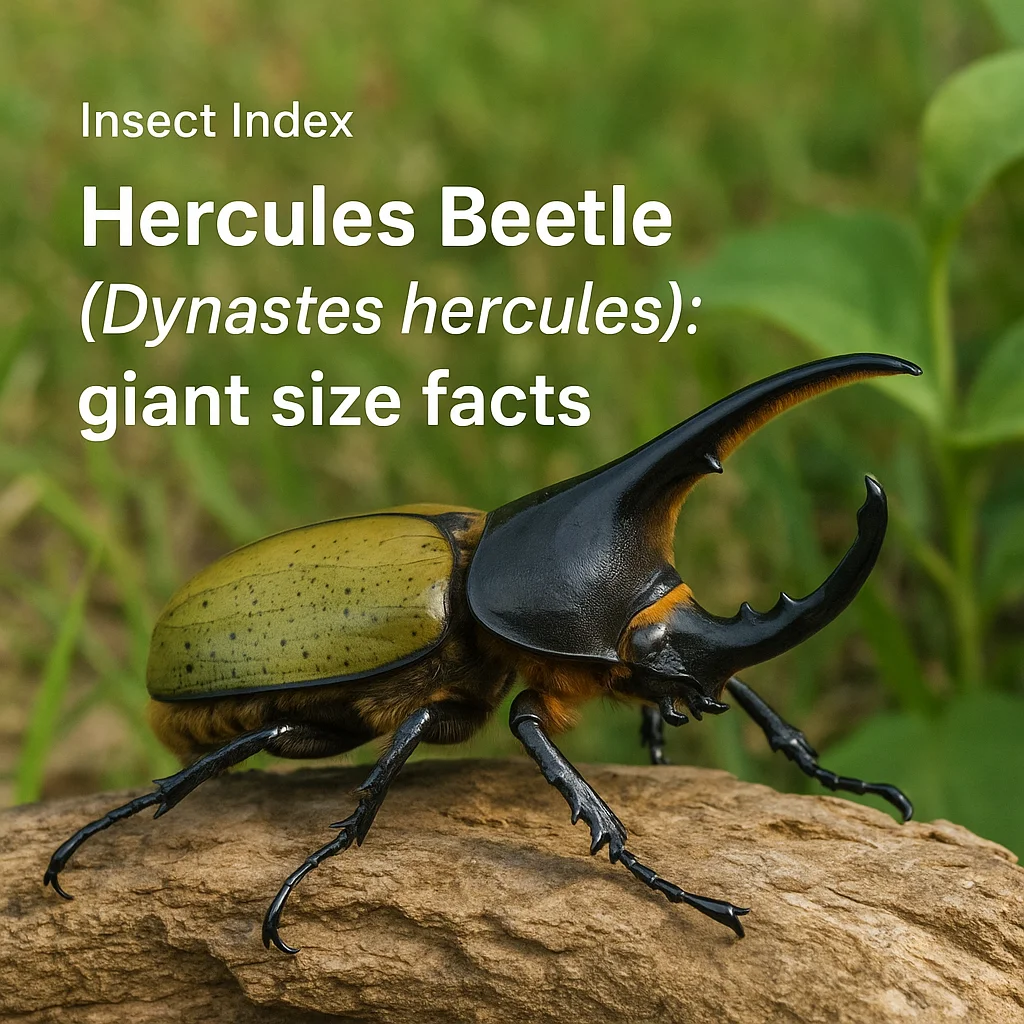
- Key Colors/Patterns: Greenish or yellowish elytra with black markings; males have prominent horns.
- Activity: Primarily nocturnal
- Typical Habitats: Tropical rainforests, primarily in Central and South America.
- Where in the World It Occurs: Central and South America, particularly in countries like Costa Rica, Bolivia, Colombia, and Brazil.
- Seasonality: Adults are most visible in the rainy season, typically in summer.
🔍 Identification
Recognizing the Hercules Beetle in the field involves noting several distinctive characteristics. The male beetles are especially notable for their large, impressive horns on their heads and thoraxes. Females lack these prominent horns but are robust in size. Their body is noticeably elongated, and their elytra (wing covers) are often colorfully mottled with hues of green, brown, or yellow with black spots. The beetle has three sets of jointed legs and antennae suited to their role in detecting scents.
- Large body with an oblong shape.
- Males have large forward-pointing horns.
- Short, fan-like antennae.
- Hard elytra covering functional hind wings.
- Strong legs adapted for climbing.
- Females are often mistaken for other beetles due to the absence of horns.
- Bright patterns can vary among individuals.
🧠 Basic Body Structure
The Hercules Beetle, like all insects, is structured with three main body segments: the head, thorax, and abdomen. It possesses six legs, three on each side of the thorax, and is covered by a robust exoskeleton. This outer shell not only provides protection but also helps prevent water loss.
This beetle undergoes molting, shedding its exoskeleton multiple times throughout its life to grow. The Hercules Beetle is an invertebrate, which means it lacks a vertebral column, as opposed to vertebrate animals that have a spine or backbone. Its wings, protected by the hard elytra, enable it to fly short distances despite its large size.
🌍 Habitat & Distribution
The Hercules Beetle thrives in tropical forests where humidity levels are high. They prefer areas with plenty of decaying wood, which is crucial for their survival, as these environments provide nourishment and opportunities for reproduction. Their geographic range includes regions throughout Central and South America, especially in dense rainforest settings where climatic conditions support their life cycle.
Microhabitats include rotting logs, under loose bark, and leaf litter where larvae and adults find both shelter and food resources. Changes in these habitats, due to deforestation or climate impact, can significantly affect their population distribution and visibility.
📅 Seasonal Appearance & Activity
The Hercules Beetle is most active during the rainy season when humidity is at its peak. Their activity patterns are primarily nocturnal, making nighttime the best period for observing them in their natural environment. Temperature and precipitation have a significant influence on their visibility, as moist conditions facilitate their emergence and activity.
- Most visible in summer months.
- Best spotted during warm, humid nights.
- More active after rainfall.
- Near decay-rich environments.
🥚 Reproduction & Egg-Laying
Reproductive behavior among Hercules Beetles involves notable male competition, with horned males often engaging in battles to win access to a mate. Courtship is typically brief, and successful mating results in the female laying eggs.
The eggs are usually deposited within decaying wood or underneath moist leaf litter, providing a nurturing environment for the larvae upon hatching. The number of eggs laid can vary widely but generally ranges from several dozen to over a hundred, contingent on environmental factors.
🌀 Metamorphosis & Life Cycle
The Hercules Beetle undergoes complete metamorphosis, passing through four distinct stages: egg, larva, pupa, and adult. After hatching, larvae dwell within decomposing wood, feeding on the materials and growing steadily over several months.
The larva stage can last for over a year, followed by a pupation period where significant transformation occurs. Once metamorphosis is complete, the adult beetle emerges, ready to partake in its role in the ecosystem and reproductive cycle. This stage can last several months, depending on environmental conditions.
🍽️ Diet & Feeding Behavior
The diet of the Hercules Beetle varies across its life stages. As larvae, they feed on decaying wood, which supplies essential nutrients for growth. With robust chewing mouthparts, these larvae efficiently break down their diet source.
Adult beetles primarily consume plant juices and rotting fruits, using their mouthparts to access the nutrients. Contrary to many beetles, they play a limited role as pollinators, focusing more on decomposition as a part of their ecological niche.
🦉 Predators & Defense
The Hercules Beetle is subject to predation by a range of animals, including birds, reptiles, and small mammals. Its primary defense mechanisms are mimicry and camouflage, thanks to its coloration that blends well with decaying foliage.
The beetle's large horns may also serve as deterrents against potential threats, as well as tools for competing with rivals. In addition, their strong exoskeletal armor provides a formidable and protective barrier against aggressors.
- Camouflage with leaf litter.
- Hard exoskeleton acts as shield.
- Large horns intimidate predators.
- Quick reflexes for hiding.
👥 Social Behavior & Swarms
The Hercules Beetle is generally solitary, except during mating seasons when male beetles may congregate to compete for females. Individual beetles may cover significant distances in search of mates, though they do not exhibit swarm behavior.
Although these beetles do not form colonies or engage in collective activities, their interactions during mating seasons revolve around combative displays among males and brief engagements with females for reproduction.
🧭 Senses & Communication
The Hercules Beetle is equipped with well-developed senses that aid in its survival and reproduction. Like many beetles, they rely heavily on olfactory cues, detecting pheromones released during mating periods to locate potential partners.
Vision plays a minor role compared to smell, yet it remains useful in avoiding obstacles and predators. Tactile senses also guide them, particularly for nocturnal navigation across complex forest floors.
🌱 Role in the Ecosystem
The Hercules Beetle plays a crucial ecological role in decomposition. By breaking down decaying organic matter, both adults and larvae assist in nutrient cycling, enriching soils within their habitats.
Though not primary pollinators, their consumption of rotting fruits propagates seed dispersal to some extent. They also serve as prey to many predators, forming essential links within tropical food webs.
📉 Population & Conservation Notes
The population status of Hercules Beetles often varies locally. While they are robust within well-preserved tropical environments, habitat destruction poses a significant threat to their numbers. The loss of rainforests due to human intervention reduces viable living spaces and food sources.
- Encourage rainforest protection.
- Support habitat conservation efforts.
- Reduce pesticide use in tropical regions.
- Educate on sustainable ecosystems.
⚠️ Human Interaction & Safety
Hercules Beetles are generally harmless to humans and do not bite or sting. However, their large size and horns can be intimidating. When encountering these beetles, it is crucial to observe respectfully and avoid handling, as inappropriate interaction can cause harm to the beetle.
If any reactions occur from secondary exposure or contact, individuals should gently wash the affected area and seek professional advice for any severe reaction.
📌 Summary
- Identifiable by large size and male horns.
- Inhabits tropical rainforests, contributing to decomposition.
- Most visible during warm, rainy seasons at night.
- Undergoes complete metamorphosis across four life stages.
- Larval and adult stages aid in organic material breakdown.
- Acts as prey for various tropical animals.
- Alters rainforest ecology through nutrient cycling.
- Threatened by habitat destruction and necessitates conservation efforts.
- Safe for human observation when left undisturbed.