🕷️ Whirligig Beetles Why They Spin On The Water Surface
🧾 Quick Facts
Whirligig beetles are fascinating aquatic insects named for their distinctive spinning behavior on water surfaces. Found worldwide, these beetles are a delight for nature enthusiasts observing ponds and streams.
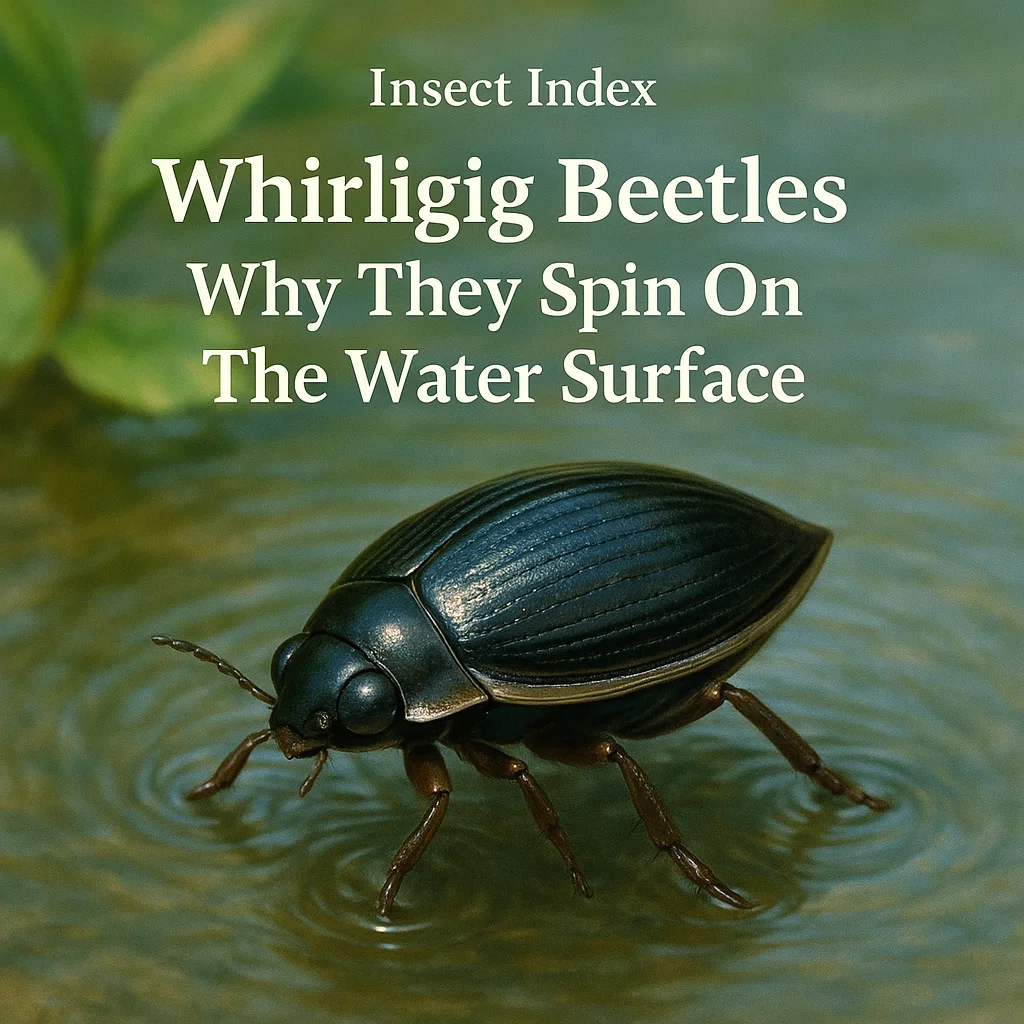
- Common names: Whirligig beetles
- Scientific name: Gyrinidae family
- Insect: Yes, they are invertebrates
- Order / Family: Coleoptera / Gyrinidae
- Typical size range: 3 to 18 mm (depending on species)
- Key colors/patterns: Dark, often metallic; some with distinct markings
- Activity: Diurnal
- Typical habitats: Freshwater ponds, lakes, quiet streams
- Where in the world it occurs: Worldwide, except Antarctica
- Seasonality: Most visible in warmer months
🔍 Identification
Whirligig beetles are easily recognizable by their unique spinning motion on water. They possess sleek, flattened bodies and shortened forewings that make them excellent swimmers.
- Body shape and silhouette: Oval, with a streamlined, hydro-dynamic form
- Antennae type: Short and clubbed, adapted to detect vibrations on the water's surface
- Wing features: Elytra are tough, covering membranous hind wings
- Leg traits and movement style: Paddle-like hind legs for swimming
- Distinguishing look-alikes and common confusion: Distinguished from similar aquatic beetles by their surface skimming and spinning behavior
- Flat, streamlined body helps identification
- Two-part movement: spinning on surface, diving below
- Pairs of eyes, dividing vision for above and below water
- Metallic sheen in many species, aiding recognition
- Found in fresh, still or slow-moving water bodies
- Typically seen in groups rather than alone
- Surface disturbance from spinning visible from a distance
- Short, visible antennae differing from long-legged water beetles
🧠 Basic Body Structure
Whirligig beetles, like all beetles, have three main body segments: the head, thorax, and abdomen. They exhibit the typical insect arrangement of six legs, with the hind legs being specially adapted for swimming. As invertebrates, whirligig beetles possess an exoskeleton that provides structure and protection. They undergo a process called molting, where they shed their exoskeleton to grow. Their forewings are known as elytra, which are hardened to protect the hind wings used in flight.
🌍 Habitat & Distribution
Whirligig beetles inhabit various freshwater environments, including ponds, lakes, and slow-moving streams. They prefer still or calm waters where they can employ their characteristic spinning behavior. Found on every continent except Antarctica, their presence in specific habitats is often influenced by the availability of suitable microhabitats, such as water edges or floating debris. Sightings may be reduced in heavily polluted or altered water bodies where conditions become unsuitable for their survival.
📅 Seasonal Appearance & Activity
Whirligig beetles are most commonly observed during warmer months when they are active on the water's surface. They are diurnal, meaning they are seen during daylight hours, often when temperatures rise. Their activity can vary with weather conditions; they are less active during rainy or excessively windy days.
- Best seen from spring through early fall in temperate regions
- Look for them on sunny days when the waters are calm
- Observed more frequently during the afternoon
- Less active in chillier weather, when slower to respond
🥚 Reproduction & Egg-Laying
Mating for whirligig beetles involves elaborate courtship dances atop the water's surface, where males display their prowess through spins and twirls. Eggs are typically laid on submerged objects like stems, stones, or aquatic plants. The number of eggs varies by species, with some laying hundreds to increase the chances of offspring survival in aquatic environments where predation is common.
🌀 Metamorphosis & Life Cycle
Whirligig beetles undergo complete metamorphosis, with four life stages: egg, larva, pupa, and adult.
The larvae are predatory, residing under stones or inside aquatic vegetation to hunt smaller invertebrates. The larval stage lasts for a few weeks, during which they grow considerably. Upon reaching the pupal stage, larvae attach themselves to submerged surfaces where they undergo transformation into adults.
Adult whirligig beetles emerge to spin and feed on the water's surface, living for several months depending on environmental conditions and predation pressures.
🍽️ Diet & Feeding Behavior
Whirligig beetles feed on small aquatic insects and organic debris found on the water surface. Their mouthparts are adapted for chewing, allowing them to consume a wide range of prey. They serve an important role as scavengers and predators in their aquatic ecosystems, helping to control insect populations and recycle organic matter.
🦉 Predators & Defense
Natural predators of whirligig beetles include birds, amphibians, and fish. To evade these predators, whirligig beetles rely on their speed and agility, quickly spinning or diving below the water surface. Their dark coloration provides camouflage against the water, and they can secrete a defensive chemical to deter predators.
- Rapid spinning confuses predators
- Ability to dive quickly for safety
- Camouflaged against the water surface
- Chemical secretions as a secondary defense
👥 Social Behavior & Swarms
Whirligig beetles are typically social and can be observed in groups or swarms on the water surface. This behavior is advantageous for avoiding predators, as the combined motion of many individuals can confuse potential threats. Swarming also facilitates mating, allowing for quicker partner finding and reproduction.
🧭 Senses & Communication
Whirligig beetles have well-developed senses adapted to their aquatic environment. They possess divided eyes that allow simultaneous vision above and below the water. Their short antennae are sensitive to vibrations, helping detect prey and communicate with others. Despite having no vocal communication, they rely on movement and water ripples to convey information.
🌱 Role in the Ecosystem
Whirligig beetles play a critical role in aquatic ecosystems. As both scavengers and predators, they help maintain the balance of insect populations and assist in breaking down organic matter. Their presence indicates a healthy water body with low pollution levels. While they are not directly beneficial to humans in agriculture, their role in natural water purification and insect control is valuable.
📉 Population & Conservation Notes
Whirligig beetles are often common in suitable habitats worldwide, but their populations can be affected by water pollution, habitat destruction, and climate change. Conservation efforts focus on maintaining clean, healthy waterways to support these and other aquatic insects.
- Preserve natural wetlands and water bodies
- Reduce use of chemical pesticides near water
- Encourage native vegetation along water edges
- Monitor water quality regularly for pollutants
⚠️ Human Interaction & Safety
Whirligig beetles do not bite or sting humans and are harmless to observe. For those wanting to enjoy the beauty of these beetles, it is best to observe them respectfully and discourage invasive practices such as collecting. If involved in any form of water activity near their habitats, care should be taken to avoid disturbing their environment.
📌 Summary
- Whirligig beetles are easily identified by their spinning movement on water surfaces
- They inhabit freshwater bodies globally where the water is still or slow-moving
- Visible mainly during warmer months and daylight hours
- Complete metamorphosis with egg, larva, pupa, and adult stages
- Diet consists mainly of small aquatic insects and organic matter
- Natural predators include birds, amphibians, and fish, but they employ rapid movement and chemical defenses
- Their role in the ecosystem involves insect population control and organic matter decomposition
- Maintaining clean water habitats is vital for their conservation
- Safe and non-threatening to humans, they should be appreciated without interference