🕷️ Weevils: long snouts and plant feeding
🧾 Quick Facts
Weevils are a fascinating group of beetles known for their distinctive elongated snouts and wide range of plant-based diets. Here's a quick rundown of what makes them unique:
- Common Names: Weevils, Snout Beetles
- Scientific Name: Varies (Depending on species such as Curculionidae family)
- Insect: Yes, weevils are invertebrates
- Order / Family: Coleoptera / Curculionidae
- Typical Size Range: 1 to 40 mm (adult)
- Key Colors/Patterns: Typically brown, black, or gray with varied patterns
- Activity: Diurnal (Active during the day)
- Typical Habitats: Forest edges, fields, gardens, crop areas
- Where in the World: Worldwide, excluding extreme polar regions
- Seasonality: Spring and summer are peak visibility times
🔍 Identification
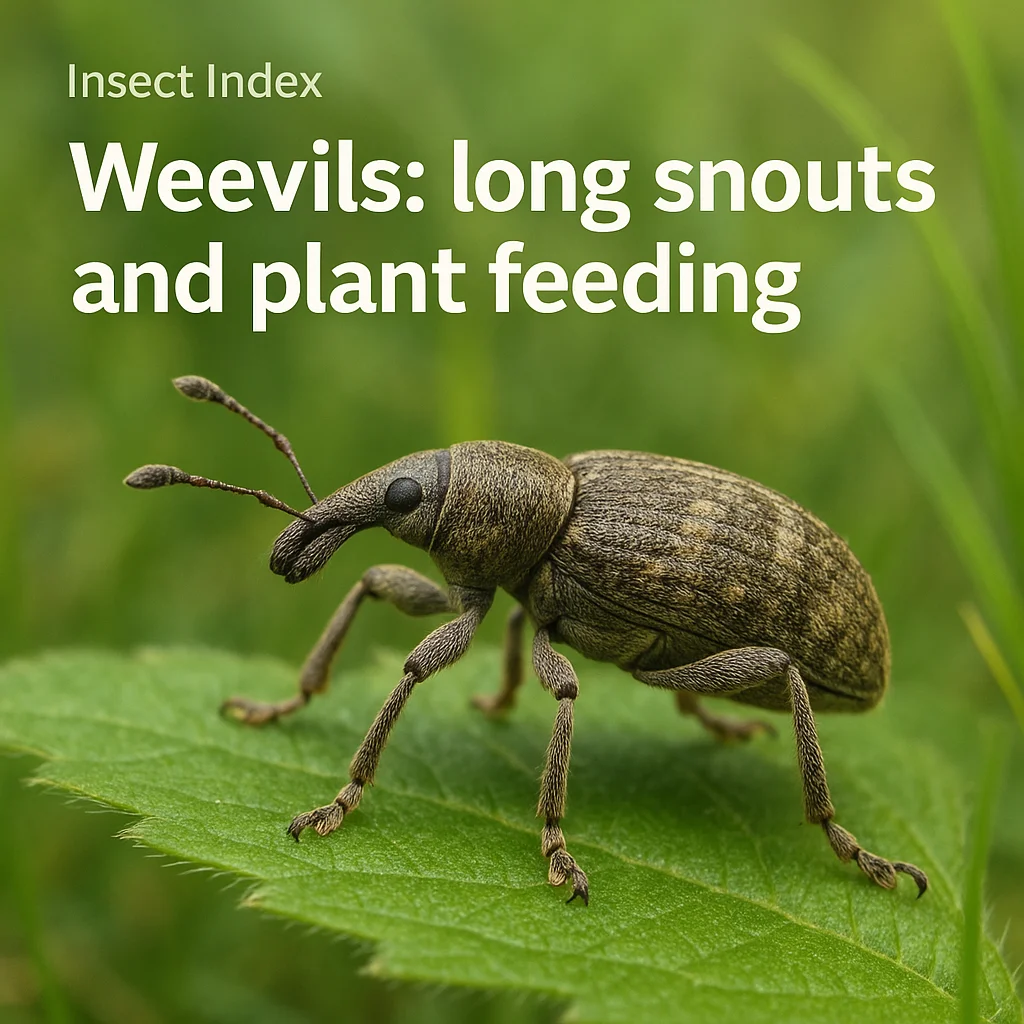
To recognize weevils in the field, look for their unique body shape and features. Weevils are known for their long, curved snouts which they use to feed and lay eggs.
- Body Shape: Compact with a distinct, elongated snout
- Antennae Type: Usually elbowed and often retract back into grooves in the snout
- Wing Features: Hard elytra covering membranous wings, capable flyers
- Leg Traits: Typically short and stout, aiding in digging
- Distinguishing Look-alikes: Other beetle families, but the snout is a key differentiator
- Top ID Tips:
- Look for the characteristic snout
- Note their compact size and silhouette
- Observe the elbowed antennae
- Check for hard elytra on top of the wings
- Identify color patterns—often drab to help in camouflage
- Found mostly on plant surfaces or in soil
🧠 Basic Body Structure
Weevils, like all insects, have a segmented body divided into the head, thorax, and abdomen. They possess six legs and an exoskeleton which they molt as they grow. Weevils are invertebrates, meaning they lack a backbone and instead have a supporting exoskeleton. Their wings, when present, are hidden beneath their hardened elytra.
🌍 Habitat & Distribution
Weevils thrive in a variety of environments. They are especially prevalent in areas with abundant plant life, such as forests, grasslands, gardens, and agricultural fields. Within these environments, they can be found in microhabitats including under leaves, inside seeds, and within the bark of trees. Weevils have a nearly worldwide distribution, though they are less common in extreme polar or desert conditions. Climate and seasonal changes, like rainfall, can alter their appearance in these habitats.
📅 Seasonal Appearance & Activity
Weevils are most commonly observed during the warmer months when their food sources are abundant. They are generally seen in the spring and summer, but exact timing can vary based on location.
- Best Time to Spot It:
- Spring and early summer
- During daylight hours
- After rain or in humid conditions
- Near host plants or crops
🥚 Reproduction & Egg-Laying
Weevils have varied mating behaviors and strategies depending on the species. Typically, females will lay eggs within a food source such as plant tissues, ensuring larvae have immediate access to nourishment. Egg counts can vary significantly, with some species laying hundreds over their lifetime. The precise egg-laying method and preference for host plants differ among weevil species.
🌀 Metamorphosis & Life Cycle
Weevils undergo complete metamorphosis, transitioning through the stages of egg, larva, pupa, and adult.
During the larval stage, which takes place within a food source like seeds or plant stems, weevils consume voraciously until they reach the pupation phase. The larval stage can last several weeks to months. The pupation stage occurs in a protected environment, such as within soil or burrowed into woody tissue.
After development, adult weevils emerge and continue the cycle of feeding and reproducing. The lifespan of a weevil varies, but it typically spans from several months to over a year, contingent on the species and environmental conditions.
🍽️ Diet & Feeding Behavior
Weevils primarily feed on plant matter. As larvae, they often consume their food sources from the inside, targeting seeds, stems, and roots. Adult weevils are equipped with snouts adapted for chewing, which they use to bore into plants to feed. They serve as significant herbivores in their ecosystems, impacting both wild plants and cultivated crops.
🦉 Predators & Defense
Weevils face predation from a variety of animals including birds, spiders, and parasitoid wasps. To defend themselves, many weevil species rely on camouflage, blending in with their surroundings using their drab coloration. Some weevils also have hardened bodies that make them difficult to consume.
- Defense Highlights:
- Camouflage through color and pattern
- Hard exoskeleton protection
- Burrowing into plant material
- Remaining still to avoid detection
👥 Social Behavior & Swarms
Most weevils are solitary, living independently except during mating. They do not typically form swarms, though some species may be observed in large numbers when food sources are plentiful or during certain agricultural infestations.
🧭 Senses & Communication
Weevils utilize a range of sensory mechanisms for survival. They have eyes adapted for detecting movement and antennae capable of sensing pheromones for communication. Chemical signaling is crucial for mating and locating food.
While not known for sound communication, some species can produce vibrations or tapping sounds, which may serve to ward off predators or signal to mates.
🌱 Role in the Ecosystem
Weevils play a vital role as herbivores within their ecosystems, helping control plant populations. They also serve as prey for various predators, making them integral to the food web. In agriculture, they are considered pests due to their potential to damage crops. However, in natural settings, they can promote biodiversity by dispersing seeds and promoting plant growth dynamics.
📉 Population & Conservation Notes
Weevil populations vary globally, often reported as common in suitable habitats. While many weevil species face no significant threat, habitat loss and pesticide use can impact certain populations negatively. Conservation efforts focus on promoting sustainable agricultural practices and habitat preservation.
- How to Help (Low-Impact):
- Grow native plants
- Practice organic gardening
- Preserve natural habitat features like leaf litter
- Avoid using harmful pesticides
⚠️ Human Interaction & Safety
While weevils do not bite or sting humans, their presence can be an indicator of crop or stored food infestation. If weevils are found in environments where they are unwanted, physical removal and habitat management are recommended over chemical controls. Always observe insects respectfully, avoiding unnecessary harm or collection of wild specimens.
📌 Summary
- Recognizable by their distinct snout and small size
- Commonly found in habitats rich in plant life
- Most visible during spring and summer in daytime
- Undergo complete metamorphosis with significant larval stage impact
- Diverse plant-based diet with potential agricultural impact
- Predators include birds and spiders; rely on camouflage for defense
- Play crucial roles as herbivores and prey in their ecosystems
- Impacted by habitat change; conservation through sustainable practices advised