🕷️ Longhorn Beetle Larvae Why They Bore Into Wood
🧾 Quick Facts
Longhorn beetle larvae, belonging to the family Cerambycidae, are known for their wood-boring behavior. These larvae play a crucial role in the decomposition of dead and dying trees by feeding on the internal wood tissues. Here are some quick facts to introduce these fascinating creatures:
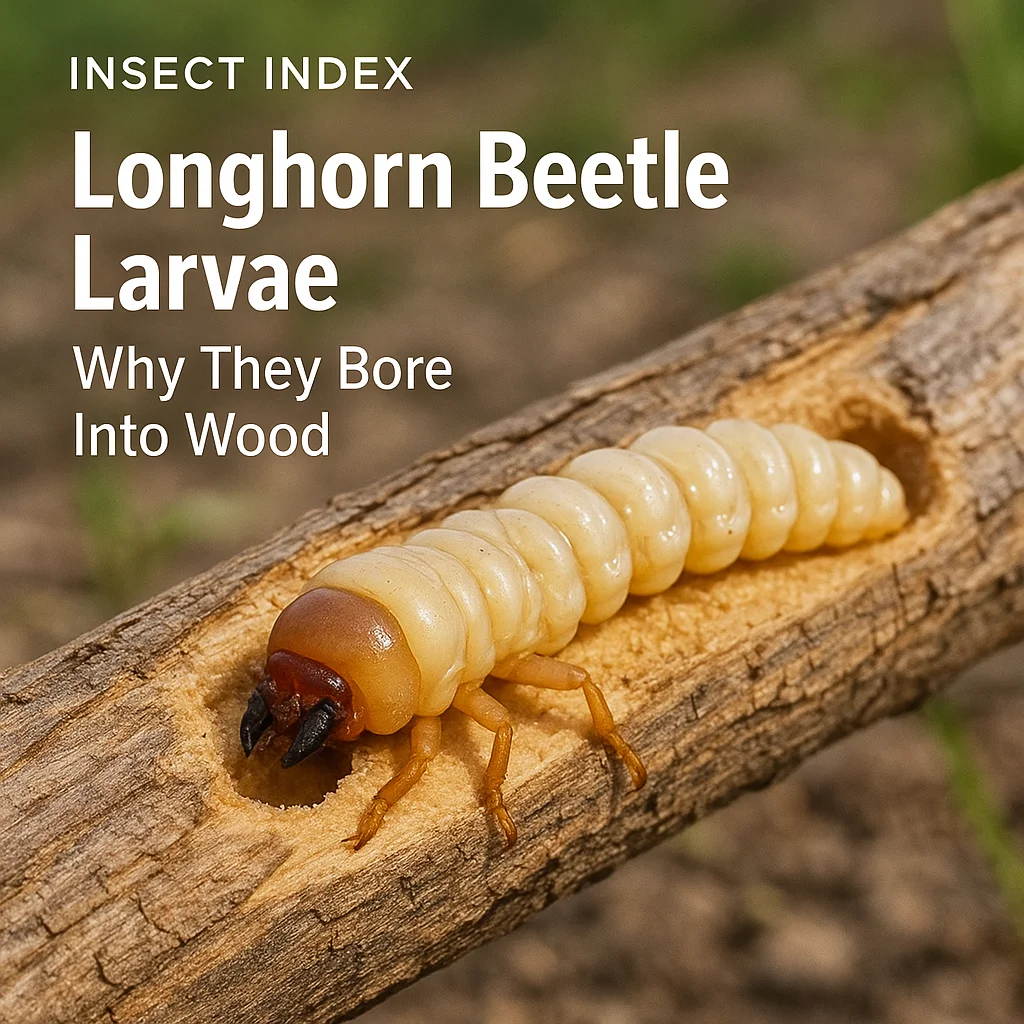
- Common names: Longhorn beetle, round-headed borer
- Scientific name: Varies
- Insect or not: Yes, they are insects (invertebrates)
- Order / family: Coleoptera / Cerambycidae
- Typical size range: Adults range from 5 to 160 mm in length
- Key colors/patterns: Varies; often elongated, cylindrical bodies with long antennae
- Activity: Mostly nocturnal
- Typical habitats: Forests, woodlands, gardens with ample woody plants
- Where in the world it occurs: Found worldwide, except in extreme polar regions
- Seasonality: Adults are typically most visible in late spring and summer
🔍 Identification
Longhorn beetle larvae are distinguished by their elongated, segmented bodies and capability to bore into wood. Recognizing these beetles in the field mainly involves identifying the adults:
- Body shape and silhouette: Long, cylindrical bodies with distinct heads.
- Antennae type: Extremely long relative to body length, evident in adults.
- Wing features: Adults possess hardened forewings (elytra) covering membranous flight wings.
- Leg traits and movement style: Six legs in adults, adapted for walking on wood surfaces.
- Distinguishing look-alikes: Often confused with closely related wood-boring beetles but can be identified by their elongated antennae.
- Top ID Tips:
- Look for elongated, cylindrical bodies.
- Identify extremely long antennae.
- Check for wood-boring holes in logs and trees.
- Notice the presence around decaying wood.
- Recognize nocturnal activity patterns.
🧠 Basic Body Structure
Longhorn beetles, as insects, have a fundamental body structure that includes a head, thorax, and abdomen, along with six legs and two pairs of wings (in adults). They possess an exoskeleton, which provides protection and support. The larvae do not have wings and are primarily characterized by their tubular, soft bodies adapted for boring into wood. They are invertebrates, meaning they lack a vertebral column.
🌍 Habitat & Distribution
Longhorn beetle larvae thrive in environments where wood is abundant, such as forests, wooded areas, and gardens with woody plants. They typically inhabit dead or dying trees, logs, and even man-made wooden structures.
Their geographic range includes almost every continent, thriving in varying climates except very cold regions. Habitat changes like deforestation or urbanization influence their presence, as they require woody habitats to support their life cycle.
📅 Seasonal Appearance & Activity
The most likely time to observe adult longhorn beetles is during their active months of late spring through summer. Their nocturnal nature means that they are primarily active during the night, particularly in warm, moist conditions. Weather plays a significant role, as dry and hot conditions might limit their activity.
- Best Time to Spot It:
- Late spring and summer months
- Warm, moist weather conditions
- Evening and nighttime hours
- After rain, when they tend to emerge
🥚 Reproduction & Egg-Laying
Longhorn beetles engage in various mating behaviors depending on the species, including use of pheromones to attract mates. The females lay eggs in or on wood surfaces, ensuring that the larvae have ample food once they hatch. Egg counts can vary widely depending on the species, from a few dozen to several hundred.
🌀 Metamorphosis & Life Cycle
Longhorn beetles undergo a complete metamorphosis, which includes the stages of egg, larva, pupa, and adult. Each stage plays a significant role in their development:
In the larval stage, they specialize in boring into wood where they consume the tissue, which can last from several months to several years, depending on conditions and species. Pupal development occurs within the wood, where they metamorphose into adults.
Adults generally emerge from wood to reproduce and continue the cycle, typically living weeks to a few months.
🍽️ Diet & Feeding Behavior
The feeding behavior of longhorn beetles is primarily herbivorous, with larvae feeding on the inner tissues of wood. They possess strong mandibles to chew through wood, enabling them to digest dense plant material. Their role as decomposers is crucial, as they break down dead and dying trees in forest ecosystems.
🦉 Predators & Defense
Longhorn beetles have several natural enemies, including birds, reptiles, amphibians, spiders, and parasitic wasps. Their primary defense mechanisms include:
- Defense Highlights:
- Camouflage with wood coloration
- Mimicry of more dangerous insects
- Startle displays of opening wings
- Hiding within wood to avoid predators
👥 Social Behavior & Swarms
Longhorn beetles are generally solitary, with interactions occurring mainly during mating. They do not form swarms or group living arrangements, and territorial behavior is not well-documented, varying by species.
🧭 Senses & Communication
Longhorn beetles primarily rely on their sense of smell, utilizing pheromones for communication during reproduction. Their vision is adapted to low-light conditions, aiding in nocturnal activities, while their antennae are sensitive to touch and chemical signals.
🌱 Role in the Ecosystem
Longhorn beetles play a substantial role in ecosystems as decomposers. By breaking down wood, they contribute to nutrient cycling and soil health. Additionally, they serve as an important food source for various predators. Although some species may impact forestry or infest wooden structures, they are overall beneficial to ecological balance.
📉 Population & Conservation Notes
Longhorn beetle populations vary locally, with some species considered common while others are rare or declining due to habitat loss and pollution. Conservation efforts can include habitat preservation and responsible pest management without harmful chemicals.
- How to Help (Low-Impact):
- Plant native trees and shrubs
- Avoid using broad-spectrum pesticides
- Keep woodlands and deadwood in landscapes
- Promote biodiversity by having varied plant species
⚠️ Human Interaction & Safety
Longhorn beetles generally do not bite or sting humans and pose no direct harm. Their presence inside homes should be managed with respect, avoiding unnecessary harm to these creatures. If longhorn beetle damage is suspected, consider consulting a pest control professional. Treat any accidental bites as minor injuries: wash the area, avoid scratching, and seek professional advice if there is a severe reaction.
📌 Summary
- Longhorn beetles are identified by their elongated bodies and long antennae.
- They inhabit forests and woody environments worldwide, except in extreme cold regions.
- Most active during warmer months, predominantly at night.
- Undergo complete metamorphosis involving a wood-boring larval stage.
- Feed primarily on wood, aiding in decomposition and nutrient cycling.
- Predators include birds and parasitic wasps, with several natural defenses like camouflage.
- Play a crucial role in the ecosystem as decomposers and prey.
- Populations are generally stable but affected by habitat change and pollution.
- Respectful observation is encouraged, with minimal human impact on their habitats.