🕷️ Ladybugs (Coccinellidae): aphid hunters explained
🧾 Quick Facts
Ladybugs, known for their vibrant colors and beneficial role in agriculture, primarily belong to the family Coccinellidae. They are iconic beetles recognized in many cultures worldwide, often celebrated as symbols of good luck.
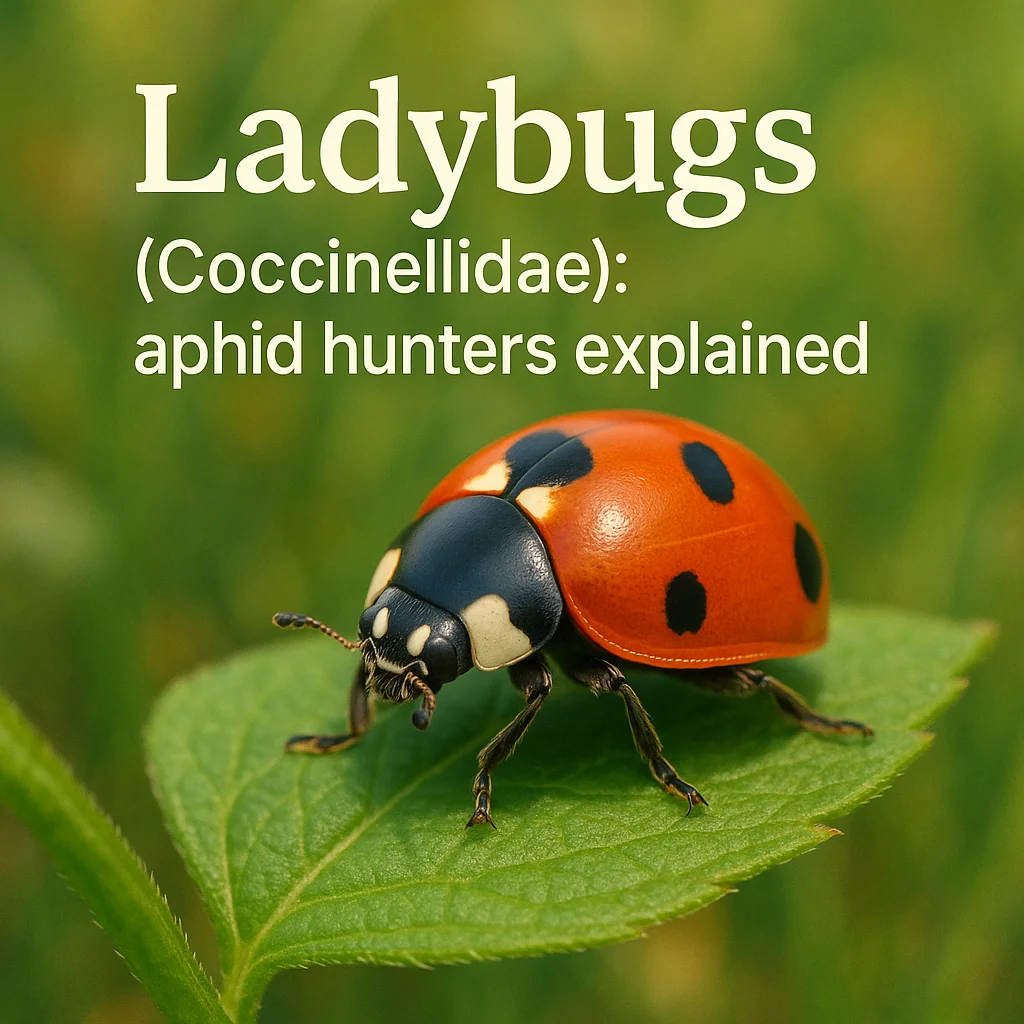
- Common Names: Ladybugs, Ladybirds, Ladybird Beetles
- Scientific Name: Varies (Family: Coccinellidae)
- Insect or not: Insect
- Order / Family: Coleoptera / Coccinellidae
- Typical Size Range: 1 to 10 millimeters in length
- Key Colors/Patterns: Red, orange, yellow with black spots; some entirely black or other color variations
- Activity: Primarily diurnal (active during the day)
- Typical Habitats: Gardens, fields, forests, grasslands
- Where in the World: Found on all continents except Antarctica
- Seasonality: Most visible in spring and summer; some species overwinter as adults
🔍 Identification
Ladybugs are easily identified by their distinctive rounded bodies and vibrant colors. They have a convex, dome-shaped back which gives them a distinctive silhouette. Their antennae are short, aiding in sensation rather than grabbing food. Their wings, often concealed by their colorful wing covers, enable short bursts of flight.
Ladybugs have three pairs of legs that are relatively short and well-suited for crawling and gripping onto plants. Misidentification often arises with other beetles that mimic ladybug coloration, a form of protective mimicry.
- Rounded, dome-shaped back
- Vibrant coloration with spots (typically black on red/yellow/orange background)
- Short antennae
- Hidden wings under colorful elytra
- Characteristic crawling movement
- Potential confusion with other beetle species
🧠 Basic Body Structure
As true insects, ladybugs exhibit a tripartite body structure composed of the head, thorax, and abdomen. They possess six legs, characteristic of all insects, and are covered with a tough exoskeleton that requires molting for growth. Ladybugs have hardened forewings (elytra) that protect the membranous hindwings used for flying. They are invertebrates, meaning they lack a backbone and rely on their exoskeleton for support and protection.
🌍 Habitat & Distribution
Ladybugs thrive in diverse habitats ranging from urban gardens to wild forests, wherever their food sources, mainly aphids and other soft-bodied insects, are abundant. They are highly adaptive and can be found on every continent except Antarctica. Within each habitat, they can be spotted amidst foliage, often under leaves or on flower heads. Changes in habitat due to urbanization can affect local populations and sighting frequencies.
📅 Seasonal Appearance & Activity
Ladybugs are predominantly active in the warmer months, typically spring through summer, when their prey is plentiful. While all are diurnal, their activity periods can be influenced by ambient weather conditions. Warm, sunny days are particularly conducive to higher activity levels.
- Mid-spring through late summer
- Warm, sunny days increase sightings
- Mostly seen during daylight hours
- Activity may decrease on cooler or overcast days
🥚 Reproduction & Egg-Laying
Ladybugs engage in courtship that involves visual and pheromonal signals. Females lay clusters of eggs often on the underside of leaves where aphids congregate, offering immediate food for emerging larvae. Egg counts can vary significantly depending on the species and environmental conditions.
🌀 Metamorphosis & Life Cycle
Ladybugs undergo complete metamorphosis, transitioning through four distinct life stages: egg, larva, pupa, and adult.
The egg stage lasts about 3 to 7 days depending on temperature. Larvae, resembling tiny alligators with elongated bodies, emerge to feed voraciously on aphids for about two to three weeks. Pupation follows, lasting around one week, during which the insect undergoes significant transformation. The adult emerges fully formed and begins the cycle anew.
🍽️ Diet & Feeding Behavior
At all life stages, ladybugs primarily feed on soft-bodied insects, with aphids being a primary food source. Their mouthparts are adapted for chewing, enabling them to consume a substantial number of prey each day. As carnivorous predators, they play a vital role in controlling pest populations, making them beneficial in agricultural contexts.
🦉 Predators & Defense
Natural enemies of ladybugs include birds, parasitic wasps, spiders, and certain types of mammals. They employ various defense mechanisms, such as their contrasting coloration which serves as a warning (aposematism) to potential predators. Ladybugs can also exude a yellow, foul-smelling fluid from their leg joints to deter attackers.
- Bright colors deter predators (aposematism)
- Foul-smelling defensive secretion
- Armor-like exoskeleton for protection
- Ability to fly away quickly
👥 Social Behavior & Swarms
Ladybugs are generally solitary creatures but can congregate in large numbers for overwintering. This aggregation behavior is triggered by environmental cues such as temperature drops and reduced daylight. These swarms provide collective warmth and protection during cold months.
🧭 Senses & Communication
Ladybugs have well-developed senses that assist in navigation and hunting. Their compound eyes detect movement and light, while their antennae are sensitive to chemical cues and tactile information. Communication often involves pheromones, especially during mating or when forming aggregations.
🌱 Role in the Ecosystem
Ecologically, ladybugs are hailed as allies to farmers and gardeners due to their appetite for aphids and other pests, thus assisting in natural pest control. They occupy a crucial place in the food web, serving as prey to larger animals while controlling insect populations, aiding the health of plant communities.
📉 Population & Conservation Notes
Ladybug populations are generally stable, yet some species face threats from habitat destruction, pesticide use, and climate change. Strategies to support their populations include creating biodiverse gardens and reducing chemical pesticide use, both of which help maintain ecological balance.
- Plant native species to provide habitats
- Avoid pesticide use where possible
- Maintain leaf litter and garden debris for shelter
- Create beetle banks and hedgerows
⚠️ Human Interaction & Safety
Ladybugs do not bite or sting humans, and interactions are generally harmless. If threatened, they might exude a fluid that can stain skin or fabric but is not harmful. Observing ladybugs in nature should be done respectfully to minimize disturbance to their populations.
📌 Summary
- Ladybugs are easily recognized by their round, spotted bodies.
- They inhabit a wide range of environments and are most active in warmer months.
- Ladybugs undergo complete metamorphosis from egg to adult.
- They are beneficial predators, primarily feeding on aphids.
- Ladybugs face predation from birds and other animals.
- They help control pest populations, enhancing ecosystem health.
- Conservation efforts include planting native flora and reducing pesticide use.
- They are safe to observe and pose no threat to humans.