🕷️ Jewel beetles: metallic colors explained
🧾 Quick Facts
Jewel beetles, known for their dazzling metallic colors, represent a family of beetles (Buprestidae) widely distributed across the globe. Understanding these shimmering insects can enrich knowledge of both natural artistry and ecological significance.
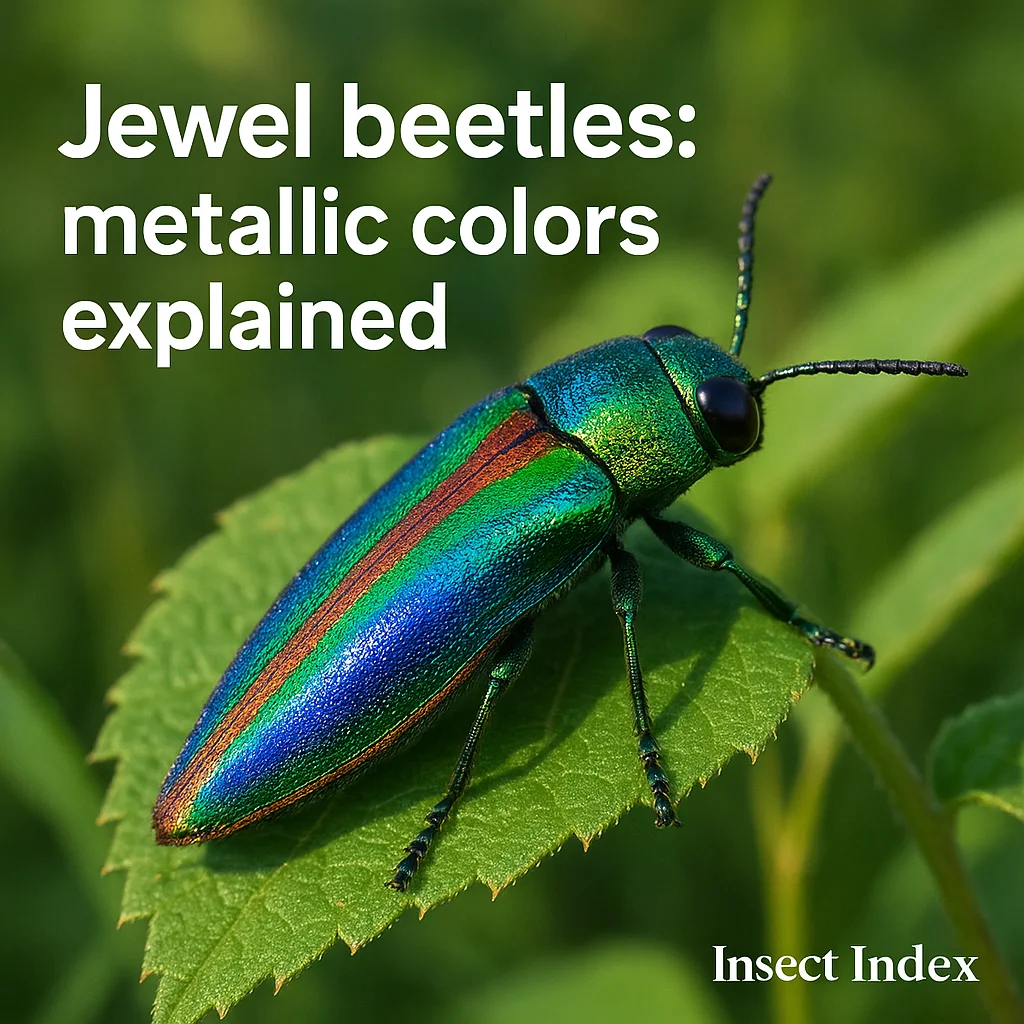
- Common names: Jewel beetles, Metallic wood-boring beetles
- Scientific name: Family Buprestidae (genus and species vary)
- Insect or not: Yes, they are insects and invertebrates
- Order / family: Coleoptera / Buprestidae
- Typical size range: 3 mm to 100 mm in length (varies)
- Key colors/patterns: Metallic greens, blues, reds, and golds; intricate patterns
- Activity: Mainly diurnal
- Typical habitats: Forests, woodlands, grasslands, urban gardens
- Where in the world: Globally, more abundant in tropical and temperate regions
- Seasonality: Primarily visible in warmer months; varies by climate zone
🔍 Identification
Jewel beetles are recognized by their elongated bodies and vibrant metallic coloration, which can include hues of green, blue, red, and gold. Their bodies are typically glossy and hard, giving them a jewel-like appearance. These beetles have serrated antennae and well-developed legs adapted for rapid movement.
Their wings are usually tough and protect soft, membranous hind wings used for flying. Some species can be mistaken for other metallic beetles, but careful observation of shape and color patterns aids in accurate identification.
- Top ID Tips:
- Elongated, narrow body shape
- Entire insect visible in a full-body image
- Bright metallic coloration
- Serrated antennae
- Well-defined patterns on elytra (wing covers)
- Sit low when walking due to legs
- Found on trees during the day
🧠 Basic Body Structure
Jewel beetles, like other insects, are composed of three main body segments: head, thorax, and abdomen. They possess six legs and a pair of compound eyes. Their exoskeleton, critical for protection and rigidity, is what grants jewel beetles their remarkable reflective colors.
These beetles also undergo a process called molting to grow. As invertebrates, they lack an internal skeleton but have a hard outer shell that provides their frame structure.
🌍 Habitat & Distribution
Jewel beetles thrive in various environments, predominantly in forests, woodlands, grasslands, and occasionally urban gardens. They often inhabit areas rich in trees and are frequently found under bark or in decaying wood.
Geographically, jewel beetles are present on every continent except Antarctica. They prefer areas with temperate to tropical climates. Changes in forest or tree health can drastically influence their population visibility.
📅 Seasonal Appearance & Activity
The most active period for jewel beetles is during the warmer months, where they are diurnal, appearing in the early parts of the day when the sun highlights their metallic radiance. Their activity is sensitive to weather changes, typically less visible during cooler temperatures or heavy rains.
- Best Time to Spot It:
- During sunny, warm days
- Early to mid-summer is optimal
- In daylight hours on tree trunks or leaves
- After rain, when they are attracted to moisture
🥚 Reproduction & Egg-Laying
Jewel beetles engage in a reproductive process where males often seek females through visual cues and chemical signals. Females lay eggs on host plants or near suitable wood surfaces. The choice of oviposition varies widely, depending on tree species present in the area.
Egg counts can vary significantly, often depending on the species and environmental conditions, but generally, females lay several dozen eggs.
🌀 Metamorphosis & Life Cycle
Jewel beetles undergo complete metamorphosis, comprising four stages: egg, larva, pupa, and adult. This cycle allows them to occupy different ecological niches at each stage.
The larval stage feeds on wood or plant material, constructing tunnels as they grow. This stage can last several months to years, particularly in cooler climates. Pupation occurs within wood, and the adult emerges, typically living for several months, focusing on reproduction and dispersal.
🍽️ Diet & Feeding Behavior
The diet of jewel beetles varies across life stages. Larvae are wood-borers, consuming the inner bark and sapwood of trees. Adults predominantly feed on pollen or foliage, becoming crucial pollinators for some plant species.
Their feeding apparatus consists of chewing mouthparts, enabling them to grasp and process plant material efficiently.
🦉 Predators & Defense
Jewel beetles face numerous predators, including birds, reptiles, amphibians, and small mammals. To defend themselves, they utilize their metallic coloring as camouflage, blending with the shiny surfaces of leaves or bark.
- Defense Highlights:
- Reflective camouflage to blend with sunlight
- Hard exoskeleton as physical armor
- Rapid flight to escape threats
- Remaining still on surfaces to avoid detection
👥 Social Behavior & Swarms
Jewel beetles are primarily solitary insects, with interactions mainly occurring during mating. They do not form swarms, but clusters may appear due to local food abundance or suitable conditions.
🧭 Senses & Communication
Vision is critical for jewel beetles, aiding them in mate selection and locating appropriate host plants. They also use olfactory cues to navigate their environment, detecting pheromones emitted by potential mates or host trees.
Some species may produce sounds, albeit rarely, using stridulation as a means to attract partners or deter rivals.
🌱 Role in the Ecosystem
Ecologically, jewel beetles contribute to nutrient cycling through the breakdown of dead wood and are important pollinators in specific ecosystems. They provide sustenance for higher trophic levels such as birds and mammals.
While they can become pests if they infest timber or structures, their overall presence in nature is beneficial for maintaining ecological balance.
📉 Population & Conservation Notes
While many jewel beetle species are common, habitat destruction, climate change, and the use of pesticides negatively impact their populations. Conservation efforts focus on preserving natural habitats and minimizing pollution.
- How to Help (Low-Impact):
- Plant native species preferred by local beetles
- Avoid using chemical pesticides
- Preserve dead trees and logs in natural areas
- Minimize light pollution in natural habitats
⚠️ Human Interaction & Safety
Jewel beetles do not pose significant danger to humans. They do not bite or sting, and their presence is considered safe. As a general precaution, it is advised to wash any contact area with water and avoid scratching if irritation occurs, seeking professional advice for severe reactions.
Observation should be respectful, and capturing or collecting wild specimens is discouraged to promote conservation.
📌 Summary
- ID: Metallic, elongate body; full-body beetle in images
- Habitat: Woodlands, gardens; microhabitats under bark
- Seasonality: Warm months, diurnal activity
- Life cycle: Complete metamorphosis
- Diet: Larvae on wood, adults on pollen and foliage
- Predators: Birds, reptiles; defenses include camouflage
- Ecology: Role in pollination, nutrient cycling
- Human notes: Non-threatening, conservation-friendly practices encouraged