🕷️ Ground beetles: night predators in gardens
🧾 Quick Facts
Ground beetles are prominent nocturnal predators that play a crucial role in controlling pests in gardens and natural ecosystems. They are part of the diverse family of beetles known for their adaptability and predatory habits.
- Common names: Ground beetles
- Scientific name: Varies
- Insect or not: Insect (invertebrate)
- Order / family: Coleoptera / Carabidae
- Typical size range: 5-35 mm (0.2-1.4 inches)
- Key colors/patterns: Black or brown, often with metallic or iridescent sheen
- Activity: Nocturnal
- Typical habitats: Gardens, forests, fields, and urban areas
- Where in the world: Found globally, especially in temperate regions
- Seasonality: Spring to late autumn (varies by region)
🔍 Identification
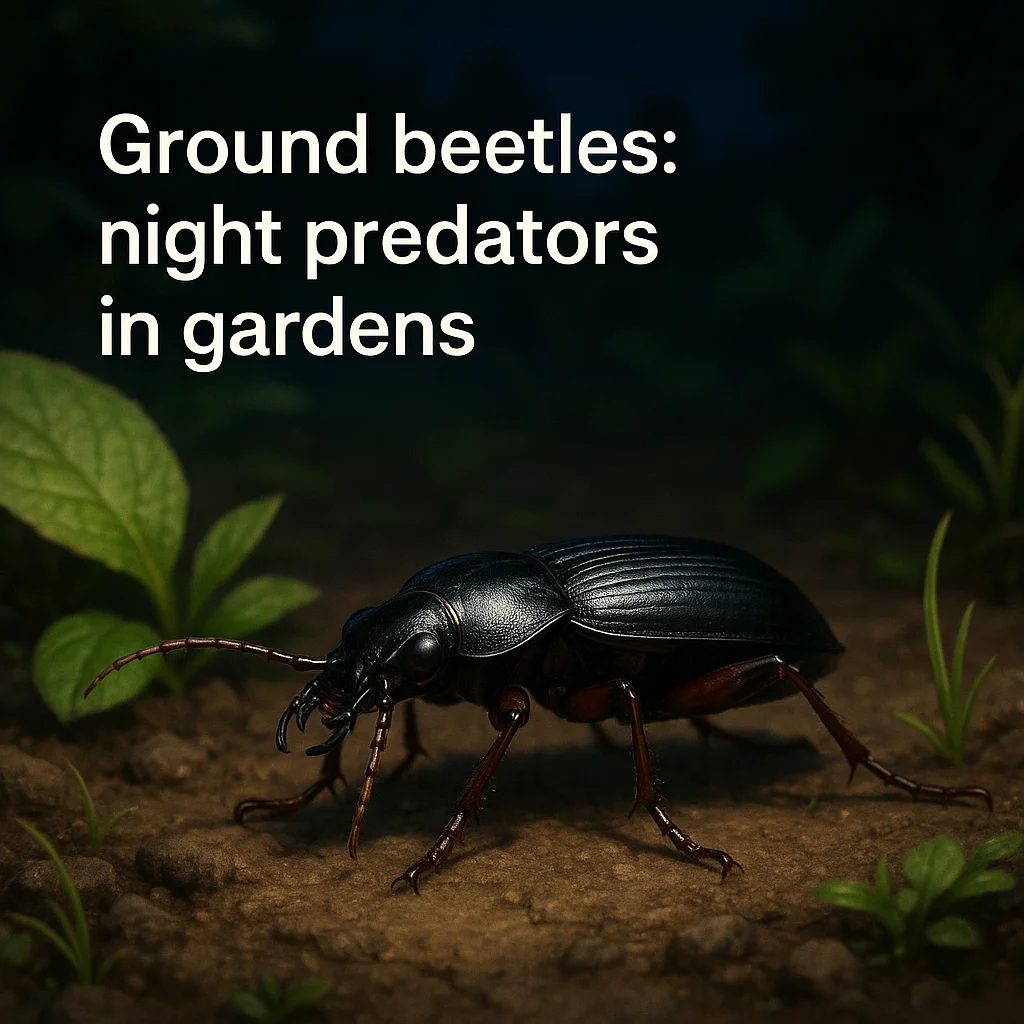
Ground beetles exhibit distinct physical characteristics allowing for easy identification. They have elongated, flattened bodies that help them squeeze into tight spaces. Typically, their antennae are long and thread-like, aiding in their nocturnal navigation. Although ground beetles are winged, many species are flightless or seldom fly. Their strong legs enable rapid movement across the ground, vital for hunting prey.
Due to their size and coloration, they can be confused with other beetles such as Darkling beetles. However, the shape and texture of their elytra (wing covers) and the protruding jaws used for predation are distinguishable features.
- Sleek, elongated body
- Long, filamentous antennae
- Hard, ridged wing covers
- Black or dark brown with occasional metallic sheen
- Rapid ground movement
- Visible, sometimes prominent jaws
🧠 Basic Body Structure
As insects, ground beetles have a tripartite body consisting of a head, thorax, and abdomen. They boast a robust exoskeleton that offers protection and structural support. Like other insects, ground beetles have six legs, which are adapted for fast, efficient movement. The presence of an exoskeleton necessitates periodic molting to allow for growth. Despite possessing wings, ground beetles often have adapted to life on the ground and are considered predominantly flightless.
The ground beetle is an invertebrate, meaning it lacks an internal skeleton or spine, a common characteristic of all insects.
🌍 Habitat & Distribution
Ground beetles prefer a variety of habitats, thriving in moist and sheltered environments such as gardens, forests, and fields. They are also common in urban areas, where they benefit from the abundance of food sources. Microhabitats under rocks, leaf litter, and logs offer them ideal conditions to hide from predators and hunt for prey.
They are found on every continent except Antarctica, flourishing particularly in temperate climates. Changes in habitat, such as increased urbanization, can influence their abundance and distribution, making garden conservation efforts important for their persistence.
📅 Seasonal Appearance & Activity
Ground beetles are generally most active from spring to late autumn, with their presence peaking during summer when temperatures are moderate. As nocturnal creatures, they emerge after dusk to hunt, relying on cooler temperatures and the cover of darkness to aid in their predatory activities. Weather conditions such as heavy rain may see a decrease in their surface activity as they seek shelter.
- Spring through autumn
- Active in the cooler evening hours
- Decreased visibility during prolonged rain
- Found during leaf turnover in gardens
🥚 Reproduction & Egg-Laying
Mating among ground beetles involves direct contact and is often preceded by the male using his mandibles in a gentle grasp of the female. The specific courtship behaviors can vary by species and region.
Females lay their eggs in moist soil, ensuring the protection and suitable humidity needed for the developing larvae. The number of eggs can vary significantly, reflecting the beetle's adaptability to different environmental pressures.
🌀 Metamorphosis & Life Cycle
Ground beetles undergo complete metamorphosis which includes four stages: egg, larva, pupa, and adult. This transformation allows them to exploit different ecological niches and reduce intraspecific food competition.
As voracious consumers, larvae feed on a variety of insects and are found in the soil, where they remain hidden while hunting. The larval stage can last several weeks to months, depending on the species and environmental conditions.
The pupal stage marks a period of dramatic transformation within a protective casing, subsequently leading to the emergence of an adult beetle. Adults generally live from several months up to a year, continuing the cycle by preying on pests and contributing to ecosystem balance.
🍽️ Diet & Feeding Behavior
At all life stages, ground beetles are predominately carnivorous. They employ their strong mandibles to catch and consume other invertebrates such as caterpillars, slugs, and insect larvae, making them beneficial for natural pest control in gardens and farms. While adults usually hunt at night, larvae are equally effective predators within the soil.
Their mouthparts are adapted for chewing, allowing them to easily process prey items and fulfill their ecological role as efficient pest managers.
🦉 Predators & Defense
Ground beetles face predation from birds, mammals, reptiles, and other arthropods such as spiders and ants. Their primary defense is a hard exoskeleton, which provides some protection against predators. Additionally, many can release noxious chemicals from glands as a deterrent to would-be predators.
Some species also exhibit cryptic coloration, blending into their surroundings to avoid detection.
- Hard exoskeleton for protection
- Noxious chemical secretions
- Camouflage with natural habitat
- Swift ground retreat
👥 Social Behavior & Swarms
Ground beetles are primarily solitary, focusing on individual hunting and foraging. Territory is loosely defined by the availability of food sources. During certain conditions such as abundant prey availability, they may appear aggregated, but true social interaction is limited. Their interactions are often dominated by brief encounters during mating.
🧭 Senses & Communication
Ground beetles rely on an array of senses to navigate their environment. Their acute sense of smell, utilizing specialized appendages, helps them locate prey and potential mates through chemical cues. They also use tactile sensations to detect vibrations and navigate across the terrain.
While sound and visual communication are less developed, chemical signals play a significant role in marking territory and finding mates, facilitated by pheromonal communication.
🌱 Role in the Ecosystem
Ground beetles are vital components of terrestrial ecosystems, contributing to natural pest control by preying on harmful agricultural pests, thus reducing the need for chemical interventions. They participate in the decomposition process, aiding in nutrient cycling by breaking down organic matter.
Their interactions with plants and animals can foster mutualistic relationships, although their primary impact is through predation and pest management.
📉 Population & Conservation Notes
Ground beetles are generally considered common within their suitable habitats, with local abundance varying based on environmental conditions and human impact. However, factors such as habitat destruction, pesticide use, and climate change can adversely affect their populations.
- Plant native flora to support diverse ecosystems
- Reduce pesticide use in gardens and farms
- Leave leaf litter and natural debris
- Promote sustainable agricultural practices
⚠️ Human Interaction & Safety
Ground beetles are not harmful to humans and do not sting. They may bite if mishandled, but this is not typically dangerous. It's important to treat ground beetles with respect and observe them without capturing or disturbing their habitat. If bitten, clean the area with soap and water and avoid scratching. Seek professional medical advice if a severe reaction occurs.
📌 Summary
- Ground beetles are nocturnal predators with an elongated body and strong jaws.
- Commonly found in gardens and forests worldwide, particularly in temperate areas.
- Active from spring to autumn; most visible during mild weather.
- Undergo complete metamorphosis, supporting diverse ecological roles at each stage.
- Primarily feed on pests, supporting natural pest control in ecosystems.
- They face predation from larger birds, mammals, and arthropods.
- Play critical roles in pest management and nutrient cycling.
- Respectful observation helps maintain their role without compromising safety.