🕷️ Glow-worms Explained Not Worms But Beetle Larvae
🧾 Quick Facts
Glow-worms, often mistaken for worms, are fascinating luminescent creatures that are, in fact, the larvae of certain types of beetles. They belong to the family Lampyridae, which includes fireflies, and are known for their bioluminescent abilities. Each glow-worm species has its unique characteristics, often varying based on geographic location.
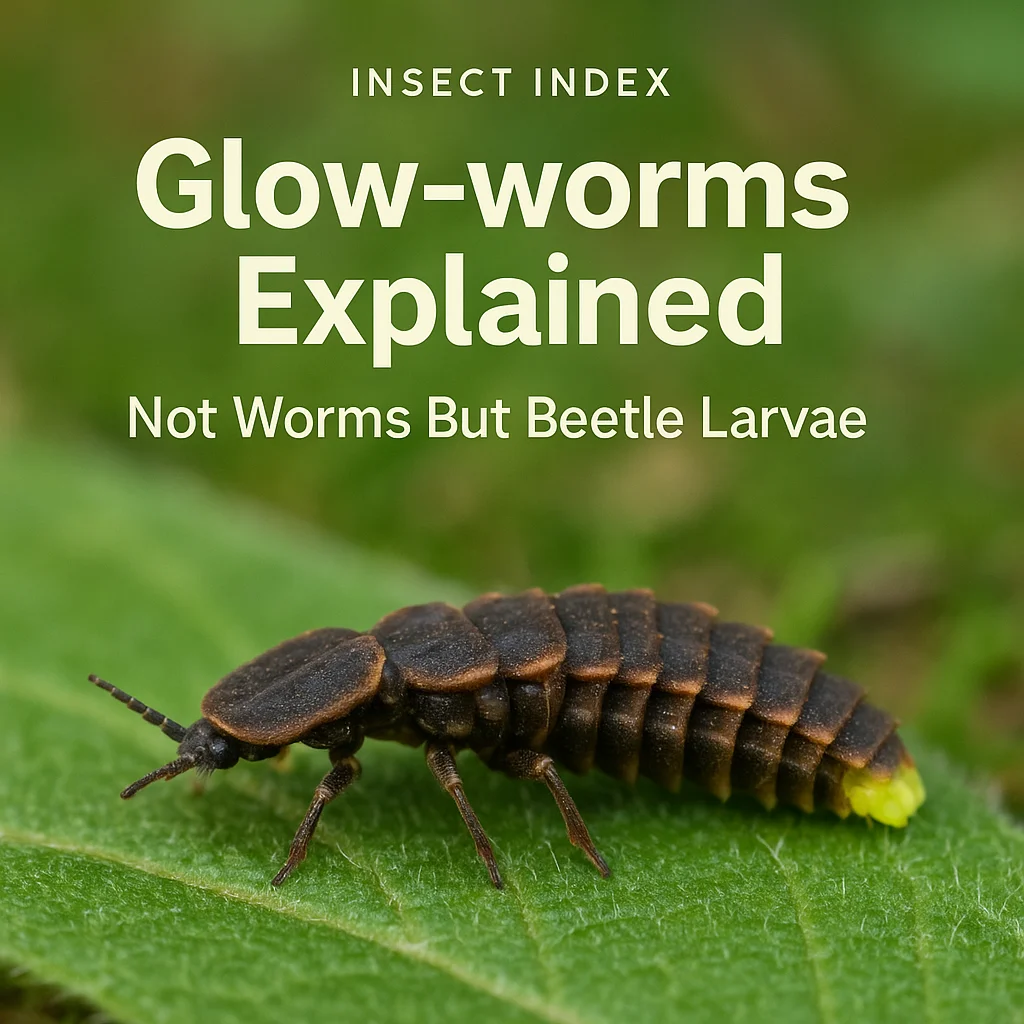
- Common names: Glow-worm, Firefly Larvae
- Scientific name: Varies by species, commonly Lampyris noctiluca in Europe
- Insect or not: Yes, they are invertebrates
- Order / family: Coleoptera / Lampyridae
- Typical size range: 10-25 mm as larvae
- Key colors/patterns: Generally brown with a yellow or greenish glow
- Activity: Nocturnal
- Typical habitats: Forest floors, grasslands, gardens
- Where in the world it occurs: Europe, Asia, parts of North America
- Seasonality: Most visible from late spring to early autumn
🔍 Identification
Identifying glow-worms in their natural habitat requires an understanding of their distinct larval appearance. They have elongated, segmented bodies with a soft and flexible exterior, often appearing flattened. The antennae are short and sensitive, while wings are not present during the larval stage. Their movement is slow and measured, helping them to stalk prey unnoticed. Glow-worms are often confused with other beetle larvae due to their soft bodies and color, but their glow is distinct, especially in low-light conditions.
- Elongated, segmented body
- No visible wings in larvae
- Short antennae
- Brownish color with subtle stripes
- Distinct bioluminescence
- Slow-moving, often found under rocks and leaves
- Nocturnal visibility due to glowing
🧠 Basic Body Structure
As insects, glow-worms have the three fundamental body parts: head, thorax, and abdomen. They possess six legs, typical of all insects, and an exoskeleton that provides protection and support. Due to being invertebrates, glow-worms lack a backbone. Their glow comes from specialized chemical reactions in certain cells, and they undergo molting as they grow, eventually transitioning to their beetle form.
🌍 Habitat & Distribution
Glow-worms prefer various habitats that offer shelter and abundant food sources, usually moist and shaded areas like forest floors, hedgerows, and gardens. These environments often provide the ideal conditions for their prey, mainly small snails and other soft-bodied invertebrates. In Europe and parts of Asia, glow-worms are common, thriving in temperate climates, while their population might be more localized in North America. Habitat changes, such as urban expansion and deforestation, can significantly impact their distribution.
📅 Seasonal Appearance & Activity
The seasonal visibility of glow-worms is highly dependent on their geographical location. Generally, they are most active and visible from late spring through to early autumn. These months offer the optimal temperature and humidity levels for their survival and mating activities. Glow-worms are nocturnal and can often be seen glowing during warm, damp nights, especially after rain.
- Late spring to early autumn visibility
- Best seen at night
- Humidity enhances glow visibility
- Active on warm, damp evenings
🥚 Reproduction & Egg-Laying
Glow-worms exhibit unique mating behaviors; males are usually attracted to females by their glow. Female glow-worms use their light to signal readiness to mate, attracting flying males. After mating, females lay their eggs in damp soil or under rocks. The number of eggs laid can vary greatly, typically ranging from dozens to over a hundred, depending on the species and environmental conditions.
🌀 Metamorphosis & Life Cycle
Glow-worms undergo complete metamorphosis, transitioning through the stages of egg, larva, pupa, and adult beetle. Larvae primarily feed on snails, using special enzymes to digest their prey. They live in leaf litter or soil and can remain in the larval stage for up to two years, depending on environmental factors. Pupation occurs in the soil, with the adult emerging in warmer months. Adults live primarily to reproduce and do not feed extensively compared to their larval stage.
🍽️ Diet & Feeding Behavior
As larvae, glow-worms are voracious predators of small mollusks like snails, which they subdue with a secretion that pre-digests their prey. They possess chewing mouthparts, which are effective in breaking down soft tissues. Adults, however, consume little to nothing, focusing mainly on reproduction and dispersal.
🦉 Predators & Defense
Glow-worms face numerous threats from predators like birds, amphibians, and small mammals, which find them an easy meal due to their slow movement. To deter predation, their bioluminescence can act as a warning signal, a tactic known as aposematism. Additionally, their ability to blend with the leaf litter serves as camouflage, reducing visibility to predators.
- Bioluminescence as a warning
- Camouflage in natural environment
- Defensive chemicals in some species
- Hiding under rocks and leaves
👥 Social Behavior & Swarms
Glow-worms are generally solitary creatures, coming together only for mating purposes. They do not form colonies or swarms. The temporary grouping during mating is driven by the male's attraction to the female's light signal rather than social cooperation or communication.
🧭 Senses & Communication
Glow-worms primarily rely on their vision to detect subtle light signals during the night. Their glow acts as a communication tool, facilitating mating interactions. While they do not rely heavily on pheromones or sound, the visual communication through their bioluminescence is crucial for reproductive success.
🌱 Role in the Ecosystem
Glow-worms play an essential role in maintaining the ecological balance, primarily through their predatory feeding habits as larvae, which help control snail populations. They contribute to the nutrient cycle by breaking down snail masses, aiding decomposition. Additionally, they serve as prey for various animals, fitting into the broader food web.
📉 Population & Conservation Notes
Globally, glow-worm populations are stable in many regions but face local declines due to habitat destruction, light pollution, and pesticide use. Conservation efforts focus on habitat preservation and promoting dark sky initiatives to reduce light pollution, which can disrupt their mating signals. Public awareness and participation in such initiatives can help conserve these enchanting creatures.
- Encourage native plantings
- Reduce artificial lighting
- Avoid pesticides
- Maintain natural garden structures
⚠️ Human Interaction & Safety
Glow-worms are harmless to humans and do not bite or sting. Their presence is often appreciated for the enchanting display they offer. When observing these creatures, it is essential to respect their habitats and avoid disturbing them, as even minimal interference can disrupt their delicate life cycle. Responsible observation is encouraged and can be a remarkable way to enjoy their natural bioluminescence.
📌 Summary
- Glow-worms are beetle larvae, not worms.
- Identified by their segmented, glowing bodies.
- Found in moist, sheltered environments.
- Visible primarily at night during warmer months.
- Complete life cycle: egg, larva, pupa, adult.
- Larvae are predators of small mollusks.
- Chemical luminescence acts as a defense.
- Important in controlling snail populations.
- Threatened by habitat loss and light pollution.
- Safe for humans, promoting respectful observation.