🕷️ Darkling Beetles Desert Survivors And The ‘stink' Defense
🧾 Quick Facts
Darkling beetles are a fascinating group of insects, known for their resilience in arid environments and their unique defensive strategies. Below are some quick facts about these extraordinary creatures.
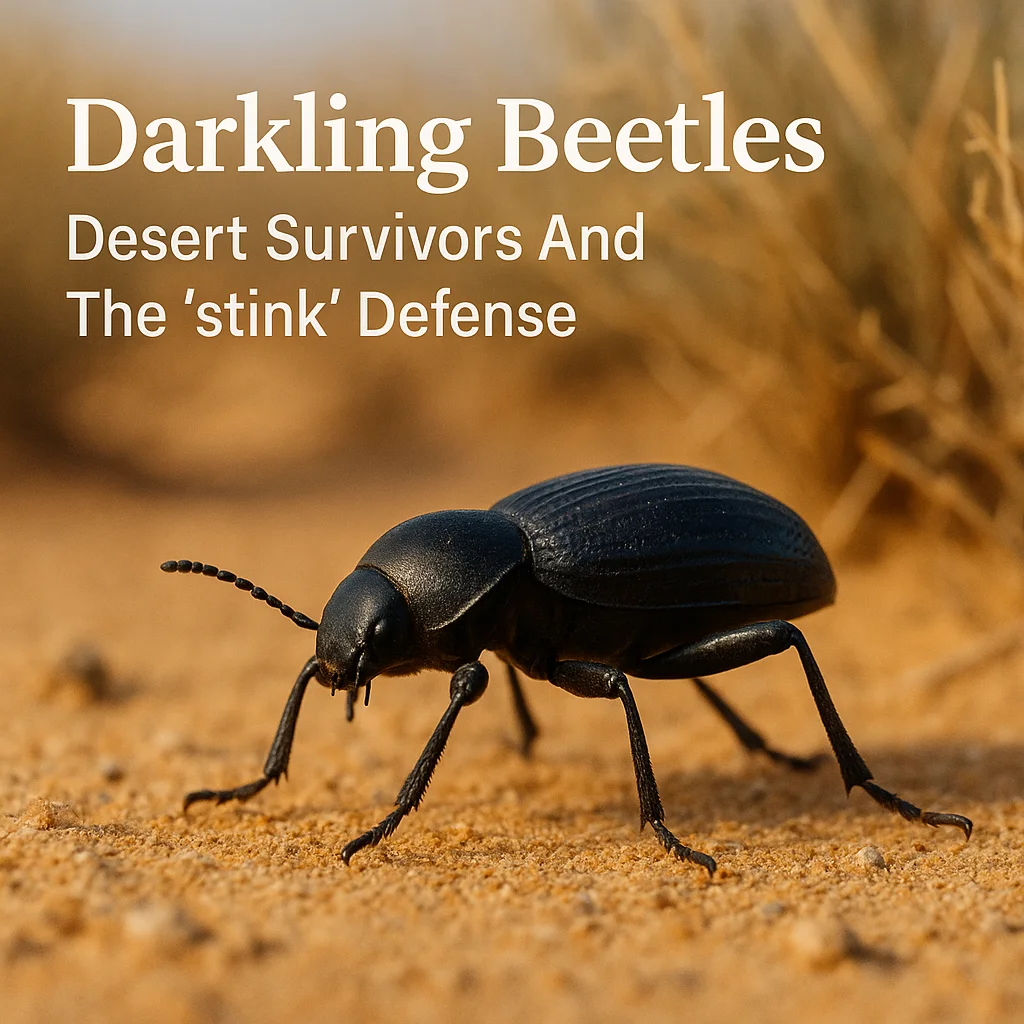
- Common names: Darkling beetles, Stink beetles
- Scientific name: Varies (multiple genera within the family Tenebrionidae)
- Insect or not: Yes, these are insects and, like all insects, they are invertebrates.
- Order/family: Coleoptera/Tenebrionidae
- Typical size range: 1–4 cm in length
- Key colors/patterns: Typically black or dark brown, sometimes with dull metallic sheens
- Activity: Primarily nocturnal
- Typical habitats: Deserts, arid regions, and sometimes woodlands
- Where in the world it occurs: Global, but predominantly in desert ecosystems
- Seasonality: Can be observed throughout the year in desert climates, visibly active during milder temperatures
🔍 Identification
Recognizing darkling beetles in the field can be an engaging task for nature enthusiasts. These beetles generally have a robust, somewhat elongated body shape. Their antennae are usually short and club-shaped, helping to distinguish them from other beetles. While many beetles have a distinct pair of wings, darkling beetles often have fused elytra (wing covers), giving them a hardened appearance. Their legs are adapted for moving across sandy dunes and rocky terrain.
Some beetles, like blister beetles, might look similar, but darkling beetles are less colorful and have smoother bodies.
- Top ID Tips:
- Look for a matte finish on the body with little to no shine
- Check for clubbed, short antennae
- Observe the lack of colorful patterns
- Notice their slow, deliberate movement style
- Observe their preference for ground habitats over plants
🧠 Basic Body Structure
Darkling beetles, like all insects, are composed of three main body segments: the head, thorax, and abdomen. The head houses sensory organs, including antennae and compound eyes. The thorax bears three pairs of legs, totaling six legs, a characteristic feature of insects. These beetles, being invertebrates, possess an exoskeleton—a rigid outer shell providing protection and support. The elytra are typically fused, which prevents them from flying but provides added body armor.
🌍 Habitat & Distribution
Darkling beetles predominantly inhabit deserts and arid regions across continents, including North America, Africa, and Australia. Their microhabitats include sandy dunes, under rocks, and within leaf litter where they can find shade and moisture. Adaptable to versatile climates, darkling beetles are less frequently seen in environments that are too humid or cold, preferring dry, warm conditions.
📅 Seasonal Appearance & Activity
While darkling beetles can be found year-round in desert regions, they are most visibly active during cooler parts of the day, such as early morning or late afternoon. Nighttime often sees increased movement as they take advantage of lower temperatures. Their activity can also spike after rainfall, when the ground is moist and food sources become more abundant.
- Best Time to Spot It:
- Early morning or late afternoon in deserts
- After rainfall periods in arid regions
- During mild weather conditions
- Under the cover of night
🥚 Reproduction & Egg-Laying
Mating behavior among darkling beetles involves specific courtship rituals, although details can vary by species. Eggs are typically laid in the soil or beneath debris. The number of eggs a female lays can differ, but a common strategy is to produce a large clutch to ensure some survive to maturity despite harsh conditions.
🌀 Metamorphosis & Life Cycle
Darkling beetles undergo complete metamorphosis, progressing through four distinct stages: egg, larva, pupa, and adult. The larval stage, often called mealworms in some species, is primarily a period of growth and development as they feed voraciously on organic material within their habitat. Pupation occurs in a concealed location, with the beetles emerging as adults ready to reproduce and contribute to the ecosystem.
Stage durations vary; larvae might occupy this stage for several months depending upon environmental conditions, while pupation is generally shorter.
🍽️ Diet & Feeding Behavior
As omnivorous scavengers, darkling beetles consume a range of organic materials, including decaying plant matter, fungi, and dead insects. The larval stage, commonly known as mealworms, feeds similarly, processing organic debris in the ecosystem. They possess chewing mouthparts, which aid them in breaking down tough plant material.
🦉 Predators & Defense
Darkling beetles face threats from a variety of predators, including birds, reptiles, and arachnids. Their unique defensive strategy includes emitting a pungent chemical substance when threatened; this stink serves to deter potential predators. Their hardened exoskeleton also provides a physical barrier against attackers.
- Defense Highlights:
- Pungent chemical defense to repel predators
- Camouflaged, dark coloration for blending with the environment
- Hardened exoskeleton for protection
- Sheltering behavior to avoid predation
👥 Social Behavior & Swarms
Darkling beetles are generally solitary creatures. They do not form swarms or large colonies. However, they might congregate in favorable habitats where food and shelter are plentiful, yet these gatherings are more opportunistic than structured social behavior.
🧭 Senses & Communication
Darkling beetles rely heavily on their sense of smell to locate food and recognize mates. They use chemical signals known as pheromones for communication, especially during the mating season. Their vision is adapted to low-light conditions, allowing them to navigate effectively at night.
🌱 Role in the Ecosystem
Darkling beetles play a vital role in their ecosystems by breaking down decomposing organic matter, enriching the soil, and contributing to nutrient cycling. They are part of the food web, serving as prey for various predators and helping control populations of other small insects through their scavenging.
📉 Population & Conservation Notes
Darkling beetles are generally common in suitable habitats, though data on specific populations may be limited. They are resilient to many environmental changes but are still affected by habitat loss and pesticide use. Conservation efforts can focus on preserving their natural habitats and reducing chemical impacts on their ecosystems.
- How to Help (Low-Impact):
- Preserve natural leaf litter in gardens
- Minimize use of pesticides in farming practices
- Support conservation of desert environments
- Plant native vegetation to encourage diverse insect life
⚠️ Human Interaction & Safety
Darkling beetles do not bite or sting humans, making them safe to observe in their natural habitat. If handling, a faint odor might be emitted as a defensive measure. It's always best to observe these beetles without disturbing their surroundings and avoid collecting or removing them from the wild.
📌 Summary
- Darkling beetles are resilient desert insects with a unique chemical defense.
- They inhabit arid regions across the globe, often camouflaged in their environment.
- These beetles are primarily nocturnal and active during mild temperatures.
- Complete metamorphosis characterizes their life cycle, including a well-known larval stage.
- As scavengers, they play a crucial role in decomposing organic matter.
- Their natural enemies include birds and reptiles, but their chemical defenses offer protection.
- They are solitary with opportunistic congregations rather than structured societies.
- Through food web interactions, they contribute significantly to ecological balance.
- Population data is sparse, but they are common where habitats remain intact.
- Humans interact safely with darkling beetles; observation over collection is recommended.