🕷️ Click beetles: the “snap” mechanism explained
🧾 Quick Facts
Click beetles, known for their distinctive flipping motion, belong to a diverse family of beetles found worldwide. This mechanism is not only a fascinating display of their agility but also serves as an effective escape tactic. Here's a quick overview of these intriguing insects:
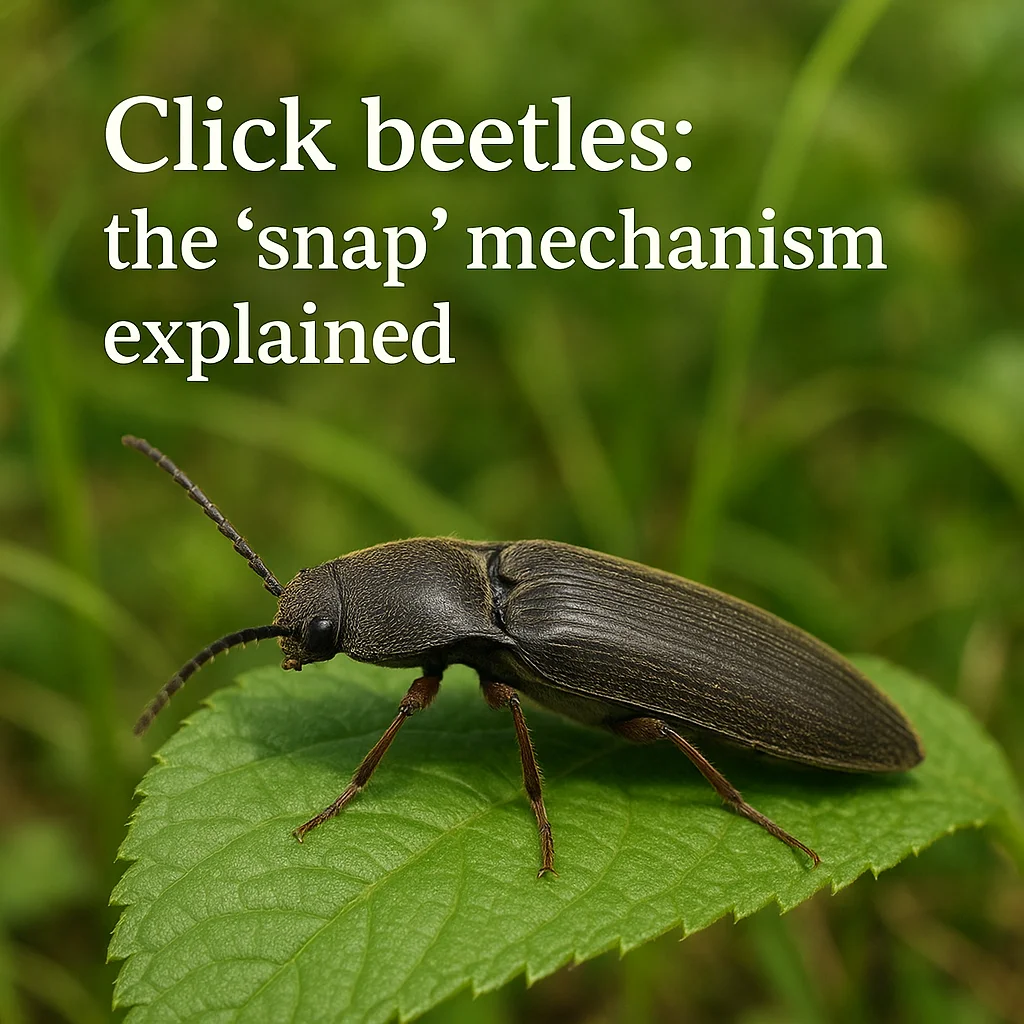
- Common names: Click beetles
- Scientific name: Varies, primarily family Elateridae
- Insect: Yes, they are invertebrates
- Order/Family: Coleoptera/Elateridae
- Typical size range (adult): 5-20 mm in length
- Key colors/patterns: Dull brown to black, some species with bright markings
- Activity: Mostly nocturnal
- Typical habitats: Woodlands, grasslands, gardens
- Where in the world it occurs: Found globally
- Seasonality: Most visible during spring and summer
🔍 Identification
Identifying click beetles can be a straightforward task once familiar with their unique body structure and behavior.
- Body shape and silhouette: Elongated and cylindrical, the body tapers at both ends.
- Antennae type: Usually filiform (thread-like) and straight.
- Wing features: They possess hardened forewings called elytra that protect their membranous hindwings used in flight.
- Leg traits and movement style: Click beetles have relatively short legs and are capable of sudden flips due to the "click" mechanism.
- Distinguishing look-alikes: May be confused with certain other beetles. Their click mechanism is a key distinguishing feature.
- Top ID Tips:
- Elongated body shape
- Thread-like antennae
- Brown or black coloration
- Ability to flip with a click sound
- Visible in gardens and forests
- Nocturnal activity
🧠 Basic Body Structure
Click beetles exhibit fundamental insect anatomy. Their bodies are divided into three main segments: the head, thorax, and abdomen. They have six legs, typical of insects, and possess an exoskeleton, which is a hard covering that provides protection and support. As insects, they are invertebrate animals, meaning they lack a backbone. The hard elytra protect their delicate flight wings. During their development, they undergo molting, shedding their outer layer as they grow.
🌍 Habitat & Distribution
Click beetles are highly adaptable and can be found in a wide range of environments. They are commonly seen in woodlands, grasslands, gardens, and even in urban areas. They often inhabit microhabitats such as under bark, within leaf litter, and occasionally within cultivated crops. Their distribution is truly global, thriving in diverse climatic zones from tropical to temperate regions. Changes in habitats, such as deforestation and urbanization, can impact their local populations and visibility.
📅 Seasonal Appearance & Activity
The best time to observe click beetles is during the spring and summer months, aligning with their active adult phase. Being primarily nocturnal, they are more active during the night. However, they may be less active during cold spells or extreme heat, preferring moderate weather conditions. Rain can also influence their visibility, as they often seek shelter from heavy precipitation.
- Best Time to Spot It:
- Spring and early summer
- At night
- After moderate rain
- During mild, warm evenings
🥚 Reproduction & Egg-Laying
Reproduction in click beetles involves a detailed courtship process, often initiated by pheromones. Males use chemical signals to locate receptive females. Once mating occurs, females typically lay eggs within soil or decaying wood, ensuring the larvae have immediate access to nourishment. The number of eggs laid can vary greatly among species, reflecting their adaptive strategies to maximize survival.
🌀 Metamorphosis & Life Cycle
Click beetles undergo complete metamorphosis, which consists of four stages: egg, larva, pupa, and adult. The larvae, commonly known as wireworms, primarily consume plant roots and other organic material. They live within the soil or decaying logs for several months, sometimes years, before pupating. This stage is critical as they develop into adults. Pupation can last a few weeks, after which adults emerge, ready to repeat the life cycle.
🍽️ Diet & Feeding Behavior
As wireworms, the larval stage of click beetles, they primarily act as herbivores, feeding on roots of grasses and crops. This diet can sometimes make them a pest in agricultural settings. Adults, conversely, have a varied diet and may feed on nectar, pollen, or small insects. Their mouthparts are designed for chewing, which allows versatility in their dietary choices across different life stages.
🦉 Predators & Defense
Natural predators of click beetles include birds, reptiles, amphibians, and other predatory insects. To defend themselves, click beetles employ several strategies. Their primary defense is the startle display known as the "click" mechanism, which propels them into the air, away from predators. Additionally, their dull colors offer camouflage among leaf litter and soil, making them less conspicuous to enemies.
- Defense Highlights:
- Sudden "click" escape mechanism
- Camouflage coloration
- Hard exoskeleton
- Quick hiding ability
👥 Social Behavior & Swarms
Click beetles are generally solitary insects, with interactions largely limited to mating. They do not form swarms or colonies, unlike some social insects. Encounter between individuals typically occurs for reproductive purposes, triggered by pheromonal cues released to attract mates. Their solitary nature means they establish no permanent social structures or cooperative behaviors.
🧭 Senses & Communication
Click beetles rely heavily on their olfactory senses, using pheromones for communication, especially during mating rituals. Their vision is adapted to low-light conditions, aiding their nocturnal lifestyle. Touch and vibration play minor roles, primarily for environmental interactions. Sound production is not a significant communication channel, although their clicking noise can act as an unintended signal during escape attempts.
🌱 Role in the Ecosystem
Click beetles hold ecological importance, primarily as decomposers and part of the food web. Larvae contribute to the breakdown of organic matter in soil ecosystems. While larvae can sometimes damage crops, they also aerate the soil, benefiting plant health. Adults contribute to the pollination of some plants and serve as prey for various animals, supporting broader biodiversity.
📉 Population & Conservation Notes
Click beetles are often reported as common in suitable habitats. However, like many insects, they face threats from habitat loss, pesticide use, and climate change. Understanding local abundance is challenging, as it varies greatly depending on habitat conditions and geographical area. While not generally considered endangered, their presence is essential for ecological balance.
- How to Help (Low-Impact):
- Encourage native plant growth
- Avoid pesticide use in gardens
- Preserve leaf litter and natural habitats
- Support ecological farming practices
⚠️ Human Interaction & Safety
Click beetles are generally harmless to humans and do not sting or bite. If handled, they may use their click mechanism as an escape response, posing no injury risk. Encouraging their natural presence in gardens can aid in maintaining balanced ecosystems. As always, observing wildlife respectfully and avoiding unnecessary disturbance is crucial.
📌 Summary
- Recognizable by their elongated bodies and clicking mechanism
- Commonly found in woodlands and gardens across the globe
- Primarily active at night during warmer months
- Complete metamorphosis lifecycle with distinct larval and adult stages
- Diet consists of plant roots, nectar, and small insects
- Predators include birds and reptiles, but defense is strong with "click" mechanism
- Solitary behavior, primarily interacting for reproduction
- Vital role in decomposing organic matter and providing food for other species
- Common in suitable habitats but affected by environmental changes
- Poses no significant risk to human safety and should be observed respectfully