🕷️ Potter Wasps Tiny Clay Pots For Larvae
🧾 Quick Facts
The group of wasps known as potter wasps, or solitary vespid wasps, uniquely construct small clay pots to house their larvae. The name "Potter Wasps Tiny Clay Pots For Larvae" refers to their distinctive nest-making behavior, not a single species but a variety of species within this category.
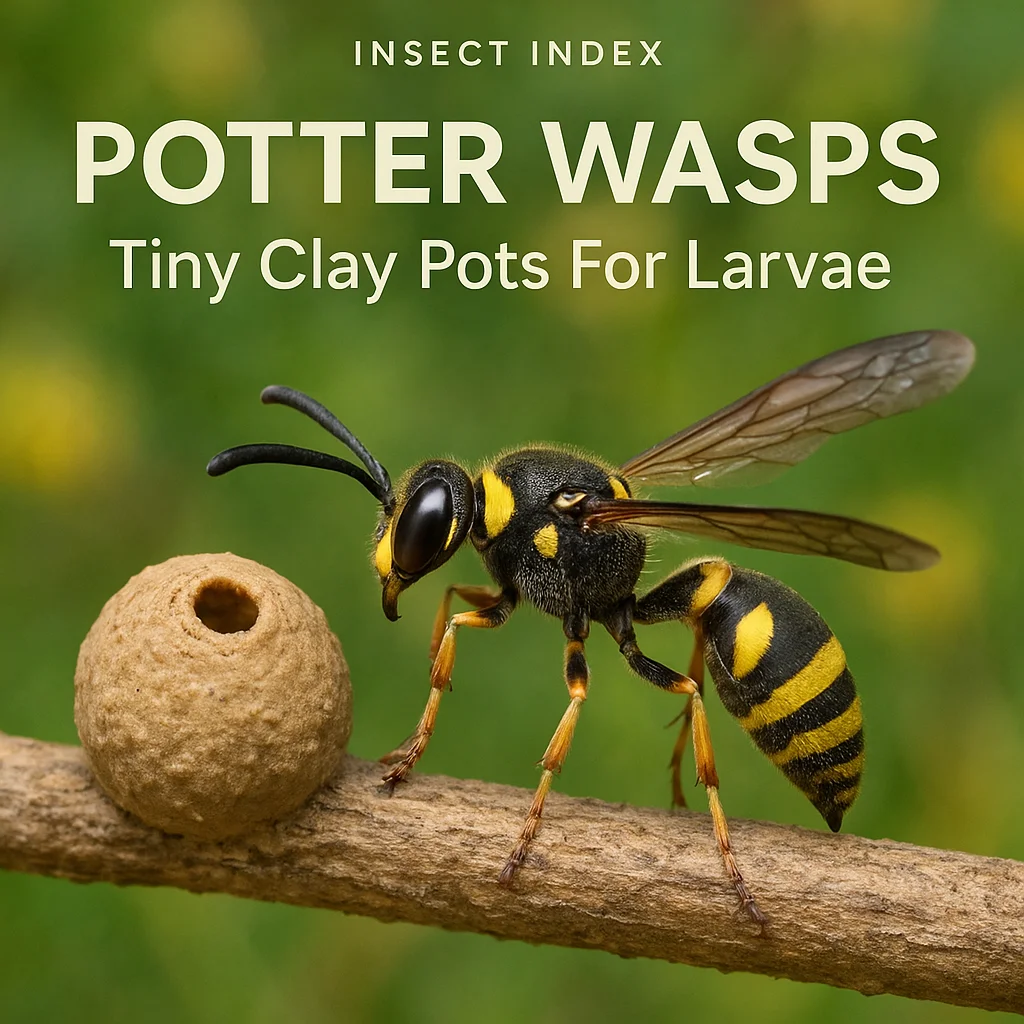
- Common names: Potter Wasps, Mason Wasps
- Scientific name: Varies across species
- Insect or not: Yes, they are insects
- Order / family: Hymenoptera / Eumeninae
- Typical size range: 10-20 mm in length (adult)
- Key colors/patterns: Varies, often black or dark with bright bands or markings
- Activity: Day (diurnal)
- Typical habitats: Gardens, woodlands, meadows, rocky areas
- Where in the world it occurs: Globally, in temperate and some tropical regions
- Seasonality: Most visible in spring and summer
🔍 Identification
Potter wasps can be identified by their unique construction of pot-like nests. They typically have a slender body with a pronounced waist and a smooth, shiny exoskeleton. Antennae are straight and fairly long, aiding in navigation and communication. Their wings fold longitudinally at rest and are transparent or slightly tinted.
Movement is deliberate and direct, often hovering near flowers or walls where they construct their nests. Potter wasps may be confused with other wasps, such as mud daubers, which also build solitary nests but with a different structure.
- Top ID Tips:
- Look for small, clay pot nests on walls and foliage
- Slender and shiny appearance with a visibly narrow waist
- Straight antennae
- Wings folded along the length of the body at rest
- Distinctive solitary behavior
- Often seen in gardens near flowers or building materials
- Presence of colorful or metallic markings
- Observe the careful and purposeful flight pattern
🧠 Basic Body Structure
Like all insects, potter wasps have three main body sections: the head, thorax, and abdomen. They possess six legs and typically two pairs of wings. Their exoskeleton serves as a protective armor, which they periodically shed during molting as they grow. As invertebrates, they lack a vertebral column.
Their head houses sensory organs such as compound eyes and antennae, aiding in detecting environmental cues. Legs are adapted for grasping while building their clay nests.
🌍 Habitat & Distribution
Potter wasps are frequently found in a variety of open and semi-open landscapes. They prefer habitats that provide adequate materials for their nest-building, such as gardens with clay-rich soil, rocky outcrops, and wooded edges. Some are even adapted to urban environments where they utilize building materials for nest construction.
These wasps are distributed across temperate and subtropical regions of the world, thriving in climates where flowers provide nectar and materials for nest building are abundant. Changes in land use and habitat fragmentation can impact their distribution and visibility.
📅 Seasonal Appearance & Activity
Potter wasps are primarily active and visible during the warmer months, particularly in spring and summer. They are diurnal, actively foraging and constructing nests during daylight hours. Their activity can be influenced by weather, with warm, dry conditions often resulting in increased visibility.
- Best Time to Spot It:
- Spring and summer months
- Warm and sunny days
- Midday, when temperatures are highest
- Dry conditions with minimal wind
- When flowers are in bloom
- Near clay-rich soil or suitable building materials
🥚 Reproduction & Egg-Laying
Potter wasps have intricate mating rituals where males may court females with aerial displays or by showcasing nest-building skills. Females select suitable mates and engage in territory establishment after mating.
Eggs are laid within the carefully constructed clay pots. Each pot contains a single egg accompanied by provisions of paralyzed prey (typically small caterpillars or larvae) for the emerging larva. The precise number of eggs per season can vary by species and environmental conditions.
🌀 Metamorphosis & Life Cycle
These wasps undergo complete metamorphosis, encompassing the egg, larva, pupa, and adult stages. The larva, upon hatching, consumes the prey left by the mother. This development takes place within the protective confines of the pot, ensuring shelter from the external environment.
The larval stage is fundamentally a period focused on growth, and once fully developed, the wasp enters the pupal stage before emerging as an adult. Most potter wasps complete their life cycle within one season, although the duration of each stage can vary widely.
🍽️ Diet & Feeding Behavior
Adult potter wasps primarily feed on nectar from flowers, serving as occasional pollinators. Their larvae, however, are carnivorous, provisioned by the female with paralyzed insects or spiders stored within the clay pots.
Feeding adaptations include a suite of mouthparts designed for nectar feeding. These wasps play dual roles as pollinators and pest controllers, maintaining ecological balance.
🦉 Predators & Defense
Potter wasps have predators including birds, frogs, spiders, and larger predatory insects. Defense mechanisms are subtle yet effective, involving camouflage and startle displays to avoid predation.
Stings are rare and generally reserved for self-defense when the wasp perceives a threat. Potter wasps are generally not aggressive towards humans.
- Defense Highlights:
- Camouflage within natural settings
- Startle displays to confuse predators
- Construction of secure, protective nests
- Low aggression levels unless disturbed
- Variable coloring for environmental blending
👥 Social Behavior & Swarms
Potter wasps are solitary insects, with each female independently constructing and provisioning nests. They do not form colonies and therefore lack social roles or swarm behavior.
While territorial disputes may arise, they are typically resolved without aggression. Encounters mainly occur during mating or territorial negotiations.
🧭 Senses & Communication
These wasps rely heavily on vision and olfactory cues for navigation and communication, with effective use of pheromones for short-range interactions. Visual cues are paramount in recognizing ideal nesting spots and flowers.
Communication methods are minimal, as solitary wasps interact less frequently with conspecifics. Sensory adaptations are well-suited for their solitary and constructing lifestyle.
🌱 Role in the Ecosystem
Potter wasps fulfill crucial ecological roles through natural pest control by predating on caterpillars and other insects. Some contribution to pollination occurs via adult nectar feeding, enhancing ecosystem diversity and plant reproduction.
They serve as a food source for higher trophic levels, maintaining dynamic ecological interactions. Relationships with plants and animals primarily orbit around predation and minimal pollination.
📉 Population & Conservation Notes
Potter wasps are generally abundant in suitable habitats, though localized decline can occur due to pesticide use and habitat alteration. Conservation efforts focus on maintaining natural gardens and minimizing chemical applications.
- How to Help (Low-Impact):
- Plant diverse floral gardens
- Reduce pesticide use
- Maintain natural landscapes with clay soils
- Encourage biodiversity in small green spaces
- Leave fallen logs for nesting material
⚠️ Human Interaction & Safety
While potter wasps can sting, they are non-aggressive and will usually only react if provoked. Most interactions with humans involve brief observations in gardens.
In the event of a sting, wash the area with soap and water, and avoid scratching. Seek professional medical advice if a severe reaction occurs. Observing potter wasps respectfully from a distance without attempting to disturb or collect them maintains mutual peace.
📌 Summary
- Unique clay pot nests identify potter wasps.
- Common in temperate and subtropical regions.
- Active during the day in warmer months.
- Undergo complete metamorphosis in their life cycle.
- Adults feed on nectar; larvae consume insects.
- Low aggression; sting only in self-defense.
- Participate in pest control and some pollination.
- Encourage natural habitats, minimize pesticide use for conservation.