🕷️ Paper wasps: open-comb nest builders
🧾 Quick Facts
Paper wasps are fascinating insects known for their distinctive open-comb nests. These social wasps form colonies and can be found in various parts of the world. Below are some quick facts about them:
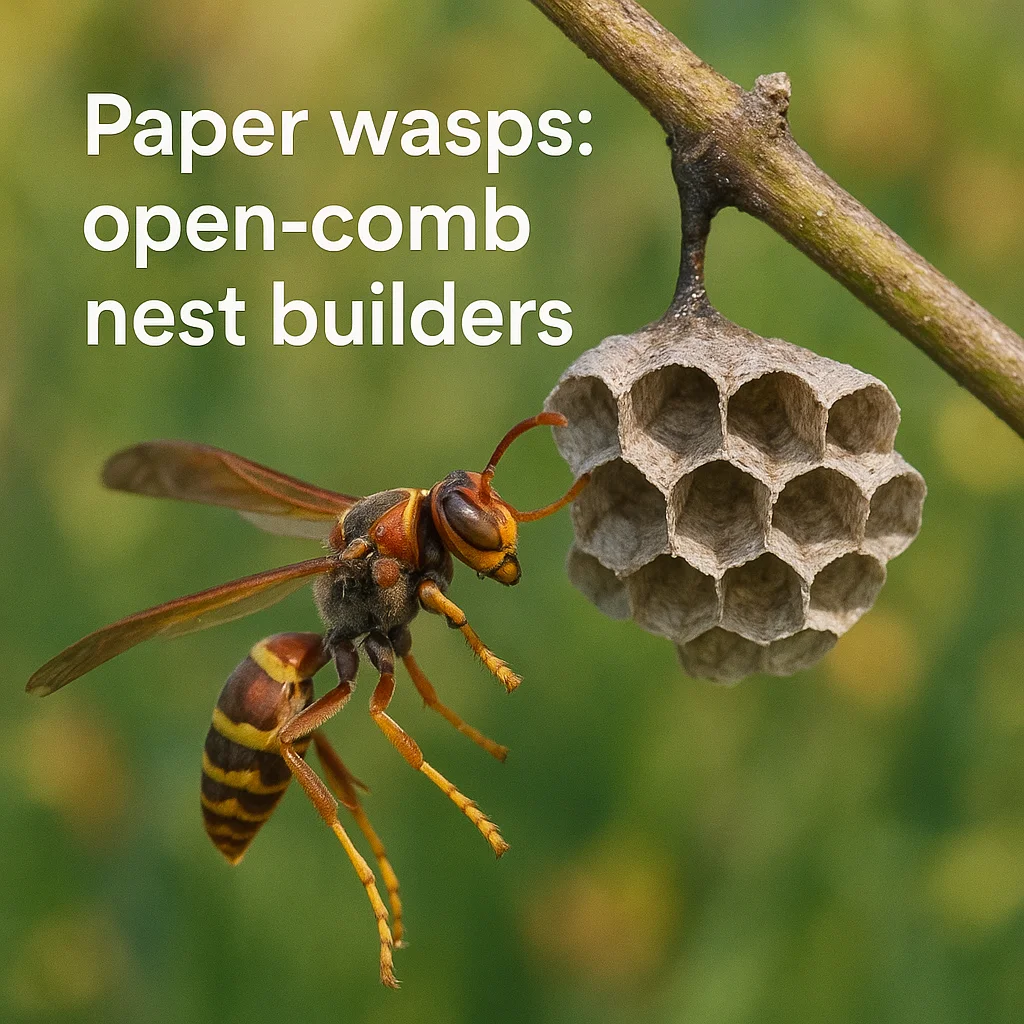
- Common names: Paper wasps
- Scientific name: Varies by species (Polistes is a common genus)
- Insect or not: Yes, they are insects (members of the order Hymenoptera)
- Order / family: Hymenoptera / Vespidae
- Typical size range (adult): 1.5 to 3 cm (0.59 to 1.18 inches)
- Key colors/patterns: Brown to black with yellow or red markings
- Activity: Diurnal (active during the day)
- Typical habitats: Gardens, forests, fields, urban areas
- Where in the world it occurs: Globally, especially in temperate regions
- Seasonality: Most visible from spring through late summer
🔍 Identification
Recognizing paper wasps in the field can be achieved by observing their unique physical characteristics. They have elongated bodies with a distinct waist connecting the thorax and abdomen. Their wings are narrow and fold along their bodies when at rest. Antennae are typically medium-length and prominent.
Common confusions might occur with other wasps and hornets, but paper wasps can be distinguished by their smaller size and relatively slender build. They have long legs that hang down during flight, a key feature for identification.
- Narrow waist between thorax and abdomen
- Long, dangling legs in flight
- Narrow wings folded lengthwise against the body
- Brown to black coloration with yellow-red markings
- Small open-comb nests, often visible
- Slender, streamlined body
- Antennae medium-length and visible
- Gregarious behavior around nest sites
🧠 Basic Body Structure
As insects, paper wasps have the fundamental body structure of a head, thorax, and abdomen. They possess six legs and a pair of antennae that help them navigate their environment. The presence of an exoskeleton provides structural support, which they periodically shed through molting, especially as they grow from larvae to adults.
Paper wasps have two pairs of wings, which are vital for flight. As invertebrates, they lack a backbone, which is a characteristic feature of vertebrate animals.
🌍 Habitat & Distribution
Paper wasps thrive in a variety of environments, including gardens, forests, fields, and urban areas. They are commonly found in habitats that offer structures for nesting, such as eaves, shrubs, and branches. Their geographic range is extensive, covering many parts of the world, particularly temperate regions where conditions are conducive to their survival.
Climate changes and urban development can affect their distribution and sightings. Warmer temperatures and construction can lead to increased visibility as paper wasps adapt to new environments.
📅 Seasonal Appearance & Activity
Paper wasps are most visible during periods of warm weather, typically from spring through late summer. They are diurnal creatures, active primarily during daylight and less so in cooler or rainy conditions. The best times to observe them often depend on regional climate conditions.
- Spring to late summer is peak visibility
- Active mostly during the day
- Warm, sunny days increase activity
- Reduced activity in cold or rainy weather
🥚 Reproduction & Egg-Laying
Paper wasps engage in intricate mating behaviors, often involving courtship rituals and territorial displays. The queen lays eggs in individual cells of the open-comb nest. The number of eggs can vary greatly, influenced by the specific species and environmental conditions. Nests are typically built in sheltered areas, providing protection for developing larvae.
🌀 Metamorphosis & Life Cycle
Paper wasps undergo complete metamorphosis, transitioning through the stages of egg, larva, pupa, and adult. The larvae are primarily fed by the queen and worker wasps, often on chewed-up insects. This stage is critical for growth and development within the safety of the nest. Once the larvae mature to pupae, they undergo transformation within their cells until emerging as adult wasps.
The lifecycle from egg to adult can vary, lasting several weeks to months depending on environmental factors like temperature and food availability.
🍽️ Diet & Feeding Behavior
In their different life stages, paper wasps exhibit varied feeding behaviors. Larvae receive a diet of protein-rich insects brought by adult wasps, while adults primarily feed on nectar and other sugary substances. The dual dietary practices aid their roles as both predators and pollinators, contributing to ecosystem balance by controlling pest insects and assisting in plant pollination.
🦉 Predators & Defense
Paper wasps face numerous predators, including birds, reptiles, and larger insects. Their primary defense mechanisms include the use of chemical stings to deter attackers and the construction of protective nests. The coloration of paper wasps can mimic more dangerous counterparts, offering a degree of visual deterrence against potential threats.
- Stinging capability as a defense
- Nests as a physical shield
- Mimicry of more aggressive species
- Flight as an evasion tactic
👥 Social Behavior & Swarms
Paper wasps exhibit social behavior, living in colonies with distinct roles for queens, workers, and males. Communication within the colony involves sophisticated signals and cooperation in building and maintaining their nests. While they are social, paper wasps do not form large swarms like some other insect species. Rather, their colony size remains moderate, ensuring resource availability and effective nest management.
🧭 Senses & Communication
Paper wasps rely on their senses of vision and smell for communication, using visual signals and pheromones to coordinate activities. Their antennae play crucial roles in detecting chemical cues, which aid navigation and social interaction. Communication methods include pheromone trails and potentially simple movements interpreted by colony members.
🌱 Role in the Ecosystem
In the ecosystem, paper wasps serve vital roles as both predators and pollinators. Their predation on various insect pests helps control populations, while their pollination activities support plant reproduction. This dual function demonstrates the ecological balance they help maintain, contributing significantly to biodiversity and habitat sustainability.
Interactions with their environment often involve mutualistic relationships with plants and occasionally competitive interactions with other species.
📉 Population & Conservation Notes
The status of paper wasp populations varies regionally, often considered stable in areas of suitable habitat but susceptible to threats from pesticides, habitat alteration, and climate change. Conservation efforts can focus on promoting natural habitats and reducing chemical use in landscaping practices.
- Encouraging natural garden spaces with native plants
- Minimizing pesticide use
- Preserving nesting sites in natural landscapes
- Supporting habitat restoration projects
⚠️ Human Interaction & Safety
While paper wasps can sting when threatened, they are generally not aggressive. Care should be taken near nests to avoid provoking them. If stung, it is advised to clean the area and monitor for any allergic reactions, seeking professional advice if symptoms are severe. Respectful observation and appreciation from a distance are recommended to avoid disturbances.
📌 Summary
- Paper wasps can be identified by their slender bodies and distinct nesting habits.
- They inhabit diverse environments worldwide, particularly in temperate regions.
- Most active during the warmer months and during daylight hours.
- Undergo complete metamorphosis, playing roles as predators and pollinators.
- Natural predators include birds and insects, with defense strategies involving stings.
- Social insects with structured colonies but do not engage in large swarming behavior.
- Key ecological contributors, involved in pest control and pollination.
- Population stability varies, with conservation efforts focused on habitat protection.
- Peaceful human interaction encouraged through respect and non-invasive observation.