🕷️ How to respond to a hornet encounter
🧾 Quick Facts
Hornets are large wasps known for their social behaviors and potential to sting when provoked. Understanding these insects is crucial for safely managing an encounter.
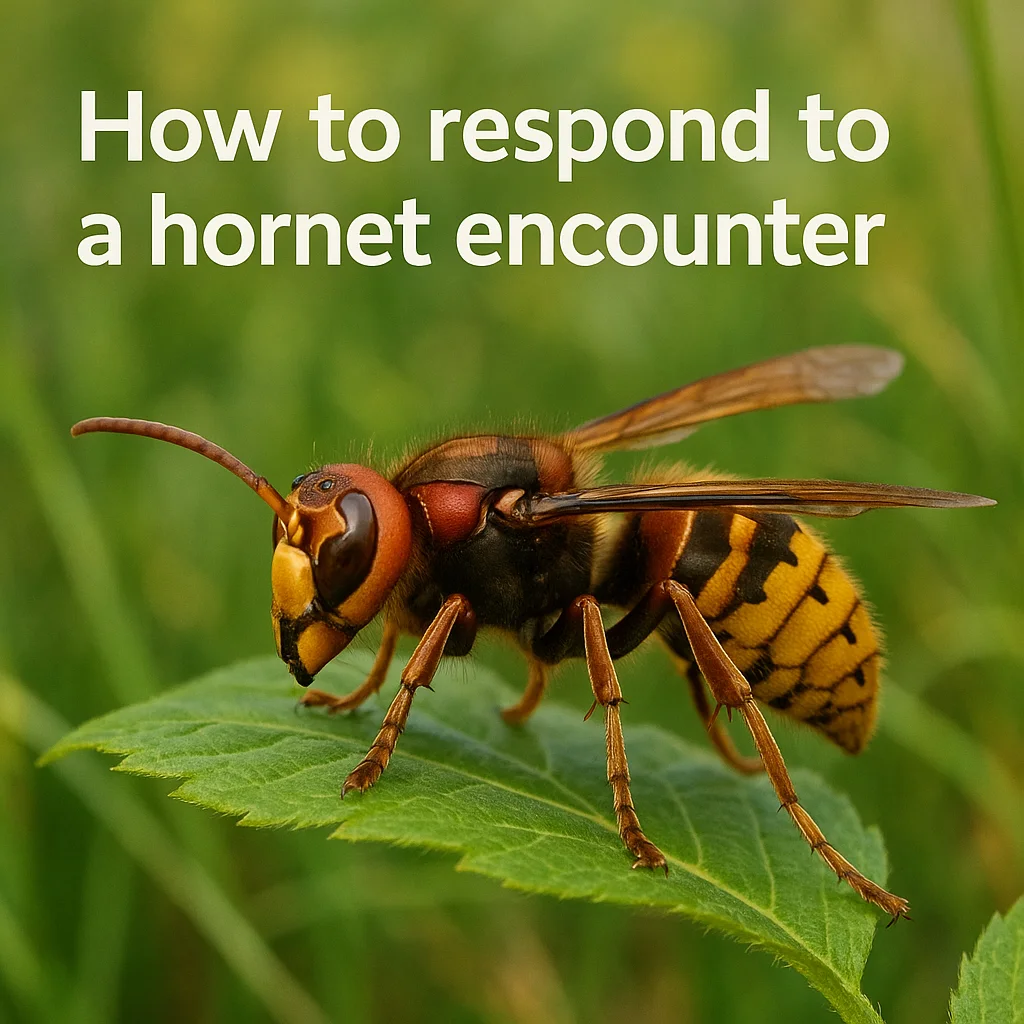
- Common names: Hornet, giant wasp
- Scientific name: Varies (common genus: Vespa)
- Insect or not: Insect; they are invertebrates
- Order / family: Hymenoptera / Vespidae
- Typical size range (adult): 2.5 to 4.5 cm (1 to 1.8 inches)
- Key colors/patterns: Often black and yellow, some species can be brown, orange, and black
- Activity: Diurnal (active during the day)
- Typical habitats: Forests, gardens, fields, urban areas
- Where in the world it occurs: Primarily in the Northern Hemisphere, particularly Europe, Asia, and North America
- Seasonality: Most visible from late spring to early autumn
🔍 Identification
Hornets can be identified by their robust body and characteristic markings. They are larger than most wasps, with a distinctive waist separating the thorax and abdomen.
- Body shape and silhouette: Large, robust, with a notable waist
- Antennae type: Elongated, whip-like antennae
- Wing features: Two pairs of transparent wings, longer than the body
- Leg traits and movement style: Six legs; strong and capable of quick flight
- Distinguishing look-alikes and common confusion: Can be mistaken for yellowjackets or large bees, but hornets are generally larger with different behavioral patterns
- Top ID Tips:
- Notice the large, robust body.
- Look for black-and-yellow or brown-and-black coloration.
- Identify the floating-like flight pattern.
- Check for the distinct waist separating thorax and abdomen.
- Observe their size; they're generally larger than wasps.
- Observe their more aggressive nature when threatened.
🧠 Basic Body Structure
Hornets possess a typical insect body plan divided into three parts: the head, thorax, and abdomen. They have six legs and two pairs of wings, emphasizing their ability to fly efficiently. As invertebrates, they do not have a backbone; instead, they have an exoskeleton that provides structural support. This external skeleton is shed through molting as they grow.
🌍 Habitat & Distribution
Hornets thrive in a variety of environments, primarily favoring places that offer abundant food sources. They are commonly found in forests, suburban gardens, and urban parks. Microhabitats include areas under tree bark, eaves of buildings, and dense foliage. They predominantly inhabit temperate regions in Europe, Asia, and parts of North America. Environmental changes, such as deforestation and urban expansion, influence their distribution and sightings, often pushing them closer to human habitats.
📅 Seasonal Appearance & Activity
Hornets are most visible from late spring to early autumn, when they are actively foraging and building nests. Their activity peaks during warm days, as they are cold-blooded and depend on external temperatures to regulate their body heat. Most hornets are diurnal, meaning they are active during daylight hours, particularly when it's sunny and warm.
- Best Time to Spot It:
- Late spring to early autumn
- During warm, sunny days
- Midday hours
- Near gardens and wooded areas
🥚 Reproduction & Egg-Laying
Hornet reproduction begins with the queen emerging from hibernation in the spring to establish a new colony. After mating, a queen selects a nest site, often in a secluded location, such as a tree hollow or attic. She lays her eggs in hexagonal cells constructed from chewed wood fibers.
The typical egg-laying strategy involves the queen first laying a small number of eggs to start the colony. Worker hornets emerge to take over nest building and maintenance. The number of eggs laid by a single queen can vary widely depending on the species and environmental conditions. As the season progresses, the colony grows, sometimes numbering in the thousands.
🌀 Metamorphosis & Life Cycle
Hornets undergo complete metamorphosis, which includes four stages: egg, larva, pupa, and adult. Initially, the eggs hatch into larvae, which are fed by worker hornets. Larvae are voracious eaters and depend on predatory workers to provide food. After maturity, they enter the pupal stage, encapsulated in a cocoon within the nest. Eventually, they emerge as adults, ready to contribute to colony activities or establish new colonies if they are new queens.
Each stage duration varies; typically, the larval stage lasts a few weeks, while the pupal stage may last around two weeks. The overall lifecycle from egg to adult can span 30 to 40 days, with colony lifecycle completing over a single year.
🍽️ Diet & Feeding Behavior
Hornets are primarily predatory and play a role in controlling pest populations. They feed on a variety of insects, including flies, caterpillars, and other wasps. The mouthparts are adapted for chewing, enabling hornets to tear up prey and chew fibrous plant material for nest construction. Hornet larvae are fed primarily protein-rich prey, while adults consume more carbohydrate-rich substances like nectar and tree sap.
🦉 Predators & Defense
Hornets are not without natural enemies. Birds, particularly bee-eaters, as well as some mammals and reptiles, are known to prey upon them. Defense mechanisms of hornets include their potent sting, used when the nest is threatened. They also employ camouflage to blend with their surroundings, while their robust exoskeleton provides protection from minor threats.
- Defense Highlights:
- Potent sting with venom
- Camouflage in natural habitats
- Robust exoskeleton for physical defense
- Warning coloration to deter predators
👥 Social Behavior & Swarms
Hornets are social insects that live in structured colonies consisting of a single queen, female workers, and males (drones). These colonies exhibit cooperative behaviors, particularly in nest building, foraging, and defense. Communication within the colony is primarily chemical, using pheromones to signal alarms or coordinate tasks. Swarming is not typically observed in hornets during normal colony activities, but large numbers can be seen during nest relocation or reproductive events.
🧭 Senses & Communication
Hornets possess well-developed senses that aid in navigation, foraging, and communication. Their compound eyes afford them good vision, enabling efficient detection of movement and colors. Antennae are equipped with olfactory sensors, crucial for detecting pheromones and other scents. Communication within the colony largely relies on chemical signals, which are essential for coordinating defense, foraging, and reproductive behaviors.
🌱 Role in the Ecosystem
Hornets hold a significant ecological role as both predators and pollinators. As predators, they help manage insect populations, indirectly benefiting agriculture by preying on pests. While generally not primary pollinators, hornets do contribute to pollination when visiting flowers for nectar. Their presence in the ecosystem supports biodiversity through controlling pest populations and serving as prey for other animals.
📉 Population & Conservation Notes
Hornet populations are largely stable across their natural habitats, though regional threats like habitat destruction and pesticide use can impact local numbers. Urbanization can increase encounters with humans, leading to more frequent nest removals and population impacts. Efforts to preserve their habitats, reduce pesticide use, and promote native plant growth can help sustain hornet populations.
- How to Help (Low-Impact):
- Plant native flowering plants
- Avoid pesticide use
- Provide natural hiding spaces (e.g., leave leaf litter)
- Preserve wooded areas and old trees
⚠️ Human Interaction & Safety
Hornets can sting if provoked, particularly when their nest is disturbed. The sting is painful and can cause allergic reactions in some individuals. In the event of a hornet sting, it is advised to clean the area with soap and water, avoid scratching, and seek professional help if severe reactions occur. Respectful observation of hornets in their natural habitat is encouraged, and it's important not to disturb or collect wild specimens.
📌 Summary
- Hornets are large, social insects often mistaken for large wasps.
- They thrive in diverse habitats but are primarily found across the Northern Hemisphere.
- Active from late spring to early autumn during warm, sunny days.
- They undergo complete metamorphosis with defined life stages.
- Primarily predators, they feed on various insects, aiding pest control.
- Possess effective defense mechanisms like stings and warning colors.
- Serve important ecological roles in pest management and occasional pollination.
- Population stable but affected by habitat changes and pesticide use.
- Exercise caution and respect when encountering hornets through safe distances and observation.