🕷️ European Hornet: identification and habits
The European Hornet (Vespa crabro) is a large, imposing insect known for its distinctive size and coloration. As one of the larger wasps encountered in Europe and parts of North America, it plays a complex role in its ecosystem, contributing to both pest control and pollination. With its impressive social structure, interesting behaviors, and important ecological role, the European Hornet is a fascinating subject for entomologists and nature enthusiasts alike.
🧾 Quick Facts
Below are some essential facts about the European Hornet to help quickly familiarize you with this species:
- Common names: European Hornet
- Scientific name: Vespa crabro
- Insect or not: Insect (an invertebrate)
- Order / family: Hymenoptera / Vespidae
- Typical size range: 2-3.5 cm (adults)
- Key colors/patterns: Yellow and black, reddish-brown thorax
- Activity: Diurnal (active during the day)
- Typical habitats: Woodlands, gardens, and urban areas
- Where in the world it occurs: Europe, parts of Asia, and introduced to North America
- Seasonality: Adults are most visible from spring to early fall
🔍 Identification
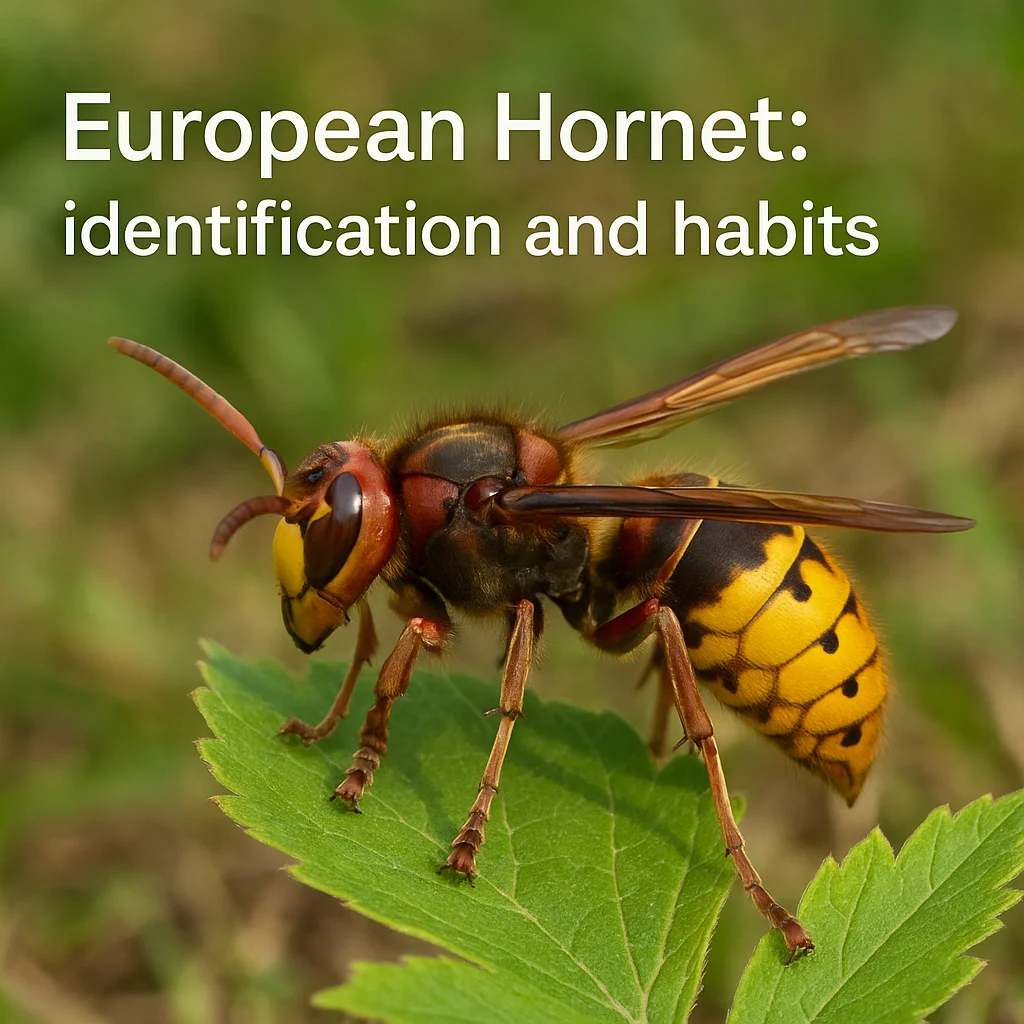
The European Hornet can be recognized by its large size and robust, elongated body. It possesses long antennae, and its wings are often slightly reddish. The legs are stout, providing strong support and aiding in climbing and landing. Similar to other hornets, the European Hornet may be confused with other large wasps, but its distinctive color pattern and size help set it apart.
- Top ID Tips
- Elongated, robust body typical of hornets
- Large size compared to other wasps
- Yellow and black bands on the abdomen
- Reddish-brown head and thorax
- Single pair of wings, slightly reddish in color
- Strong mandibles visible in profile
- Smooth appearance, lacking hair
- Visible segmentation in the abdomen
🧠 Basic Body Structure
Like all insects, the European Hornet has a body that is divided into three main segments: the head, thorax, and abdomen. These sections are covered with an exoskeleton, a hard outer shell that provides protection. The hornet has six legs, essential for mobility, and two pairs of wings that are utilized for flying. Being an invertebrate, it does not have a backbone but relies on its exoskeleton for structural support.
🌍 Habitat & Distribution
The European Hornet is typically found in a variety of habitats including forests, woodlands, gardens, and rural areas. They often nest in hollow trees, under eaves, or in attics of buildings. Their geographical range includes Europe and parts of Asia, and they have been introduced to North America. They thrive in temperate climates but may also adapt to different environmental conditions, influencing their sightings.
Microhabitats such as under tree bark or in dense foliage provide shelter and safety, especially for nesting purposes. As habitats change, for example through urbanization or deforestation, the availability of nesting sites can significantly impact their distribution and visibility.
📅 Seasonal Appearance & Activity
People are most likely to observe European Hornets from late spring through early fall when adults are actively seeking food and expanding their colonies. They are diurnal, meaning they are predominantly active during daylight hours. Weather conditions such as temperature and humidity can influence their activity levels; they are more active on warm, sunny days.
- Best Time to Spot It
- Spring foraging and nest building
- Summer peak activity
- Warm, sunny days
- Early fall before the colony deteriorates
🥚 Reproduction & Egg-Laying
The reproductive cycle of the European Hornet begins in spring when a fertilized queen emerges from hibernation to establish a new colony. She constructs a small nest and begins laying eggs. The eggs are laid in individual cells made from chewed wood fibers and plant material, commonly in tree hollows or protected human structures.
The queen initially raises the first generation of workers by herself. As the colony grows, these workers take over the tasks of expanding the nest, caring for the larvae, and foraging for food. Egg counts can range widely as the colony expands throughout the season.
🌀 Metamorphosis & Life Cycle
The European Hornet undergoes complete metamorphosis, encompassing the stages of egg, larva, pupa, and adult. After hatching from eggs, the larvae are fed protein-rich substances by worker hornets. They reside within the nest throughout the larval and pupal stages, with each developmental stage lasting several weeks, depending on environmental conditions.
As metamorphosis progresses, pupae transform into adult hornets within their cells. Adults then exit the nest to partake in the colony's routine activities, including foraging and defending the nest. Adult hornets primarily consume carbohydrates from fruits and sap, while larvae rely on proteins provided by adult workers.
🍽️ Diet & Feeding Behavior
The European Hornet's diet shifts throughout its life stages. Larvae are fed a diet rich in proteins, consisting mostly of captured insects such as flies, caterpillars, and spiders. Adult hornets primarily seek out carbohydrates, feeding on nectar, fruit juices, and tree sap for energy. They are equipped with strong mandibles used for capturing prey and manipulating food.
As both predators and scavengers, European Hornets play an important role in controlling insect populations, thus maintaining ecological balance in their habitats.
🦉 Predators & Defense
European Hornets face various predators including birds, particularly those that specialize in hunting insects. Certain mammals and reptiles may also prey on them. In defense, hornets rely on their ability to sting, their size for intimidation, and their agility in flight. Additionally, their striking colors serve as a warning to potential predators about their capability to sting.
- Defense Highlights
- Warning coloration
- Powerful sting
- Flight agility
- Strong mandibles
👥 Social Behavior & Swarms
European Hornets are social insects that form colonies, typically led by a queen. Workers and drones each have specific roles, such as foraging, nest maintenance, and defense. Communication within the colony occurs through chemical signals and tactile interactions. Swarming, which can be seen when new queens and males leave the nest to mate, is typically triggered by seasonal changes and the maturation of the colony.
🧭 Senses & Communication
The European Hornet relies on a combination of senses including acute vision and a strong sense of smell. Smell is particularly important for communication and navigating their environment. They use pheromones to mark trails or signal distress. Touch and vibration are also vital for intra-colony communication, especially in the dark confines of their nests.
🌱 Role in the Ecosystem
As both predators and pollinators, European Hornets play crucial roles in their ecosystem. They help control harmful insect populations, curbing outbreaks of pests like caterpillars. Additionally, by feeding on nectar, they can contribute to the pollination of various plants. However, their aggressive defense mechanisms can be problematic if nests are located too close to human activity.
They engage in mutualistic relationships with plants via pollination and can impact agricultural settings by controlling pest populations, though they occasionally damage ripe fruits.
📉 Population & Conservation Notes
European Hornets are generally considered common within their native range. However, local abundance can vary due to habitat changes, pesticide use, and climatic conditions. Urban development and deforestation may pose challenges, reducing available nesting sites and altering food resources.
- How to Help (Low-Impact)
- Plant native flowering plants
- Minimize pesticide use
- Leave natural debris like leaf litter
- Create undisturbed nesting sites
⚠️ Human Interaction & Safety
European Hornets can sting when threatened or defending their nest, but they are typically not aggressive unless provoked. If stung, individuals should wash the area with soap and water, avoid scratching, and seek professional medical advice if they experience a severe reaction. Observing hornets at a distance and respecting their space helps ensure safe and respectful encounters with these intriguing insects.
📌 Summary
- Distinctive large size with yellow and black coloration
- Found in Europe, Asia, and introduced to North America
- Most active from spring to fall, during daylight hours
- Undergoes complete metamorphosis with distinct life stages
- Diet shifts from protein-rich as larvae to carbohydrate-focused as adults
- Natural enemies include birds and other larger predators
- Ecologically valuable for pest control and potential pollination
- Common but sensitive to habitat changes and pesticide use
- Exercise caution and respect when near nests