🕷️ Bald-faced Hornet Actually A Yellowjacket ID Guide
🧾 Quick Facts
The Bald-faced Hornet, though often referred to as a hornet, is actually a type of yellowjacket. Here are some fast facts about this intriguing insect:
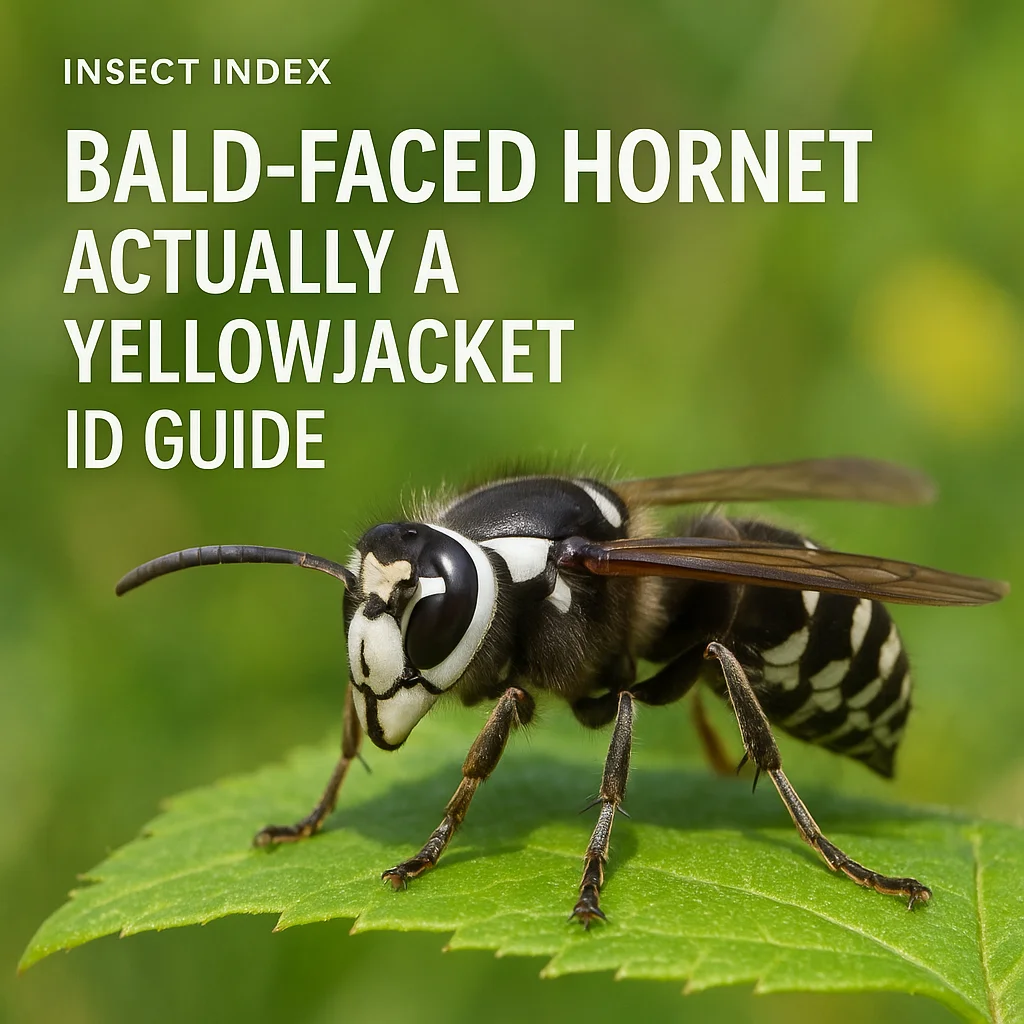
- Common names: Bald-faced Hornet, White-faced Hornet
- Scientific name: Dolichovespula maculata
- Insect classification: Invertebrate
- Order/Family: Hymenoptera/Vespidae
- Typical size range (adult): 12-20 mm in length
- Key colors/patterns: Black with white facial markings and white banding on the body
- Activity: Diurnal (active during the day)
- Typical habitats: Forests, urban gardens, and meadows
- Where in the world it occurs: Primarily North America
- Seasonality: Most visible from late spring to early autumn
🔍 Identification
The Bald-faced Hornet can be recognized in the field by its distinctive appearance. Despite its common name, it is a type of aerial yellowjacket. Its body shape is similar to other wasps, with a narrow waist separating the thorax and abdomen. This species has long antennae that are characteristically wasp-like, and transparent wings with a dark tint. Its legs are finely segmented and typically do not show the bright yellow marks associated with other yellowjackets.
- Long, straightforward antennae
- Whole specimen in frame having distinguishable black and white coloration
- Efficient fliers with visible wing venation patterns
- Long, segmented legs that dangle during flight
- Easily confused with European Hornet, but different in facial coloring
- Black body with distinctive white face
- Identifiable by its hanging, paper-mâché-like nests typically found in trees
🧠 Basic Body Structure
The Bald-faced Hornet is an invertebrate, featuring a hard exoskeleton made of chitin. It is divided into three main parts: head, thorax, and abdomen. As an insect, it has six legs attached to the thorax and two pairs of wings, which are often folded over the back when at rest. It undergoes molting as it grows, shedding its exoskeleton to allow for further development.
Vertebrate vs. Invertebrate: Invertebrates lack a vertebral column (backbone) and internal skeleton as found in vertebrates. They rely on their exoskeleton for support and protection.
🌍 Habitat & Distribution
The Bald-faced Hornet prefers environments where it can easily find wood fibers and prey to sustain itself and construct its nests. These insects are commonly found in forests, fields, and urban areas where trees and shrubs are plentiful. They are native to North America, prevalent throughout Canada, the United States, and parts of Central America. Though adaptable, they are most abundant in temperate regions where conditions do not fluctuate extremely.
Habitat changes, such as urbanization and deforestation, can influence local populations, either reducing available nesting sites or forcing them to adapt to urban gardens and parklands.
📅 Seasonal Appearance & Activity
Bald-faced Hornets are most active during the warmer months, typically from late spring to early autumn. As diurnal insects, they are generally seen during daylight hours when they are foraging and constructing nests. Their activity can vary with weather conditions; excessive rain or cooler temperatures may reduce visible activity.
- Late spring to early summer: Emerging and establishing nests
- Mid-summer: Nest expansion and brood rearing intensifies
- Early autumn: Peak foraging activity before populations decline
- Warm, dry days: Increased visibility and activity
🥚 Reproduction & Egg-Laying
Bald-faced Hornets display a highly social structure with a colony's reproduction managed by a single queen. After emerging from hibernation in spring, the queen selects a suitable location to begin constructing a nest. She lays eggs in individual cells, fertilized from sperm stored since autumn. These eggs hatch into larvae which are exclusively cared for by the queen until they mature into workers.
Eggs are placed within the nest’s paper cells, crafted from chewed wood fibers. A queen can lay several hundred eggs over a season, leading to a bustling, multi-tiered colony.
🌀 Metamorphosis & Life Cycle
The Bald-faced Hornet undergoes complete metamorphosis, with life stages including egg, larva, pupa, and adult. These wasps have a fascinating life cycle:
Egg: Eggs are laid in enclosed cells within the nest. The queen's initial clutch of eggs and larvae are critical for establishing the colony’s strength.
Larva: The larvae are legless and initially fed by the queen, later by adult workers with chewed insect prey.
Pupa: During pupation, larvae develop into adults while encased in a silk cocoon spun in the cell.
Adult: Adults emerge from the cocooned cells to take on specific roles, from foraging to caring for new larvae and maintaining the nest. Worker wasps live several weeks, while queens can live for a full year.
🍽️ Diet & Feeding Behavior
As larvae, Bald-faced Hornets are mostly carnivorous, receiving a predigested diet of chewed insects, primarily other arthropods. Adult wasps are omnivorous and exhibit opportunistic feeding behavior; they consume nectar, plant fluids, and occasional sweets, aiding in pollination. Their mouthparts are designed for both chewing and sucking, allowing them to process different types of food sources effectively.
🦉 Predators & Defense
The Bald-faced Hornet faces natural predation from a variety of animals, including birds, larger mammals, and even other insects. Their primary defense mechanism is their aggressive approach to nest defense, employing powerful stings and release of alarm pheromones to deter threats.
- Sharp, repetitive stings as a primary defense
- Alarm pheromones alerting colony to danger
- Vibrant markings act as a warning signal to potential predators
- Nest placement in high or hidden locations to minimize accessibility
👥 Social Behavior & Swarms
Bald-faced Hornets are highly social insects living in structured colonies led by a queen. The nest functions through division of labor, with specialized roles for workers in foraging, nest maintenance, and defense. Close cooperation and communication within the colony ensure survival and growth.
They do not form swarms in the traditional sense but will rally to defend their nest if threatened, exemplifying their social response to danger.
🧭 Senses & Communication
Bald-faced Hornets have keen senses that include exceptional eyesight, which aids in navigation and locating food sources. Their sense of smell is crucial, especially for identifying pheromones used for communication within the colony. Vibratory signals and scent trails facilitate coordination and relay information about food sources or threats.
🌱 Role in the Ecosystem
This species plays a notable role in ecosystems as both pollinators and predators. By feeding on a variety of insects, they help control pest populations, contributing to ecological balance. Their pollination activities support plant fertilization, promoting biodiversity. Relationships with other species can range from mutualism with plants to natural predation impacting smaller insects.
📉 Population & Conservation Notes
Bald-faced Hornets are generally common across their range, but environmental changes can impact their abundance. Habitat loss due to urban expansion and pesticide use can reduce their numbers by limiting suitable nesting and foraging areas. Despite these threats, they remain a resilient species where conditions allow.
- Plant native species to support diverse insect populations
- Avoid using broad-spectrum pesticides in your garden
- Allow natural spaces for nests to develop in non-intrusive areas
- Educate others on the importance of wasp species in ecosystems
⚠️ Human Interaction & Safety
Bald-faced Hornets can sting multiple times and may do so if their nesting area is threatened. While generally non-aggressive away from their nest, they should be respected and observed from a distance. First-aid measures for stings involve cleaning the area and avoiding scratching. If a severe reaction occurs, seek professional medical attention.
Appreciate these insects for their ecological role without resorting to collection or harm.
📌 Summary
- Recognizable by black and white coloring, often mistaken for hornets
- Preferred habitats include forests and gardens in North America
- Visible during warmer months, active during the day
- Life cycle: complete metamorphosis with four stages
- Feeds on nectar and insects; important pollinators and pest controllers
- Face predators like birds and use stings for defense
- Social creatures with complex colony structures
- Contributes to ecosystem health through pollination and predation
- Non-aggressive if undisturbed; watch from afar to ensure safety