🕷️ Asian Hornet (Vespa velutina): invasive concerns
🧾 Quick Facts
The Asian Hornet (Vespa velutina) is an insect that has garnered attention due to its invasive nature in various regions outside its native habitat. Understanding its biology and ecological impact is essential for managing its presence in non-native areas.
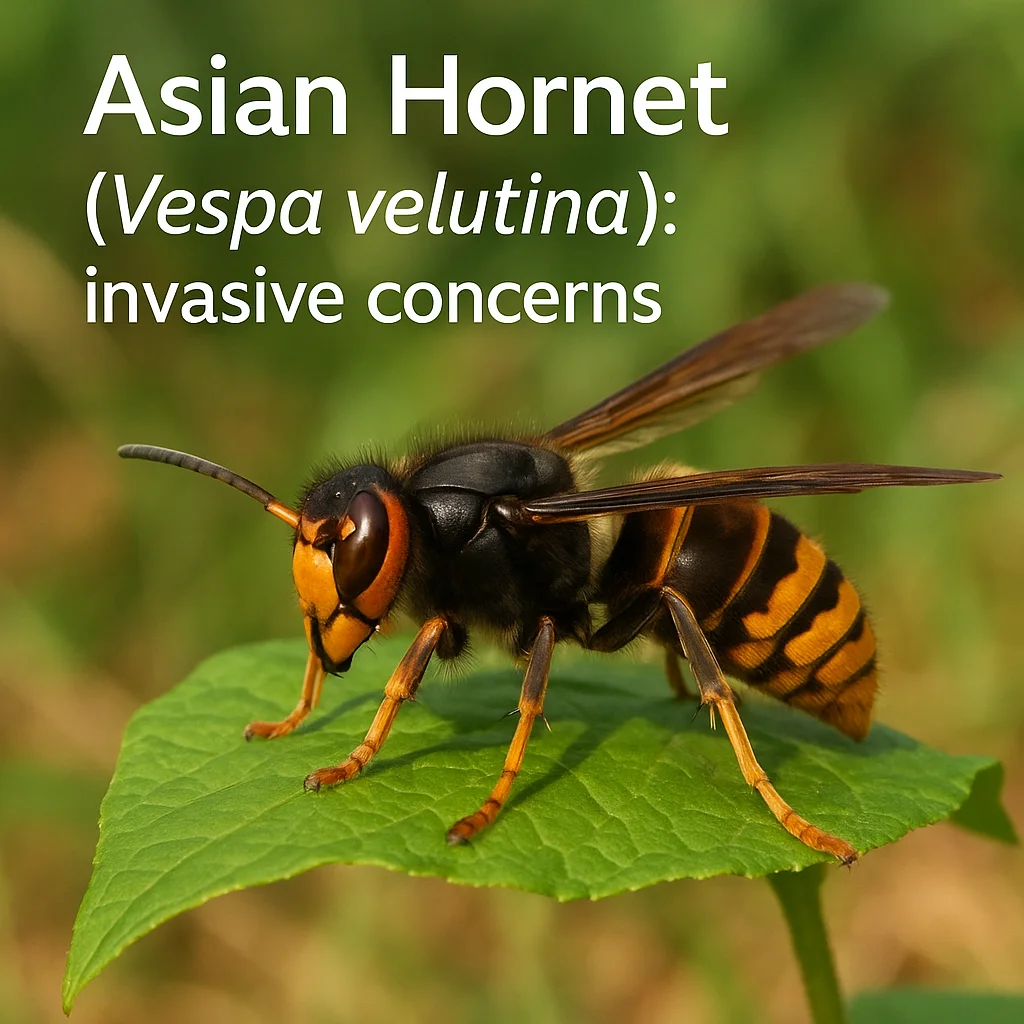
- Common Names: Yellow-legged Hornet, Asian Predator Hornet
- Scientific Name: Vespa velutina
- Insect: Yes, it is an invertebrate
- Order / Family: Hymenoptera / Vespidae
- Typical Size Range: 17-32 mm (adult)
- Key Colors/Patterns: Black with a distinctive yellow-tipped abdomen and yellow legs
- Activity: Primarily diurnal (active during the day)
- Typical Habitats: Urban areas, forests, gardens, farmlands
- Where in the World: Native to Southeast Asia; invasive in parts of Europe
- Seasonality: Most visible from spring to early autumn
🔍 Identification
Recognizing the Asian Hornet in the field involves noting its size, color, and behavior. Characteristically, it has a robust body with a thorax mainly black and a yellow band at the tip of the abdomen, contrasting with its yellow legs. The antennae are slightly clubbed towards the end, and their wings are dark with a slightly smoky appearance.
Its movement includes a rapid, direct flight pattern. Differentiating it from the European hornet (Vespa crabro) involves observing the color patterns, especially the absence of reddish-brown markings typical to the latter.
- Top ID Tips:
- Notice the yellow band on the abdomen.
- Look for the distinctive yellow legs.
- Observe its robust, black thorax.
- Flight is fast and direct, often hunting near bee hives.
- Wings have a darker, smoky hue.
- Different from European hornets by lack of reddish-brown coloration.
🧠 Basic Body Structure
The Asian Hornet, like all insects, has a fundamental body structure divided into three major parts: the head, thorax, and abdomen. It possesses six legs, characteristic of insects, and an exoskeleton which provides both protection and structure. Their pair of wings allow them a rapid, agile flight. As an invertebrate, it lacks a backbone, relying on its exoskeleton for support and defense.
🌍 Habitat & Distribution
The Asian Hornet thrives in various environments, ranging from woodlands to urban locations. It prefers mild climates and can adapt well to human-modified landscapes, such as gardens and agricultural fields. It often nests in high places like trees or man-made structures.
Geographically, it is native to Southeast Asia but has established populations in parts of Europe, facilitated by human activity such as trade and transport. Environmental changes, including urban expansion and agriculture, have increased its sightings in affected regions.
📅 Seasonal Appearance & Activity
The Asian Hornet is most active from spring through early autumn. During these months, it is often visible during the day as it hunts for food. Weather conditions such as warm temperatures and dry conditions can increase its activity levels, while colder periods reduce its visibility as it retreats to its nest.
- Best Time to Spot It:
- Spring months when temperatures rise.
- Early summer in mild climates.
- Late summer as colonies reach peak sizes.
- Daylight hours, especially midday warmth.
🥚 Reproduction & Egg-Laying
Mating behavior involves queens emerging in spring to establish new colonies. The queens produce pheromones to attract males for mating. Eggs are typically laid in paper-like nests constructed high off the ground. Each queen can lay hundreds of eggs, with the colony expanding rapidly through the warmer months.
🌀 Metamorphosis & Life Cycle
The Asian Hornet undergoes complete metamorphosis, transitioning through the stages of egg, larva, pupa, and adult.
During the larval stage, they are fed by workers and remain within the protection of the nest. Pupation leads to the emergence of adult hornets ready to expand the colony. Each stage varies in duration depending on environmental conditions, but typically extends from spring into autumn.
🍽️ Diet & Feeding Behavior
The Asian Hornet is predominantly carnivorous, preying on other insects, particularly bees. At the larval stage, they are fed masticated prey by worker hornets. As adults, they hunt actively using well-adapted chewing mouthparts capable of slicing through flesh to enable efficient feeding. Their role as predators inadvertently benefits some plant species by controlling pest populations.
🦉 Predators & Defense
Natural predators of the Asian Hornet include birds and some mammals. Defense strategies are robust, involving painful stings to deter threats. They also exhibit warning displays, such as loud buzzing, when disturbed.
- Defense Highlights:
- Effective use of painful stings to defend nest.
- Warning buzzing to signal threat readiness.
- Smart location of nests high above ground.
- Chemical deterrents via pheromones that alert colony.
👥 Social Behavior & Swarms
The Asian Hornet displays complex social behavior with distinct colony roles. Workers defend and forage, while queens focus on reproduction. Communication within the colony is crucial, and social cooperation is vital for survival and resource acquisition. Swarming is often tied to reproduction or distress within the colony.
🧭 Senses & Communication
Their sensory abilities are advanced, with well-developed vision aiding in hunting and movement. They also heavily rely on pheromones for colony communication, including marking trails and signaling danger or food sources.
🌱 Role in the Ecosystem
The Asian Hornet plays a significant role as a predator in the ecosystem. By preying on various insects, it helps regulate pest populations, although its impact on bee populations can negatively affect pollination. It sometimes indirectly supports other species through the dispersal of prey items.
📉 Population & Conservation Notes
Currently, the Asian Hornet is considered common in areas where it has become established. However, its invasive nature poses a risk to local ecosystems and bee populations. Efforts to control its spread focus on habitat management and public awareness.
- How to Help (Low-Impact):
- Encourage native plant growth to support biodiversity.
- Avoid using pesticides in areas of hornet activity.
- Report sightings to local wildlife authorities.
- Foster awareness about its ecological impact.
⚠️ Human Interaction & Safety
The Asian Hornet can sting if provoked, with stings potentially causing allergic reactions in some individuals. It's advised to wash affected areas and avoid scratching, seeking professional advice if severe reactions occur. Observing hornets from a distance is recommended to avoid provoking defensive behaviors.
📌 Summary
- Identifiable by black body and yellow-tipped abdomen.
- Active during the day, mostly visible in spring and summer.
- Complete metamorphosis from egg to adult.
- Feeds on other insects, notably bees.
- Effective defense through painful stings.
- Complex social behavior within colonies.
- Impacts bee populations, affecting pollination.
- Commonly found in Europe outside its native range.