🕷️ When bees sting (and how to avoid it)
🧾 Quick Facts
Bees are fascinating insects known for their roles in pollination and their social behavior. Here's a quick overview of these important invertebrates.
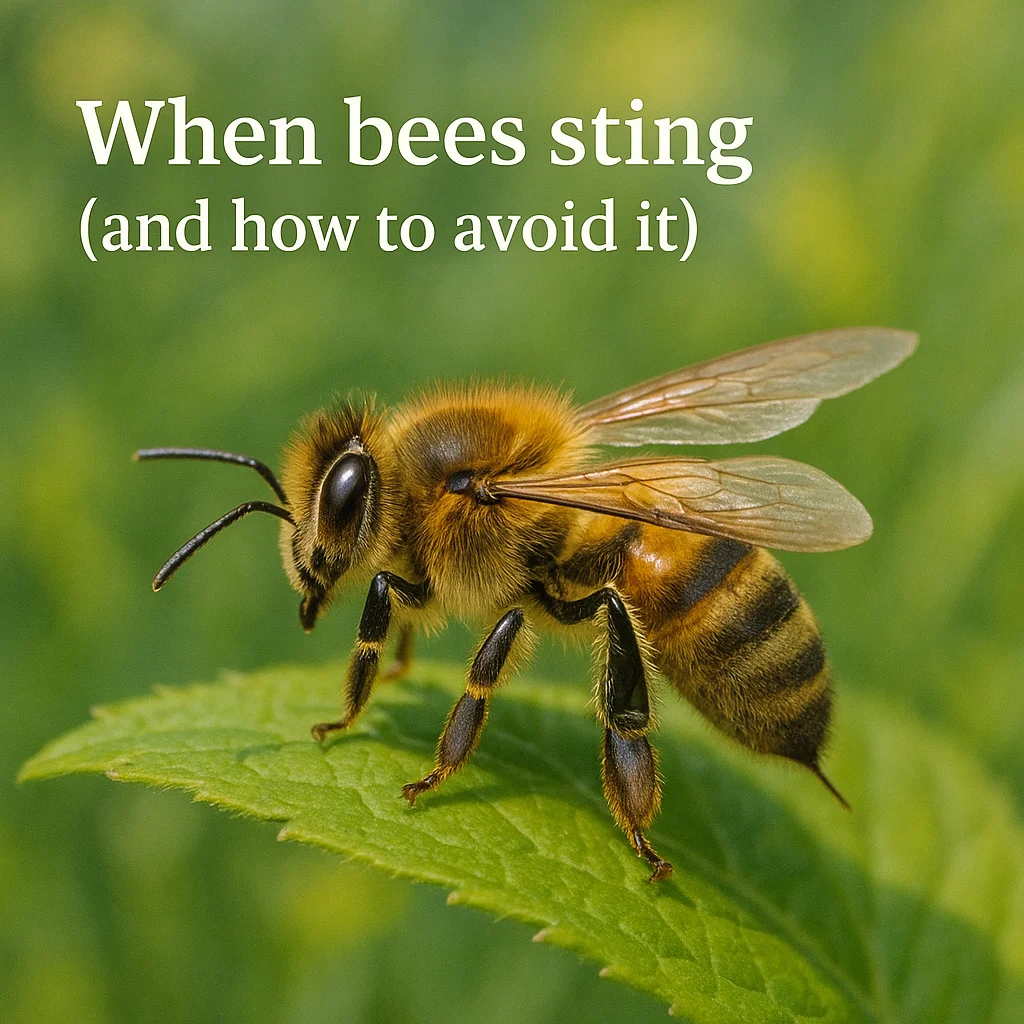
- Common names: Honeybee, Bumblebee, Carpenter bee
- Scientific name: Varies
- Insect or not: Bees are insects, as they belong to the class Insecta, which characterizes them as invertebrates.
- Order / family: Hymenoptera / Apoidea
- Typical size range: 0.3 to 1.2 inches in length
- Key colors/patterns: Yellow, black, orange bands
- Activity: Diurnal (active during the day)
- Typical habitats: Gardens, fields, woodlands, urban areas
- Where in the world it occurs: Worldwide, except Antarctica
- Seasonality: Most active in spring and summer when flowers bloom
🔍 Identification
Recognizing bees in the field involves looking at their distinct body shapes, colors, and behaviors.
Bees typically have robust bodies with a rounded abdomen, fine antennae, and two pairs of wings that may appear as one due to their interlocking mechanism. Their legs are equipped with structures to collect pollen, and many species are covered in fine hairs that can appear fuzzy. A full-body view of a bee will show their entire insect form from head to abdomen tip, including all six legs, perfectly encapsulated within a centered image.
- Top ID Tips:
- Look for yellow and black or orange striped patterns.
- Observe their movement from flower to flower.
- Check the presence of pollen baskets on hind legs.
- Notice the division between thorax and abdomen.
- Listen for a distinctive buzzing sound.
- Be aware of their preference for open flowers.
🧠 Basic Body Structure
Bees have a three-part body plan common to insects: the head, thorax, and abdomen. As invertebrates, they have an external skeleton, or exoskeleton, that provides support and protection. They have six legs attached to the thorax, and most species possess two pairs of wings also connected to this middle body segment. Bees grow through a process called molting, shedding their old exoskeleton to expand. They are invertebrates, meaning they lack a backbone, which distinguishes them from vertebrate animals like birds and mammals.
🌍 Habitat & Distribution
Bees are versatile insects that thrive in a variety of environments. They prefer habitats with abundant flowering plants, such as gardens, grasslands, forests, and urban areas. Some bees are even found in deserts and alpine zones. Microhabitats like flower beds, tree hollows, and ground burrows serve as homes or nesting areas. Their geographic range extends globally, provided there are suitable climates—temperate and tropical regions, mainly. Climate change, habitat destruction, and urbanization influence their distribution and can shift bee populations over time.
📅 Seasonal Appearance & Activity
Most bees are seen during the warmer months when flowering plants are abundant. In many areas, bees are most active during spring and summer, though in tropical regions, activity can be observed year-round. These insects are diurnal and thrive in warm, sunny conditions, often taking shelter during rain or storms.
- Best Time to Spot It:
- Spring bloom periods for most regions
- Mid-morning to late afternoon
- Warm, sunny days
- Late summer in cooler areas
🥚 Reproduction & Egg-Laying
Bees engage in intricate courtship rituals, often involving flight displays or pheromone signaling. Mating typically occurs near nesting sites or flowering areas. Females lay eggs in secure locations such as plant stems, underground burrows, or hollow wood. The number of eggs varies widely by species; for instance, a honeybee queen can lay thousands of eggs, while solitary bees might lay fewer than twenty at a time. Different species utilize diverse egg-laying strategies, influenced by diet, habitat availability, and environmental conditions.
🌀 Metamorphosis & Life Cycle
Bees undergo complete metamorphosis, transitioning through distinct life stages including egg, larva, pupa, and adult. The egg stage typically lasts a few days, followed by the larval stage where feeding is crucial for growth. Larvae consume a mixture of pollen and nectar known as bee bread.
The larval stage can last from one to several weeks, depending on the species and environmental factors, before they pupate within cells. After pupation, an adult bee emerges, ready to forage and continue the cycle. This adult life stage varies, with some living only a few weeks and others, like queen bees, living several years.
🍽️ Diet & Feeding Behavior
Bees primarily feed on nectar and pollen from flowers. Adult bees often gather nectar for energy and pollen for protein, essential for larval development. Their mouthparts are adapted to these tasks, featuring a tongue for sipping nectar and strong mandibles for manipulating pollen. Bees are renowned pollinators, critically enhancing both wild and agricultural plant growth through their feeding activities.
🦉 Predators & Defense
Bees face numerous natural predators including birds, spiders, mammals, and alligators. To protect themselves, they employ a range of defense strategies. Some use camouflage or mimic the appearance of more aggressive species. Others, namely social bees like honeybees and bumblebees, may sting to protect their nests. Stings involve injecting a deterring chemical, painful to predators. Solitary bees generally rely on speed and hiding to avoid threats.
- Defense Highlights:
- Stinging mechanism for nest protection
- Camouflage to blend with surroundings
- Buzzing to startle potential predators
- Fleeing into dense vegetation
👥 Social Behavior & Swarms
Bees exhibit varied social behavior. Honeybees and bumblebees are social insects, living in large colonies with defined roles: queens, workers, and drones. They communicate using dances and pheromones to coordinate gathering and defense. In contrast, many bees are solitary, only interacting for mating and egg-laying.
Swarms, mainly seen in honeybees, occur when a colony decides to relocate. Triggered by overcrowding or environmental changes, swarming involves a queen and workers leaving the original hive to find a new home.
🧭 Senses & Communication
Bees have highly refined senses for survival and foraging. They possess compound eyes that detect ultraviolet light, aiding in flower identification. Their antennae are sensitive to chemical signals and pheromones, crucial for navigation and communication. Bees communicate through a variety of methods, including the waggle dance, which conveys information about food sources. Their ability to sense vibrations also plays a role in social behaviors and nest maintenance.
🌱 Role in the Ecosystem
Bees play an indispensable role in ecosystems, primarily through pollination. They facilitate plant reproduction, contributing to diverse plant communities and food sources for other organisms. Bees' relationships with plants are often mutualistic, with both parties benefiting. These insects also comprise a significant portion of the diet for various predators, integrating them tightly into food webs.
They impact agriculture positively, with many crops relying on bee pollination for fruit and seed production. However, changes in bee populations can also affect plant diversity and ecosystem health negatively, highlighting bees' ecological significance.
📉 Population & Conservation Notes
Bee populations are experiencing fluctuations worldwide. Some species are common, but others face threats from habitat loss, pesticide use, and climate change. Declines are noted in regions where suitable habitats are rapidly altering. Conservation efforts focus on restoring habitats and encouraging pesticide-free practices. Data on many species remains limited, making precise conservation status difficult to ascertain.
- How to Help (Low-Impact):
- Plant native flowering plants
- Create bee-friendly gardens free from pesticides
- Leave natural areas undisturbed for nesting
- Support local conservation projects
⚠️ Human Interaction & Safety
Bees generally avoid humans, but stinging incidents occur when they feel threatened or in defense of their nest. To minimize risks, maintain calm around bees and avoid disturbing hives. If stung, clean the area with soap and water, and refrain from scratching. Seek professional advice if experiencing severe allergic reactions.
Approaching bees respectfully, admiring their behavior without attempting to capture or handle them, ensures safety and appreciation of their ecological roles.
📌 Summary
- ID: Bees are distinctive by their fuzzy bodies and buzzing sound.
- Habitat: Found worldwide, especially in flower-rich areas.
- Seasonality: Most active in spring and summer during daylight.
- Life Cycle: Complete metamorphosis with a crucial larval stage.
- Diet: Feed primarily on nectar and pollen; key pollinators.
- Predators: Include birds and spiders, require various defenses.
- Ecology: Essential for pollination, impacting biodiversity and agriculture.
- Human Notes: Stings occur defensively; observe respectfully.