🕷️ Leafcutter Bees Perfect Circles Cut From Leaves Explained
🧾 Quick Facts
Leafcutter bees are remarkable insects known for their unique habit of cutting perfectly circular sections from leaves. These bees belong to the family Megachilidae and are valued for their important role in pollination.
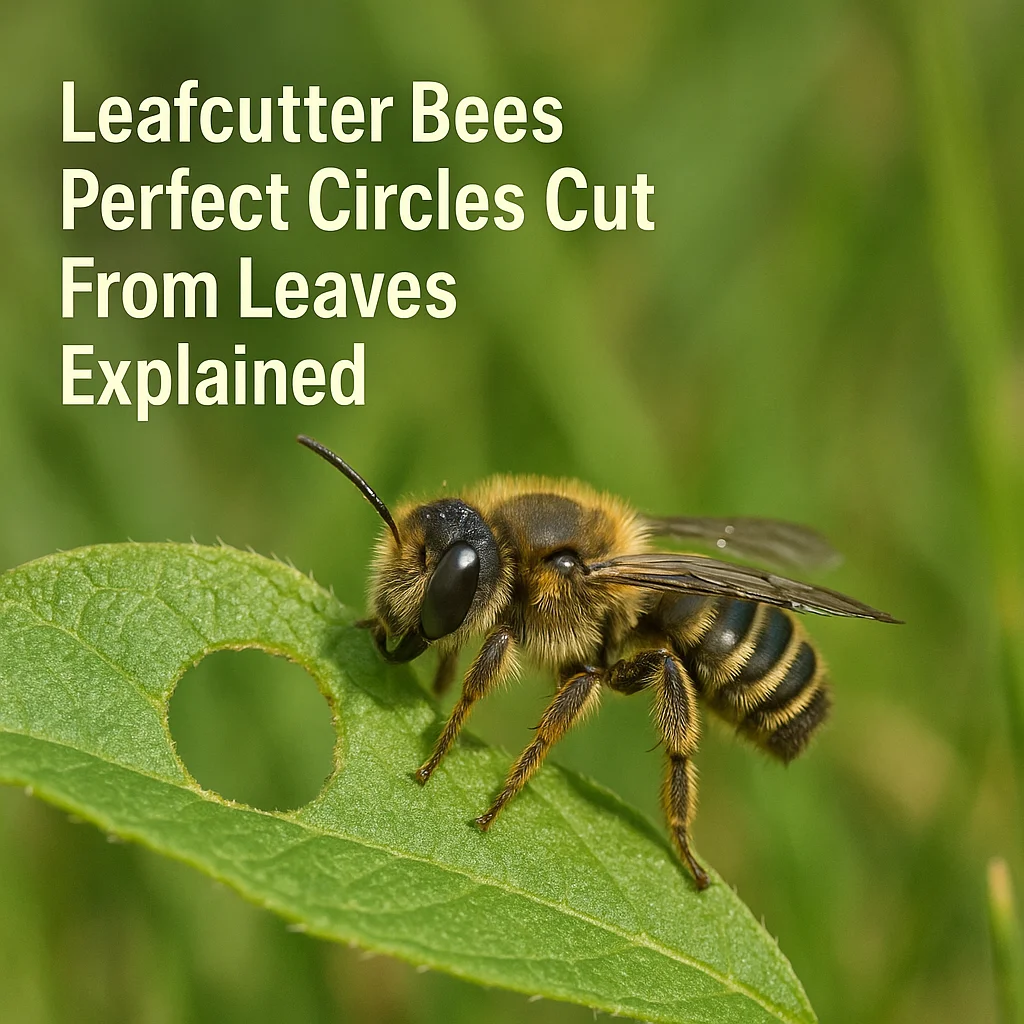
- Common names: Leafcutter bees, rose-leaf cutter bees
- Scientific name: Varies by species (common genera include Megachile and Anthidium)
- Insect or not: Yes, they are invertebrates
- Order / family: Order: Hymenoptera, Family: Megachilidae
- Typical size range: 5-24 mm
- Key colors/patterns: Generally black or dark in color with pale stripes or spots
- Activity: Diurnal
- Typical habitats: Gardens, meadows, open fields
- Where in the world it occurs: Found on every continent except Antarctica
- Seasonality: During warmer months, typically spring to late summer
🔍 Identification
Leafcutter bees can be identified by their robust and somewhat flattened body shape. They have a distinctive way of carrying pollen on the underside of their abdomen rather than on their legs, which is common in other bees.
- Body shape: Robust, elongated with a slightly flattened appearance
- Antennae: Moderately long and elbowed
- Wing features: Transparent wings with few veins
- Leg traits: Equipped with stiff hairs for pollen collection
- Distinguishing look-alikes: Often confused with honeybees but do not have the same yellow-orange color
- Top ID Tips
- Look for perfectly cut leaf circles in the vicinity
- Pollen carried noticeably on the abdomen
- Stiff hairs on hind legs
- Compact, robust body shape
- Active during sunny times of the day
- More solitary behavior compared to honeybees
🧠 Basic Body Structure
As insects, leafcutter bees have three main body sections: the head, thorax, and abdomen. They possess six legs, characteristic of the insect class, and are protected by an exoskeleton. These bees undergo molting as they grow and feature wings that are crucial for their mobility and pollen-gathering activities. Leafcutter bees are invertebrates, meaning they lack a backbone, and rely on their exoskeleton for support and protection.
🌍 Habitat & Distribution
Leafcutter bees are highly adaptable and can thrive in various environments. Commonly found in gardens, open fields, and meadows, they appreciate habitats rich with flowering plants. Globally, they are distributed across temperate and tropical regions, except the extreme cold of Antarctica. Their adaptability in habitat allows them to populate both wild and urban areas, where they often find suitable nesting sites.
📅 Seasonal Appearance & Activity
These bees are most active in warm weather during the spring and extending into the late summer. They are diurnal, with activity peaking on sunny days when flowers are in bloom. Leafcutter bees generally avoid wet and cold conditions, with their activity notably decreasing during rainy periods.
- Best Time to Spot It
- Spring through late summer
- Midday to afternoon
- Dry, sunny weather
- In gardens with abundant flowering plants
🥚 Reproduction & Egg-Laying
Leafcutter bees are solitary breeders known for their unique nesting habits. They utilize cut leaf pieces to line their nests, which are often constructed in pre-existing cavities such as hollow plant stems or wood holes. The female constructs each cell of the nest individually, laying a single egg within and providing it with a pollen supply for the larva to feed on. The number of eggs varies according to individual capability and environmental factors.
🌀 Metamorphosis & Life Cycle
These bees undergo complete metamorphosis, transitioning through the stages of egg, larva, pupa, and adult. After the female lays an egg, the larva emerges and feeds on the pollen provided. The larval stage takes place inside the nest, secure in the leafy enclave. Following sufficient growth, the larva enters the pupal stage, where it metamorphoses into an adult bee over several weeks. Adult bees emerge ready to forage and fulfill their role in the ecosystem.
🍽️ Diet & Feeding Behavior
Leafcutter bees predominantly feed on nectar, supplementing their diet with pollen needed for larval development. They possess chewing mouthparts designed to cut leaves and gather pollen efficiently, playing a pivotal role as pollinators. These bees are not predators, but herbivores, focusing on plant-derived nutrition.
🦉 Predators & Defense
Leafcutter bees face predation from various birds, spiders, and larger insects. To defend themselves, they rely on their ability to mimic other bees and wasps, deterring potential predators. Their speed and agility aid in evasion, while their nests provide sanctuary for eggs and larvae.
- Defense Highlights
- Uses camouflage to blend with surroundings
- Builds nests in secluded, protective sites
- Evasive flying behaviors
- Essential pollinator, reducing human threat perception
👥 Social Behavior & Swarms
Unlike honeybees, leafcutter bees are solitary and do not form colonies. Each female is responsible for constructing her nest and raising her offspring independently. While they may nest in proximity to each other, there is no cooperative interaction among individuals.
🧭 Senses & Communication
Leafcutter bees are equipped with highly developed senses, particularly vision and smell, which are critical for foraging and identifying flowers. They communicate mainly through chemical pheromones, which guide solitary nest-building and territorial behavior.
🌱 Role in the Ecosystem
As effective pollinators, leafcutter bees hold a significant ecological role, supporting the reproduction of a wide range of plants. They contribute to plant health and diversity, indirectly supporting other wildlife. Relationships with plants are generally mutualistic, benefiting both the bees and the flora they pollinate.
📉 Population & Conservation Notes
Leafcutter bee populations vary locally, and while often common, they face threats from habitat loss, pesticide use, and climate changes. Conservation efforts focus on creating bee-friendly environments, reducing chemical exposure, and promoting biodiversity within landscapes.
- How to Help (Low-Impact)
- Plant native flowers
- Minimize pesticide use
- Maintain natural nesting sites
- Support conservation and awareness programs
⚠️ Human Interaction & Safety
While leafcutter bees are capable of stinging, they generally do so only in defense if directly threatened. Their sting is mild compared to social bees. Should a sting occur, washing the affected area and monitoring for allergic responses is advisable. Observing bees in their natural setting without interference promotes harmonious coexistence.
📌 Summary
- Identified by robust body, fastidious leaf-cutting
- Inhabit diverse environments, aid in plant pollination
- Active in warm months, seek sunny weather
- Solitary breeders with distinctive nesting behavior
- Complete metamorphosis lifecycle
- Primarily nectar and pollen feeders
- Subject to predation by birds and insects
- Essential to ecosystems as pollinators
- Positively impacted by conservation efforts
- Resilient interaction with humans when respected