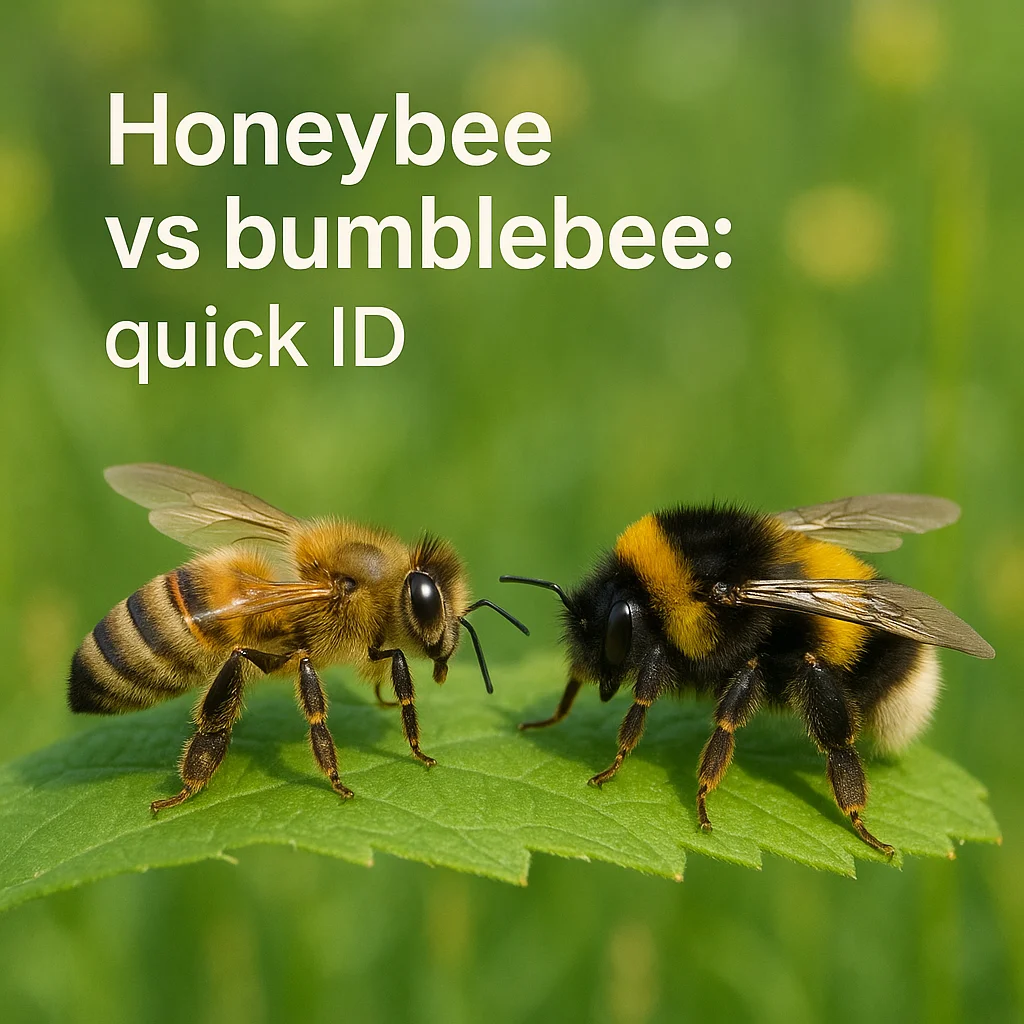
🕷️ Honeybee vs bumblebee: quick ID
🧾 Quick Facts
Honeybees and bumblebees are both vital pollinators known for their role in ecosystems around the world. In this quick ID guide, we detail the essential facts to help you distinguish between these two important bee types.
- Common names: Honeybee (Apis species), Bumblebee (Bombus species)
- Scientific name: Varies by species
- Insect or not: Insect (invertebrate)
- Order / family: Hymenoptera / Apidae
- Typical size range: Honeybee: 12–15 mm; Bumblebee: 10–23 mm
- Key colors/patterns: Honeybee: brown and amber bands; Bumblebee: black and yellow bands
- Activity: Primarily diurnal
- Typical habitats: Gardens, meadows, forests, agricultural areas
- Where in the world it occurs: Most continents except Antarctica
- Seasonality: Late spring to early autumn
🔍 Identification
Identifying honeybees and bumblebees can initially be challenging due to their similar size and coloring. However, there are distinct differences to look for:
- Body shape and silhouette: Honeybees have a slender, streamlined body whereas bumblebees are more robust and rounded.
- Antennae type: Both feature elbowed antennae, although bumblebees typically have slightly shorter and thicker ones.
- Wing features: Both have two pairs of wings, but bumblebee wings can appear more translucent.
- Leg traits and movement style: Bumblebees have hairy legs that often carry pollen in a visible "basket"; honeybees do this as well but less conspicuously.
- Distinguishing look-alikes and common confusion: Bumblebees can be mistaken for certain types of flies due to their roundness, while honeybees are sometimes confused with wasps due to their sleek appearance.
- Top ID Tips:
- Spot the abdomen: longer and slimmer for honeybees; rounder for bumblebees.
- Note the tail: bumblebees often have a white or red patch, honeybees do not.
- Observe flight: honeybees glide more, bumblebees have a more erratic flight path.
- Listen for buzzing: both buzz, but bumblebees are typically louder.
- Look at color bands: more myelinated for bumblebees.
- Consider behavior: bumblebees, being heavier, appear lazier in their flight.
- Pollen carrying: observe “pollen baskets” on hind legs.
- Habitat presence: honeybees more commonly found in larger colonies.
- Wing visibility: bumblebee wings appear shorter than total body length.
🧠 Basic Body Structure
Both honeybees and bumblebees share the standard insect body structure of a head, thorax, and abdomen, with three pairs of legs and two pairs of wings. As insects, they possess a vertebrate or invertebrate: invertebrate form, meaning they lack a backbone, and are instead supported by an exoskeleton. This exoskeleton protects their internal organs and provides structural integrity. As with all insects, they molt their exoskeletons to grow.
🌍 Habitat & Distribution
Honeybees and bumblebees inhabit diverse environments ranging from temperate gardens and meadows to urban parks and orchards. Bumblebees are more likely to thrive in cooler climates due to their ability to regulate body temperature, which is why they are often found in higher altitudes and colder regions. Honeybees are more dependent on milder climates and tend to be more populous in temperate and tropical zones. Both require habitats rich in flowering plants, which are essential for their survival. Habitat loss significantly affects their distribution and abundance, as they rely on stable environments for foraging. Urbanization, agricultural development, and climate change pose ongoing threats to their natural habitats.
📅 Seasonal Appearance & Activity
Both bees are most active during the warmer months when flowers are in full bloom. The flowering season directly influences their activity levels, as it determines the availability of nectar and pollen.
- Best Time to Spot It:
- Spring through early fall for both species
- Early morning to midday when foraging
- During sunny, calm conditions
- After rain showers when flowers open
- Avoid extremely high temperatures
- In sheltered spots out of strong wind
🥚 Reproduction & Egg-Laying
In both species, reproduction typically occurs within well-defined colonies. Queen bees play a central role, and their behavior influences colony stability. Honeybee queens lay eggs in structured hives, with a single queen capable of laying thousands of eggs in controlled environments. Bumblebee queens find suitable nest sites in abandoned burrows or cavities where they establish colonies by laying eggs in small wax cups that incubate and hatch independently.
🌀 Metamorphosis & Life Cycle
Honeybees and bumblebees undergo complete metamorphosis, transitioning through the egg, larva, pupa, and adult stages.
The egg stage lasts around 3 days for both. Larval stage: Over 5-6 days, the growing larva is fed by worker bees. Pupation occurs after larvae spin protective cocoons in honeybees or in wax cells in bumblebees. Pupation lasts roughly a week. Adult bees emerge, ready to begin their roles within the hive.
🍽️ Diet & Feeding Behavior
Both bee types are primarily pollinators, consuming nectar as their main carbohydrate source. They collect pollen as a protein source, which fulfills nutritional needs for adult bees and developing larvae. Honeybees possess a specialized tongue for lapping up nectar, while bumblebees have robust mandibles and longer tongues to access deep flowers.
🦉 Predators & Defense
Natural predators include birds, spiders, and some mammals. Both bees employ strategies like stinging, buzzing defensively, and using chemical signals to deter threats. Bumblebees rely more on their loud buzz and larger size for intimidation, while honeybees use pheromones to coordinate defense efforts in their colonies.
- Defense Highlights:
- Pheromone release for alerting hive mates
- Coordinated swarm defenses in honeybees
- Stingers as deterrents, mainly in colony defense
- Camouflage ability of bumblebees due to color variation
👥 Social Behavior & Swarms
Honeybees are highly social, living in well-organized colonies that can consist of up to tens of thousands of individuals. Each colony has a structured hierarchy, with workers, drones, and a queen working cohesively. Bumblebees also live in social colonies but on a smaller scale, often fewer than 500 individuals. In contrast to the perennial honeybee colonies, bumblebee colonies are annual, dying out each year except for new queens that hibernate over winter.
🧭 Senses & Communication
Bees rely heavily on vision and olfaction. Their compound eyes detect UV light, and they have a strong sense of smell to locate flowers and communicate through pheromones. Honeybees perform the "waggle dance" to share information about food sources' locations. Bumblebees communicate more through scent trails and physical cues.
🌱 Role in the Ecosystem
As pollinators, honeybees and bumblebees are crucial for the reproduction of flowering plants, which supports broader ecosystems and agricultural productivity. Bumblebees can pollinate in colder, cloudier conditions, aiding crops like tomatoes and blueberries. Honeybees are vital for large-scale crop pollination, including almonds and apples.
📉 Population & Conservation Notes
Many bee populations face decline due to disease, habitat loss, and pesticide use. Bumblebees are more threatened due to their specialized habitat needs compared to honeybees, which are kept largely in managed hives. Conservation efforts emphasize native plant restoration and pesticide reduction.
- How to Help (Low-Impact):
- Plant native, bee-friendly flowers
- Minimize pesticide usage
- Provide natural habitats with lawn reduction
- Support conservation initiatives and education
- Maintain gardens with diverse and continuous bloom
- Encourage local farms with sustainable practices
⚠️ Human Interaction & Safety
Bumblebees and honeybees can sting when threatened but are generally non-aggressive while foraging. If stung, washing the area with soap and water helps reduce infection risk. Avoid scratching and seek professional help if severe reactions occur. Ensure respectful observation and avoid harming or capturing individuals.
📌 Summary
- Honeybees and bumblebees are essential pollinators with distinct visual traits and behaviors for identification.
- These social insects play varied roles in natural ecosystems and agriculture.
- Both prefer habitats rich in flowering plants and are influenced by seasonal blooms.
- Reproduction occurs within structured colonies with an annual or perennial lifecycle.
- Predators are diverse; defense includes stinging and misdirection.
- They communicate through scent, dances, sounds, and patterns.
- Populations decline is concerning due to ecological disruptions.
- Ensure safety and conservation by minimizing harm and supporting habitats.