🕷️ Bee myths: “all bees make honey” (false)
🧾 Quick Facts
Many people believe that all bees produce honey, but this is a myth. Most bee species do not make honey; instead, they have diverse lifestyles and behaviors that reflect their ecological roles. Here is a quick look at why not all bees produce honey:
- Common names: Bees, solitary bees, bumblebees, stingless bees
- Scientific name: Varies
- Insect or not: Insect; bees are invertebrates
- Order / family: Hymenoptera / various families
- Typical size range (adult): 2 mm to 40 mm
- Key colors/patterns: Yellow, black, brown, metallic colors
- Activity: Primarily diurnal
- Typical habitats: Gardens, forests, grasslands, savannas
- Where in the world it occurs: Worldwide except Antarctica
- Seasonality: Varies; generally spring through autumn
🔍 Identification
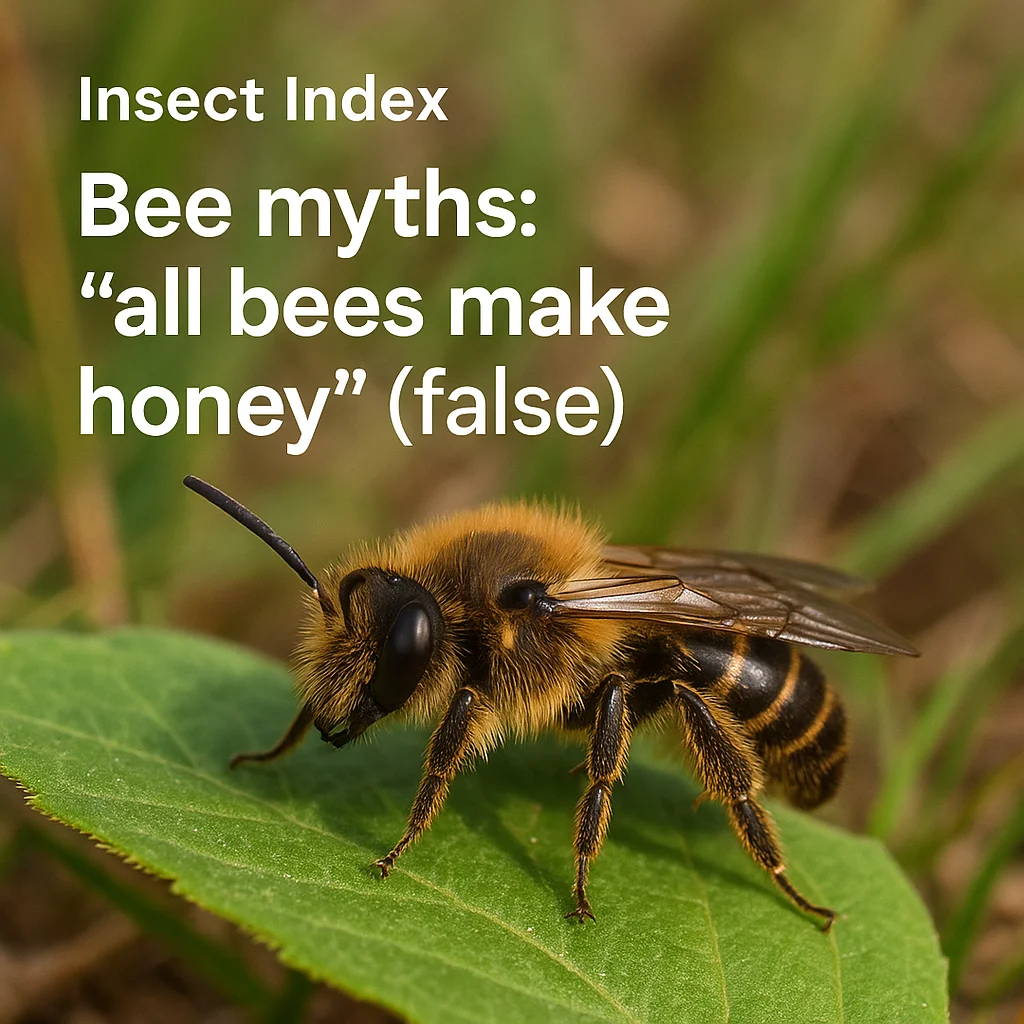
Recognizing bees in the field involves noting their size, body shape, and behavior. Bees generally have a robust, hairy body which helps them collect pollen. Their antennae are often elbowed and long.
Bees have two pairs of membranous wings, with the hind wings smaller than the forewings. Their legs are adapted for gathering pollen, and they tend to move with a buzz, often around flowers. Look-alikes include wasps, which have a slimmer body and smoother appearance, and flies, which lack the dual pair of wings.
- Top ID Tips:
- Noticeably hairy bodies
- Elbowed antennae
- Two pairs of wings
- Pollen baskets on hind legs
- Buzzing movement pattern
- Brightly colored abdomens (in some species)
- Prefer flowers for nectar and pollen
- Rounded, robust body shape
🧠 Basic Body Structure
Bees have three main body segments: the head, thorax, and abdomen. They are true insects, meaning they have six legs. Covered by an exoskeleton, bees undergo molting during their development stages. Most have wings, essential for their roles in pollination.
As invertebrates, bees lack a spinal column. Instead, their exoskeleton provides structure and protection, significant in the life of a bee.
🌍 Habitat & Distribution
Bees prefer diverse habitats depending on the species. While some thrive in lush forests and woodlands, others are well-suited to open grasslands, urban gardens, and arid environments. Some build their nests in hollow trees, underground, or in man-made structures.
Bees are found on all continents except Antarctica, thriving in environments ranging from tropical to temperate. Climate change and habitat destruction can affect their presence and abundance in certain areas.
📅 Seasonal Appearance & Activity
Bees are primarily seen during the warmer months when flowers are abundant, usually from spring to late autumn. They are diurnal, actively foraging during daylight hours. Weather conditions such as rain and temperature influence their activity, with bees less likely to be seen during wet or extremely cold weather.
- Best Time to Spot It:
- Spring through autumn
- During daytime sunny hours
- In gardens or fields full of blooms
- Less active during rainy periods
🥚 Reproduction & Egg-Laying
Most bees have distinct mating rituals where males often compete over territories to attract females. Fertilized females lay eggs in a variety of substrates, like soil, plant stems, or in preexisting cavities.
The number of eggs laid varies significantly among species. Solitary bees may lay only a few eggs per season, while social bees within a colony can collectively produce thousands, emphasizing the diversity in reproductive strategies.
🌀 Metamorphosis & Life Cycle
Bees experience complete metamorphosis with four life stages: egg, larva, pupa, and adult. After hatching, larvae consume stored pollen and nectar provisions. This stage is often spent in a secluded, structure-protected cell.
Following larval development, bees enter the pupal stage, transforming significantly before emerging as adults. The duration of each stage varies widely across bee species, largely influenced by environmental factors.
🍽️ Diet & Feeding Behavior
At all life stages, bees predominantly consume nectar and pollen. Adult bees use specialized mouthparts, often adapted for both chewing and suckling, to access food. As pollinators, bees play essential roles in plant reproduction.
While some bee species might act as predators or scavengers, most serve as specialized pollinators, contributing dramatically to ecological systems and agricultural productivity.
🦉 Predators & Defense
Bees face numerous natural threats, including birds, small mammals, spiders, and parasitoid wasps. To defend themselves, some bees have evolved stings, allowing them to deliver painful discouragements to predators.
Many non-stinging bees rely on camouflage, mimicry, or retreating to the safety of their nests. Bees can also exhibit startle behaviors or use their agile flight to evade potential threats.
- Defense Highlights:
- Stingers in some species
- Camouflage and mimicry
- Agile flight capabilities
- Retreating to nests for safety
👥 Social Behavior & Swarms
Bee behavior varies considerably; some are social, forming colonies with intricate roles and cooperative dynamics, like honeybees and bumblebees. Within colonies, communication via pheromones and 'dances' helps coordinate activities.
Solitary bee species are more individualistic, typically seen operating independently except during mating. Swarming behavior, common in honeybees, is a natural colony division process driven by resource availability and population density.
🧭 Senses & Communication
Bees utilize several sensory mechanisms, including excellent vision with compound eyes, acute olfactory senses for detecting pheromones, and sensitive hairs for touch detection. These faculties assist them in finding flowers and communicating within species.
Communication among certain bees involves unique patterns, such as waggle dances in honeybees, which convey information about resource locations and distance from the hive.
🌱 Role in the Ecosystem
Bees are pivotal in ecosystems as primary pollinators, supporting the reproduction of flowering plants, which serve as the basis for many terrestrial food webs. Their activities affect biodiversity and agricultural systems globally.
Bees interact with plants through mutualistic relationships, supporting plant diversity. While bees contribute immensely to pollination, overpopulation in commercial practices can occasionally stress local ecosystems.
📉 Population & Conservation Notes
The bee population status is complex, with some species abundant, while others face significant threats due to habitat loss, pesticide use, and climate shifts. Data remains limited, though regional declines are documented.
- How to Help (Low-Impact):
- Plant native, pollinator-friendly flora
- Minimize pesticide use in gardens and yards
- Preserve natural habitats and nesting sites
- Encourage sustainable agricultural practices
⚠️ Human Interaction & Safety
Some bees sting defensively, primarily when threatened. Honeybee stings can cause allergic reactions in sensitive individuals. First aid involves washing stung areas and seeking medical advice if reactions are severe.
People are encouraged to observe bees respectfully, maintaining a safe distance and avoiding interference in their natural activities. Not collecting wild specimens supports their wellbeing and ecological roles.
📌 Summary
- Not all bee species produce honey
- Found in diverse habitats across the globe
- Bees are mostly active in warmer months
- Undergo complete metamorphosis
- Primarily feed on nectar and pollen
- Face threats from numerous predators
- Essential pollinators in ecosystems
- Populations are affected by environmental changes
- Some species can sting defensively