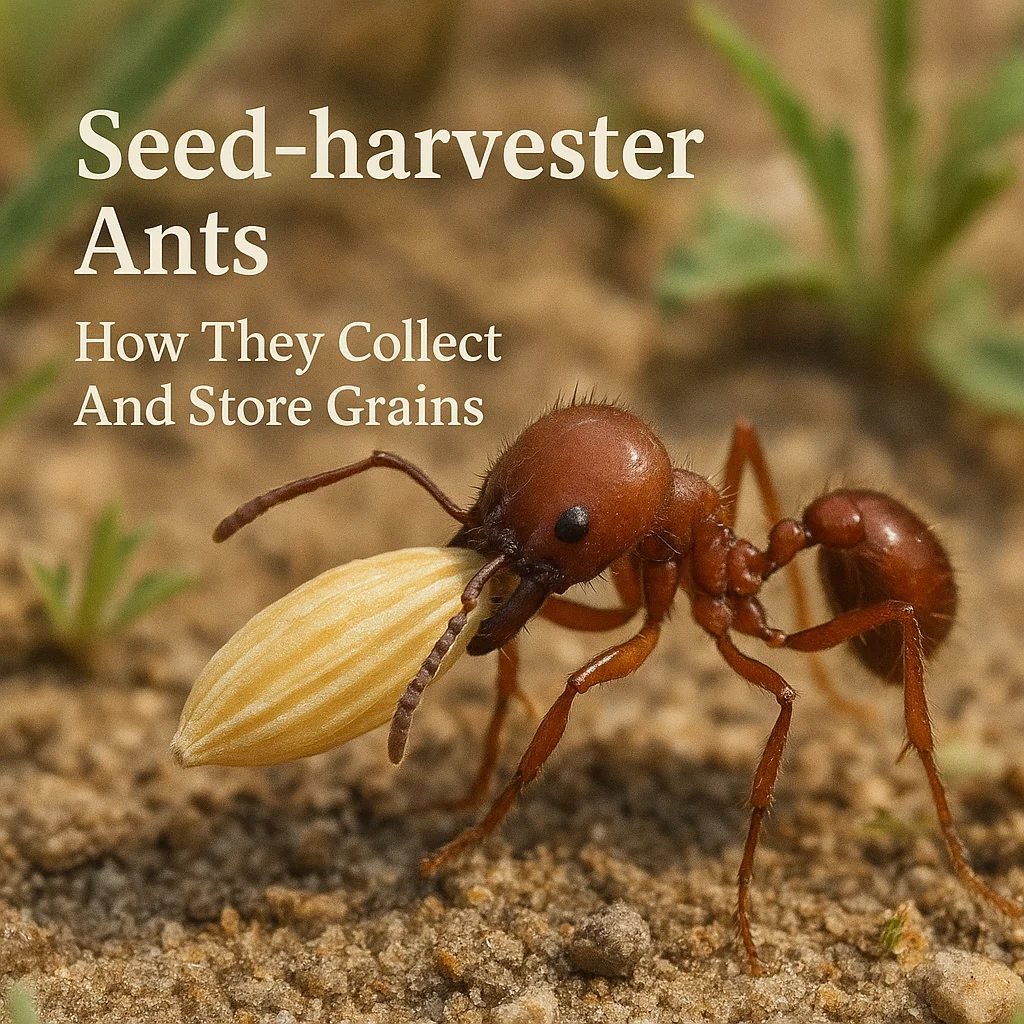
🕷️ Seed-harvester Ants How They Collect And Store Grains
🧾 Quick Facts
Seed-harvester ants are fascinating insects known for their unique behavior of collecting and storing seeds and grains. These ants are most commonly seen in various regions, adapting to different environments and playing a significant role in their ecosystems.
- Common Names: Seed-harvester ants, grain ants
- Scientific Name: Varies by species
- Insect or Not: Yes, they are insects (invertebrates)
- Order/Family: Hymenoptera/Formicidae
- Typical Size Range: 3 to 10 mm (adult)
- Key Colors/Patterns: Typically reddish-brown or black
- Activity: Primarily diurnal (active during the day)
- Typical Habitats: Grasslands, deserts, semi-arid regions
- Where in the World: Found in North America, Europe, Africa, and Asia
- Seasonality: Most visible in spring and summer
🔍 Identification
Recognizing seed-harvester ants in the field involves observing their distinctive body shape and behavior. These ants have a segmented body with a distinct head, thorax, and abdomen. Their antennae are elbowed, and workers lack wings, although winged alates (reproductive ants) are present during the breeding season. They have strong, well-developed mandibles important for their seed collection. Their legs are adapted for quick movement across their habitats, often seen carrying seeds back to their nests.
Seed-harvester ants can be mistaken for other ant species, but their behavior and preferred habitats, along with their size and mandible structure, can help differentiate them.
- Compact, segmented body with a smooth appearance
- Elbowed antennae that facilitate seed detection and coordination
- No wings in workers; wings are present in reproductive alates
- Strong mandibles for seed collection
- Quick movement, noting seed-carrying behavior
- Typically found in open, dry environments
- Color usually reddish-brown or black
- Observance of distinct nest mounds or openings
- Large storage areas within nests for seeds
🧠 Basic Body Structure
As insects, seed-harvester ants have a body divided into three main parts: the head, thorax, and abdomen. They have six legs, which are jointed and allow for rapid movement. Their exoskeleton provides protection and support. Like all insects, they are invertebrates, meaning they lack a backbone. Seed-harvester ants do not undergo molting in adulthood but have distinct life stages as part of their development. Wings are present only in reproductive members of the colony during the mating season.
🌍 Habitat & Distribution
Seed-harvester ants are primarily found in dry, open areas such as grasslands, deserts, and semi-arid regions. They thrive in environments where seeds are abundant and where they can easily build their subterranean nests. Microhabitats often include areas under rocks or sparse vegetation where they can protect their nests from predators and harsh weather conditions. While native to various continents including North America, Europe, Africa, and Asia, specific species may be restricted to particular climates and regions. Changes in habitat due to urbanization or agriculture can impact their presence and visibility in certain areas.
📅 Seasonal Appearance & Activity
Individuals are most commonly observed during the warmer months when seed availability peaks. They are typically active during the day, capitalizing on the heat and available sunlight to collect resources and construct or maintain their nests. Weather conditions such as temperature and humidity significantly influence their activity levels, often reducing visibility during extreme heat or inclement weather.
- Most visible during late spring and early summer
- Active primarily during daylight hours
- Higher activity in warm, dry weather
- Lower visibility during extreme weather conditions
🥚 Reproduction & Egg-Laying
Mating behavior generally occurs during specific seasons when environmental conditions are optimal. Winged reproductive ants (alates) leave the nest to form new colonies. Males and females engage in nuptial flights, after which the males often die shortly afterward. After mating, the fertilized queen establishes a new colony by laying eggs in an underground chamber. Egg-laying strategies vary, often influenced by environmental conditions and resource availability.
🌀 Metamorphosis & Life Cycle
Seed-harvester ants undergo complete metamorphosis, consisting of four stages: egg, larva, pupa, and adult. Eggs hatch into larvae which are fed by worker ants. The larval stage is critical as they require nourishment and protection until pupation. During the pupal stage, significant transformation occurs as they develop into adults. The duration of each stage can vary based on species and environmental conditions, typically spanning several weeks to a few months.
As adults, workers collect seeds and maintain the nest, while reproductive ants engage in colony expansion through breeding.
🍽️ Diet & Feeding Behavior
Seed-harvester ants are predominantly granivorous, scavenging seeds and grains from their surroundings. Their specially adapted mandibles are used to break down tough seed coats, allowing them to access the nutritious contents. As larvae are fed by worker ants, coordination is essential for providing sufficient food to developing members. These ants contribute significantly to seed dispersal and nutrient cycling in their ecosystems.
🦉 Predators & Defense
Natural predators of seed-harvester ants include birds, reptiles, amphibians, and some mammals that prey on their nests. They employ several defense strategies in response to threats. These include retreating into their nests, using mandibles for biting, or releasing alarm pheromones to alert the colony of danger. The structure of their nests also serves as a protective measure against intruders.
- Use of underground nests for protection
- Alarm pheromones to coordinate collective defense
- Strong mandibles for biting if threatened
- Camouflage with surrounding environment
👥 Social Behavior & Swarms
Seed-harvester ants are highly social, living in colonies with a well-defined hierarchy and division of labor. Roles within the colony include workers, soldiers, and reproductive individuals. Communication is primarily through chemical signals, enabling cooperation and collective decision-making. Swarming behavior originates from reproductive activities, particularly during mating seasons when swarms of winged ants leave to establish new colonies.
🧭 Senses & Communication
These ants possess acute senses, essential for survival and efficient resource gathering. Vision allows for navigation, although pheromones play a principal role in communication. Ants leave chemical trails to guide others to food sources and back to the nest. Touch and vibration detection are also utilized for internal colony communication and detecting external threats.
🌱 Role in the Ecosystem
Seed-harvester ants are crucial to their ecosystems, contributing to processes such as seed dispersal and soil aeration. By collecting and storing seeds, they facilitate germination and new plant growth. Additionally, their activities help cycle nutrients and improve soil quality. While beneficial, they can affect agricultural areas by altering seed availability for crops.
📉 Population & Conservation Notes
Generally considered common and adaptable, seed-harvester ant populations can be impacted by habitat destruction, pesticides, and climate change. Efforts to preserve their habitats, such as maintaining local flora and reducing chemical usage, can support their continued presence. Monitoring population changes can provide insights into broader environmental shifts.
- Plant native vegetation in gardens
- Avoid using pesticides in ant-populated areas
- Promote habitats such as grassland preservation
- Support research and conservation initiatives
⚠️ Human Interaction & Safety
While seed-harvester ants can bite if threatened, they are generally not aggressive toward humans. It is advisable to observe them respectfully, maintaining a safe distance to avoid contact. If a bite occurs, washing the area gently and seeking professional help for severe reactions is recommended. Observing without interfering helps support their natural roles in ecosystems.
📌 Summary
- Recognizable by their mandibles and seed-collecting behavior
- Found in dry, open habitats such as grasslands and deserts
- Most visible during warmer months, primarily diurnal
- Undergoes complete metamorphosis, influencing life cycle
- Granivorous, contributing to seed dispersal and ecosystem stability
- Faced by natural predators, employ collective defense tactics
- Highly social, organized colonies with diverse roles
- Population impacted by environmental changes; conservation efforts are beneficial
- Safe to observe from a distance without risk of aggression