🕷️ Leafcutter ants: fungus farming explained
🧾 Quick Facts
Leafcutter ants are a remarkable group of ants known for their unique method of fungus farming. Found predominantly in the Americas, these industrious insects play a critical role in their ecosystems by recycling plant material and enhancing soil fertility.
- Common names: Leafcutter ants, parasol ants
- Scientific name: Varies (e.g., Atta, Acromyrmex)
- Insect or not: Insect (invertebrate)
- Order / family: Hymenoptera / Formicidae
- Typical size range (adult): 1 cm to 1.5 cm
- Key colors/patterns: Dark brown, reddish-brown
- Activity: Mostly nocturnal, but some diurnal activities observed
- Typical habitats: Tropical forests, savannas, grasslands
- Where in the world it occurs: Central and South America
- Seasonality: Visible year-round in warm climates
🔍 Identification
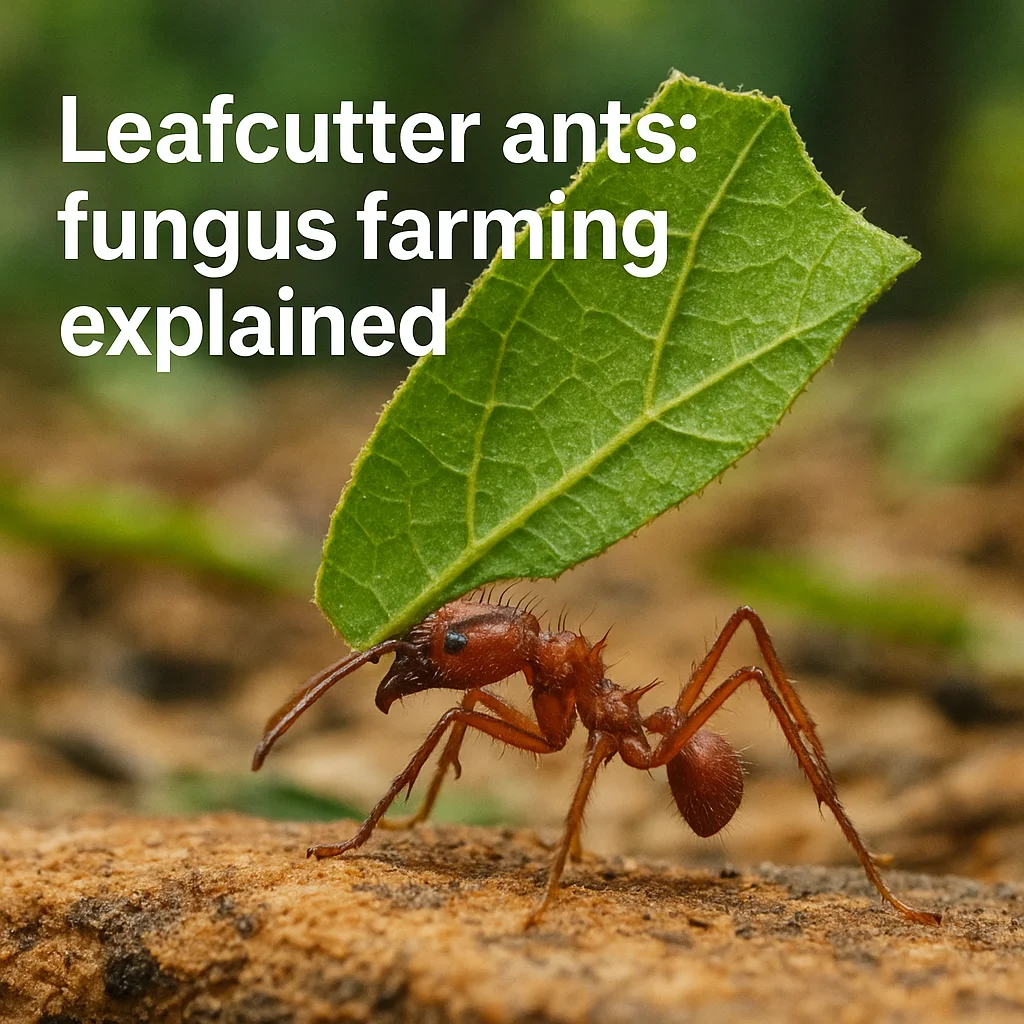
Leafcutter ants are easily identifiable by their distinctive behavior of carrying large pieces of leaves above their heads, resembling parasols. These ants have a robust body, with a pronounced thorax and spiked ridges (in some species) to aid in carrying leaves. They possess elbowed antennae typical of ants, used for communication and navigation.
- Distinctive body shape forming a straight-line silhouette when carrying leaves
- Elbowed antennae, crucial for tactile communication
- Winged individuals (females) present during mating flights
- Strong mandibles adapted for cutting leaves
- Colored from dark brown to reddish hues
- Often mistaken for army ants but distinguished by their leaf-carrying behavior
- Whole specimen in frame essential for accurate ID
🧠 Basic Body Structure
Like all insects, leafcutter ants possess three main body parts: the head, thorax, and abdomen. They have six legs and an exoskeleton that provides support and protection. The rigid exoskeleton, combined with the process of molting, allows them to grow. Some species exhibit wings during certain life stages, notably the reproductive phase.
As invertebrates, leafcutter ants lack a backbone, relying on their exoskeletal structure for movement and physical integrity, providing a versatile adaptation for their ecological role.
🌍 Habitat & Distribution
Leafcutter ants thrive in a variety of tropical and subtropical environments. They favor areas with abundant foliage like forests and grasslands. These habitats provide the necessary resources to support their fungus farming activities. Typical microhabitats include areas adjacent to tree roots or near fallen logs, where colonies can securely process and cultivate their fungal gardens.
The geographic range of leafcutter ants includes most of Central and South America. They are most prevalent in humid tropical environments, although some species have adapted to drier conditions. Climate changes can influence ant populations, with dense vegetation promoting greater success for colonies.
📅 Seasonal Appearance & Activity
Leafcutter ants are a year-round presence in tropical ecosystems, primarily active during warmer, wetter periods. Although primarily nocturnal, these ants can also be observed during the day, especially during the rainy season when humidity assists in leaf-cutting activities and fungal cultivation.
- Most visible in the rainy season
- Nocturnal, but also active on overcast days
- Attending to fungi gardens mainly at night
- Activity decreases during extreme dry spells
- Best spotted in regions with stable, warm climates
🥚 Reproduction & Egg-Laying
Reproductive behaviors of leafcutter ants include spectacular mating flights, where winged males and females leave the colony to mate. After mating, the female, now a queen, loses her wings and establishes a new colony. Eggs are typically laid in subterranean nests, meticulously cared for by worker ants.
The number of eggs a queen can lay varies significantly, reflecting colony size and environmental conditions, with larger colonies supporting high reproductive output. Eggs are laid directly onto the cultivated fungus to ensure immediate sustenance upon hatching.
🌀 Metamorphosis & Life Cycle
Leafcutter ants undergo complete metamorphosis, consisting of egg, larva, pupa, and adult stages. Eggs hatch into larvae that consume fungus exclusively, nurtured by worker ants within protected chambers.
The larval stage sees rapid growth over weeks, leading to pupation, where larvae transform within cocoons. This pupal stage is the transitional phase leading to mature, leaf-cutting adults ready to expand the colony's underground and above-ground structures.
🍽️ Diet & Feeding Behavior
Leafcutter ants have a unique diet centered around the cultivation of fungus, which they farm using cut plant material. Workers harvest leaves, which they transport to their nests, process, and use as a substrate for growing fungus, their primary food source.
Their mandibles are specially adapted for cutting, with a strong, saw-like edge enhancing their ability to harvest plant matter. Although considered herbivores due to their plant-cutting behavior, leafcutters are more accurately termed fungivores given their reliance on fungi.
🦉 Predators & Defense
Natural predators of leafcutter ants include birds, reptiles, amphibians, and spiders, which prey on the ants traveling between foraging sites and the colony. However, leafcutters employ several defense strategies to mitigate predation.
Ants rely on speed and cooperation, using pheromone trails to quickly mobilize defensive swarms. Certain species possess powerful bites and chemical secretions as further deterrents to potential threats.
- Quick mobilization of colony members
- Use of chemical defenses against predators
- Camouflage through ground cover usage
- Cooperative effort in colony defense
👥 Social Behavior & Swarms
Known for their complex social structure, leafcutter ants exemplify eusociality with defined roles within their colony. The colony is home to a queen, workers of various sizes, and occasionally, winged reproductives.
Communication among ants is vital for coordination, as they create extensive pheromone trails for navigation and indicate food sources. Swarming behavior is observed during mating flights, triggered by environmental cues like humidity and temperature changes.
🧭 Senses & Communication
Leafcutter ants rely heavily on chemical communication, employing pheromones to track routes, warn of danger, and coordinate leaf-cutting raids. Their vision is primarily suited for detecting light levels, with ocelli aiding navigation. Tactile sensation through antennae enables efficient interaction and environmental perception.
A colony's success heavily depends on precise communication channels, ensuring resource allocation and coordinated foraging missions.
🌱 Role in the Ecosystem
Leafcutter ants are pivotal to their ecosystem, acting as decomposers through their leaf processing and aiding nutrient recycling. Their subterranean farming significantly aerates the soil, enhancing its fertility. Their activities create microhabitats for other species, fostering biodiversity.
However, they occasionally conflict with agricultural interests, as their leaf-cutting can damage crops. Despite this, their ecological benefits often outweigh drawbacks, promoting rich habitats and diverse ecological connections.
📉 Population & Conservation Notes
Leafcutter ant populations typically remain robust in their natural habitats, with local abundances reflecting resource availability. Habitat loss and pesticide use can negatively impact colonies, though data on global population trends is limited.
- Maintain diverse, natural vegetation
- Reduce pesticide usage in vulnerable areas
- Encourage habitat conservation projects
- Support ecological research and monitoring
⚠️ Human Interaction & Safety
Leafcutter ants are generally non-aggressive toward humans, although they can bite when threatened. Their bites may cause minor irritation; it's best to clean the area and avoid scratching. If reactions worsen, professional medical advice should be sought.
People are encouraged to appreciate these ants from a distance, respecting their role in natural ecosystems and avoiding interference with their colonies.
📌 Summary
- Easy to recognize by their distinctive leaf-carrying behavior
- Thrives in tropical and subtropical regions, visible year-round
- Engages in complex fungus farming and social behaviors
- Undergoes complete metamorphosis from egg to adult
- Feeds primarily on cultivated fungus
- Faces predation from various natural enemies
- Important ecological role in decomposition and soil aeration
- Generally safe for human interaction, with mild potential for bites