🕷️ Ant myths: “ants never sleep” (nuance)
🧾 Quick Facts
Ants are a fascinating subject due to their complex social structures and behaviors. The myth that ants never sleep has circulated widely, but it is more nuanced than it appears. Ants do indeed rest, albeit in a manner different from humans. This field guide aims to shed light on the various aspects of ant biology, behavior, and ecology.
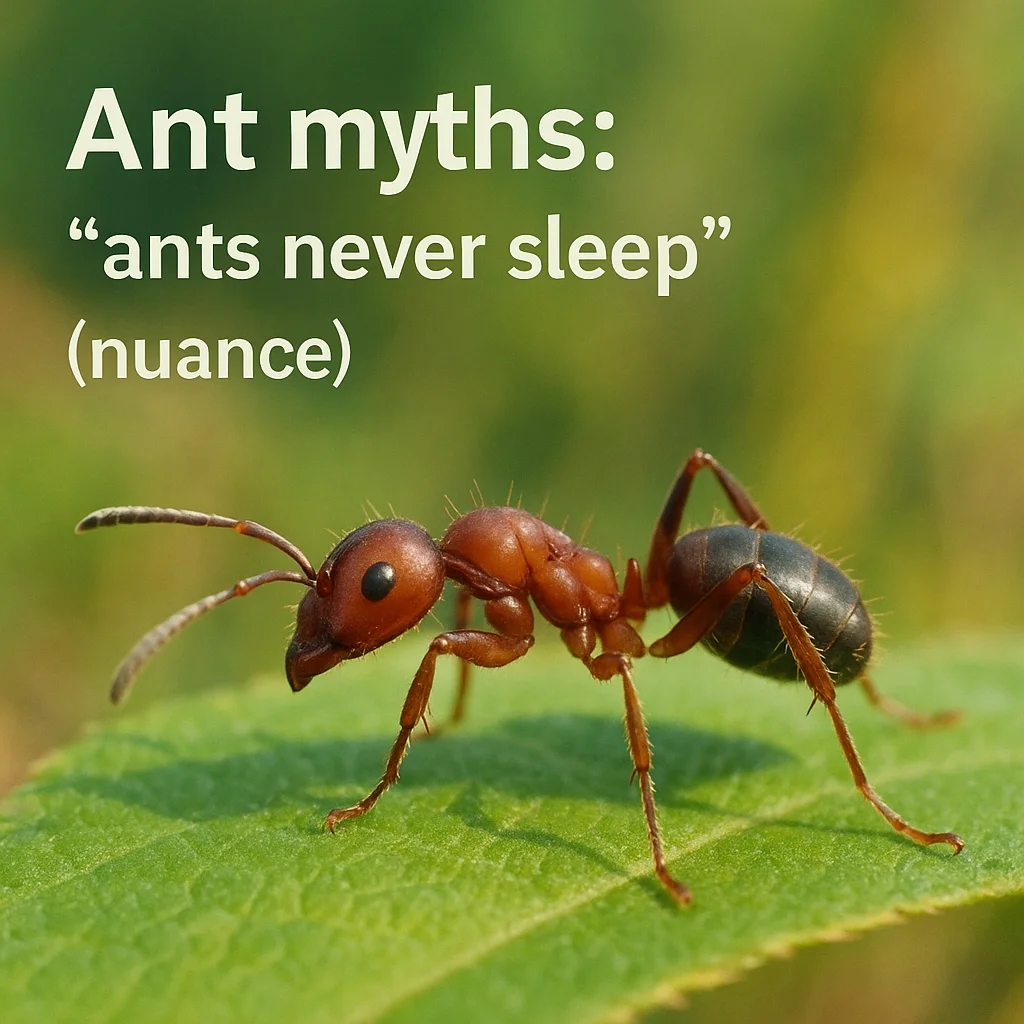
- Common names: Ants
- Scientific name: Varies (Family Formicidae)
- Insect or not: Insect (invertebrate)
- Order / family: Hymenoptera / Formicidae
- Typical size range: 1.0-13.0 mm
- Key colors/patterns: Black, red, brown, yellow
- Activity: Mainly day, some species active at night
- Typical habitats: Forests, grasslands, urban areas, wetlands
- Where in the world it occurs: Globally (except Antarctica)
- Seasonality: Active year-round in tropical climates, seasonal in temperate zones
🔍 Identification
Ants are generally small, segmented insects with distinct body parts: head, thorax, and abdomen. Their antennae are elbowed, and they possess a narrow "waist" known as the petiole. Most ants lack wings, but reproductives (queens and males) have them during mating seasons. Their legs are designed for fast movement, supporting their active foraging behavior.
- Body shape: Segmented with a narrow waist (petiole)
- Antennae: Elbowed
- Wings: Present in reproductives (temporary)
- Color: Often uniform but varies greatly
- Movement: Fast, linear, follows scent trails
- Look-alikes: Termites (difference in body shape and habits)
- Top ID Tips:
- Look for elbowed antennae
- Notice the narrow waist (petiole)
- Observe fast, efficient movement
- Check for uniform coloration
- Confirm presence in large, organized colonies
- Look for wing presence during swarming
🧠 Basic Body Structure
Ants, like all insects, are characterized by a three-part body: the head, thorax, and abdomen. They possess six jointed legs attached to the thorax, functioning under a robust exoskeleton that provides structural support and protection. As invertebrates, ants undergo processes like molting to grow. While some castes of ants develop wings, these are typically temporary adaptations for reproduction.
🌍 Habitat & Distribution
Ants are adaptable creatures found in a variety of environments. They thrive in tropical rainforests, grasslands, and even urban areas, exploiting various microhabitats such as under rocks, leaf litter, along tree trunks, and soil. Ants are nearly ubiquitous, present on all continents except Antarctica, and they favor climates ranging from dry to humid.
Changes in habitat, such as deforestation or urbanization, can influence local ant populations, affecting their visibility and the role they play in the ecosystem.
📅 Seasonal Appearance & Activity
While ants are active throughout the year in tropical environments, they may become less visible or inactive during colder months in temperate regions. Their peak activity tends to occur during warmer periods.
- Best Time to Spot It:
- Spring through late summer in temperate areas
- Year-round in tropical climates
- Midday during dry seasons
- After rainfall triggers increased activity
🥚 Reproduction & Egg-Laying
Ants exhibit intricate reproductive behaviors. Mating typically involves a nuptial flight where winged males and queens leave their colonies simultaneously. Queens will store sperm and can lay fertilized eggs years later. Ants lay eggs in protected areas like underground nests or within plant cavities, with colony size influencing egg count significantly.
🌀 Metamorphosis & Life Cycle
Ants undergo complete metamorphosis consisting of the egg, larva, pupa, and adult stages. Larvae are fed by worker ants and remain in the nest. The pupa stage is a transformative period where ants develop adult features before emerging to perform their roles. The duration of each stage can vary, influenced by species and environmental factors.
🍽️ Diet & Feeding Behavior
Ants exhibit diverse feeding habits depending on their life stage and species. Most rely on scavenging or predation, with some preferring sugary substances from plants. They possess chewing mouthparts suited for breaking down food. As opportunistic feeders, ants play roles as predators, scavengers, or even pollinators, depending on their ecological niche.
🦉 Predators & Defense
Ants face predation from a wide array of animals including birds, reptiles, amphibians, and spiders. Their defense strategies involve chemical secretions, stings, and bites. Some use camouflage or mimicry to evade predators. Their social structure also offers a collective means of defense, with soldiers protecting the colony.
- Defense Highlights:
- Chemical defenses
- Stings and bites
- Soldiers with enlarged mandibles
- Camouflage and mimicry
👥 Social Behavior & Swarms
Ants are highly social insects that form complex colonies with defined roles such as workers, soldiers, and reproductive ants. They work cooperatively through a sophisticated communication system to protect the colony, gather food, and care for offspring. Swarming occurs during reproductive phases to enable mating and colony expansion.
🧭 Senses & Communication
Ants rely heavily on their advanced sense of smell, utilizing pheromones for navigation and communication. Their senses include the ability to detect vibrations and a limited range of vision. Communication is achieved through pheromone trails, allowing them to coordinate complex colony tasks efficiently.
🌱 Role in the Ecosystem
Ants are vital ecological players participating in seed dispersal, soil aeration, and organic matter decomposition. They act as predators, helping control pest populations, and some engage in mutualistic relationships with plants and other insects. Their contributions to ecosystem functions are critical, supporting biodiversity and nutrient cycling.
📉 Population & Conservation Notes
Ants are generally common and widespread in suitable habitats. However, their diversity is susceptible to threats such as habitat loss, pesticide use, and climate change. Conservation efforts can support their populations by fostering environments with native vegetation and minimizing chemical usage.
- How to Help (Low-Impact):
- Plant native vegetation
- Reduce pesticide use
- Encourage natural landscaping
- Maintain leaf litter and natural ground cover
⚠️ Human Interaction & Safety
While most ants are harmless, certain species can bite or sting when threatened. It is advisable to clean bites with soap and water and avoid scratching to prevent infection. Seek professional medical advice if you experience a severe reaction. Observing ants respectfully in their natural habitat minimizes risks and encourages appreciation for these tiny architect ure masters.
📌 Summary
- Ants are small, social insects with elbowed antennae and narrow waists.
- They are found globally in diverse habitats, except Antarctica.
- Active mainly during warmer periods; visible year-round in warm climates.
- Undergo complete metamorphosis from egg to adult.
- Feed through scavenging, predation, and partnership with plants.
- Ants face various predators but employ effective defenses.
- Serve crucial ecological roles in soil health and pest control.
- Ant conservation involves enhancing natural habitats and reducing pesticides.
- Most ants do not pose a significant threat, but some may bite or sting.