🕷️ Ant colonies: workers, queens, and brood
🧾 Quick Facts
Ant colonies are complex social structures comprising different types of individuals, each fulfilling essential roles. Their fascinating behavior and organization highlight the intricate world of ants, showcasing workers, queens, and brood in their daily tasks and survival strategies.
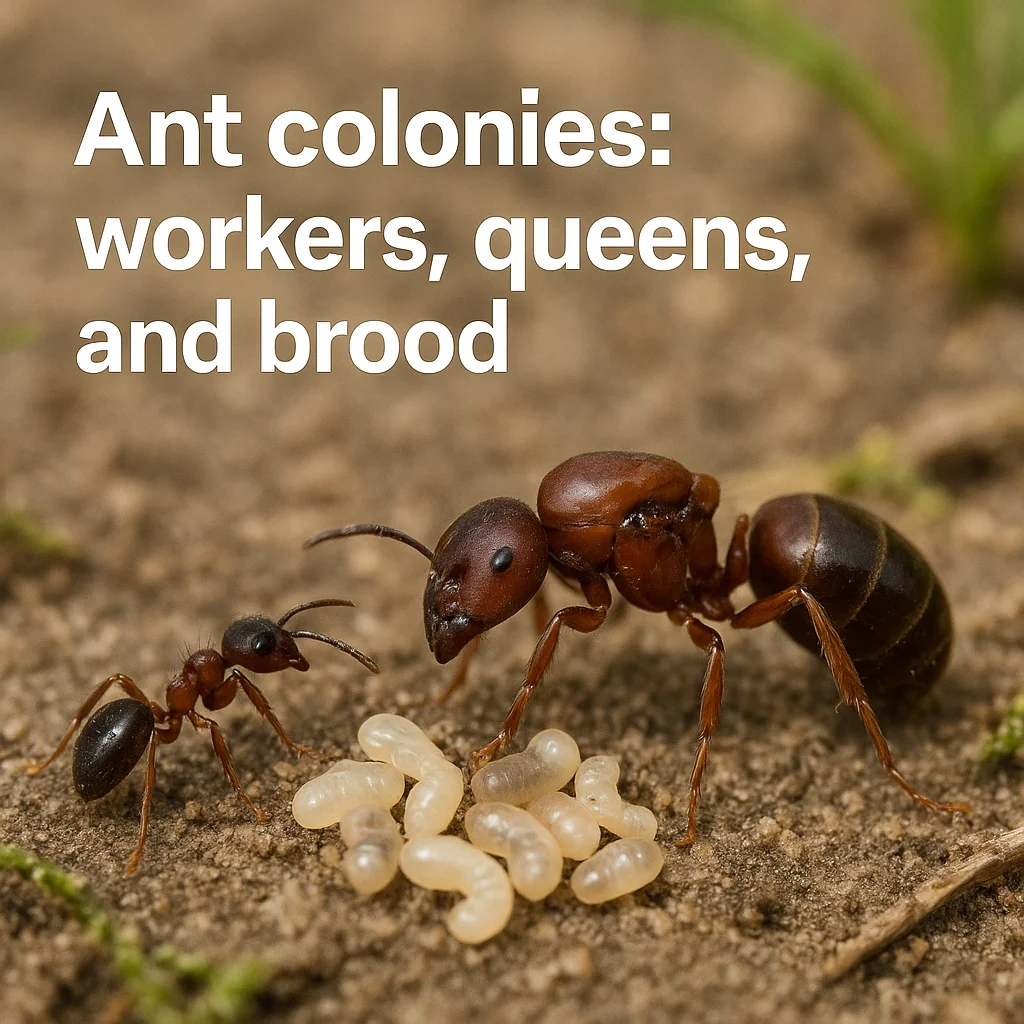
- Common names: Various, including Harvester Ants, Carpenter Ants, Fire Ants
- Scientific name: Varies (e.g., Formica spp., Camponotus spp., Solenopsis spp.)
- Insect or not: Yes, they are invertebrate insects
- Order / family: Order Hymenoptera / Family Formicidae
- Typical size range: 1.5 to 18 mm (workers vary in size)
- Key colors/patterns: Black, red, brown; some with distinctive patterns
- Activity: Mostly diurnal (active during the day)
- Typical habitats: Forests, grasslands, deserts, urban areas
- Where in the world it occurs: Worldwide, except Antarctica
- Seasonality: Visible especially in warm months or regions
🔍 Identification
Ants can be recognized by their distinct three-part body structure consisting of a head, thorax, and abdomen. They have elbowed antennae and, in many species, winged queens and males. The legs are usually adapted for rapid movement, and their small eyes typically provide limited vision compared to other insects.
- Top ID Tips:
- Distinct three-segmented body: head, thorax, abdomen
- Elbowed or bent antennae
- Queens and males may have wings, but workers do not
- Commonly confused with termites; note ants have a narrow waist
- Variety of colors and sizes, depending on species
- Whole specimen in frame identification favored for accuracy
🧠 Basic Body Structure
Ants belong to the invertebrate category, meaning they lack a backbone. Their bodies are protected by a hard exoskeleton that they periodically shed in a process called molting. Ants possess a head, thorax, and abdomen like all insects, along with six legs designed for movement. Some ants may have wings during certain life stages, but this is primarily seen in reproductive individuals.
🌍 Habitat & Distribution
Ants thrive in a wide range of environments, from dense forests to arid deserts and even bustling urban areas. They often establish their colonies in soil, under rocks, within wood, or in leaf litter. The microhabitat preferences can vary widely depending on the specific ant species, with some preferring moist conditions and others adapted to arid landscapes. Globally, ants are found on all continents except Antarctica, in diverse climates from tropical rainforests to temperate zones.
📅 Seasonal Appearance & Activity
Ant activity is primarily dictated by temperature, with the majority of species being most active in warmer months. They are predominantly diurnal, conducting most of their foraging and colony maintenance during daylight hours. Weather conditions such as rain can impact their outdoor activity, pushing them back into their nests.
- Best Time to Spot It:
- Warm, sunny days
- Spring and summer months
- Afternoon when temperatures peak
- After rainfall, often more visible
🥚 Reproduction & Egg-Laying
In ant colonies, reproduction is typically confined to the queen, who can live for several years and lay thousands of eggs throughout her lifetime. Mating usually involves a nuptial flight, where virgin queens and males leave the nest to mate. Eggs are laid within the nest, and depending on the species, they are cared for by worker ants. Egg counts can vary significantly, with some queens producing hundreds to thousands of eggs during periods of peak activity.
🌀 Metamorphosis & Life Cycle
Ants undergo complete metamorphosis, with stages including egg, larva, pupa, and adult. Larvae are typically fed through regurgitation by workers and reside within the safety of the nest. Pupation occurs within the colony, where larvae transform into adults. This stage can take several weeks to several months, influenced by species and environmental conditions.
Adult ants have roles divided by caste - queens, males, and workers. Queens are primarily reproductive, while workers maintain the colony, forage for food, and care for the brood. Males exist solely for mating and do not contribute to colony tasks beyond reproduction.
🍽️ Diet & Feeding Behavior
Ants exhibit varied diets, ranging from herbivory to carnivory and scavenging. Workers typically forage for food, using their strong mandibles to carry items back to the nest. Some species are known to farm aphids for honeydew, showcasing a remarkable example of mutualism. Feeding strategies rely largely on chewing mouthparts, and diet often evolves based on the supplement needs of the colony.
🦉 Predators & Defense
Ants face numerous natural threats, including birds, amphibians, reptiles, spiders, and some mammals. Their main defense mechanisms include the use of formic acid in certain species to deter predators, stinging capabilities, and protective armor. Camouflage and residing in large numbers can also be effective defensive strategies.
- Defense Highlights:
- Chemical defenses (e.g., formic acid)
- Physical defenses (stings and bites)
- Colonial safety in numbers
- Camouflage and nest concealment
👥 Social Behavior & Swarms
Ants are quintessentially social, living in structured colonies where complex roles exist, including queens, workers, and soldiers. Inter-colony communication is often done through pheromones, coordinating everything from foraging paths to defense scenarios. Seasonal changes or environmental triggers can invoke swarming events usually linked to mating/nesting purposes.
🧭 Senses & Communication
Vision in ants is often limited, but olfactory senses are exceptionally developed. Communication among colony members is primarily non-verbal, relying on pheromones to relay messages and coordinate activities. Tactile signals and vibrations are also significant, particularly in the absence of light.
🌱 Role in the Ecosystem
Ants hold significant ecological roles, contributing to soil aeration, seed dispersion, and organic decomposition. Some species engage in mutualistic relationships with plants and animals, while others are vital in pest control. Their presence in the food web is crucial as both prey and predator, maintaining ecological balances in various habitats.
📉 Population & Conservation Notes
Ant populations are generally considered to be quite robust, thriving in diverse habitats and regions. However, some species are susceptible to localized threats from habitat loss, pollution, and climate change. Conservation approaches include promoting native plants, reducing pesticide use, and protecting ant habitats.
- How to Help (Low-Impact):
- Plant native flora to support local ecosystems
- Avoid pesticides and chemical treatments
- Maintain natural soil structures (leave leaf litter)
- Support conservation and habitat restoration efforts
⚠️ Human Interaction & Safety
Ants can bite or sting, usually in defense of their colony. Some species, such as fire ants, are more aggressive, and their stings can lead to mild to severe reactions. Basic first-aid should involve cleaning the affected area and avoiding scratching. Seek professional advice if a severe reaction occurs. Observing ants with respect is encouraged, balancing human curiosity with conservation ethics.
📌 Summary
- Ants are identifiable by their segmented bodies and elbowed antennae
- They flourish in diverse habitats and are found globally
- Most active during warm months and daytime
- Complete metamorphosis: egg, larva, pupa, adult
- Diverse diet, often food-foraging workers
- Predators include birds, reptiles, and some mammals
- Vital role in the ecosystem: aeration, seed dispersal
- Human safety: respect colonies, manage allergic reactions appropriately